By Harper Cleves
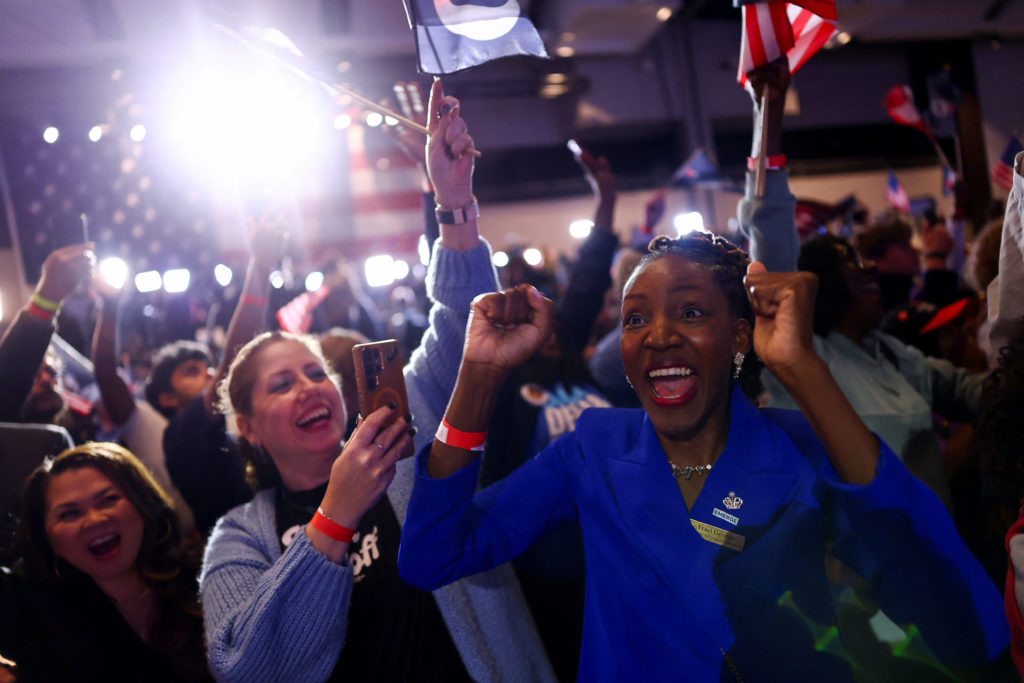
The victory of the Democrats in the midterms was decisive, to say the least. Blue wave emojis; images of Hokusai’s “The Great Wave” painting; and jokes about turning Trump’s White House ballroom into a “Covid conscious lesbian bar” abound across group chats and Instagram stories all over the US. According to a New York Times analysis, this is the biggest Congressional shift since 1976, which was in the wake of the Watergate scandal of the Nixon administration.
At the time of writing, Democrats have flipped seven Senate seats, five governor’s seats, and 39 House seats. This included Democratic victories in states such as Michigan, Iowa, Texas, South Carolina, North Carolina, Kansas and Georgia. Key races for the Senate in Mississippi and Alaska are still too close to call, as well as two congressional seats; one in Colorado and one in Tennessee, although, as it stands, the Democratic candidate is in the lead in all four.
Latinx voters and Gen Z: True blue, or anti-Trump?
To what can we attribute this massive sea change? Every single demographic saw a shift from the 2024 election in votes towards the Democrats; almost all showing double-digit increases. Young voters and Latinx voters demonstrated the most dramatic swing towards Democratic candidates. Nationally, 69% of Latinx people who voted voted for Democrats, a 29-point shift from 2024. 70% of Gen Z voters voted for Democrats and 63% of younger millennials, those aged 30-44, 33- and 24-point swings, respectively.
For Latinx voters, much of this shift is attributable to Trump’s massive overreach with Immigration and Customs Enforcement (ICE). One Texas voter, Benny Melendez, a small business owner, said to The Guardian that he had voted for Trump two years ago in part because of his stance on immigration, thinking it would be targeted at violent criminals. Instead, two of his cousins and 15 of his building workers had been picked up and deported by ICE. He voted for the Democrats out of pure rage, saying, “They’re taking our neighbors. They’re taking our friends. They’re taking our workers, and they’re taking our family members. This is an attack against our community.” His sentiment is far from singular; as Latinx people all over the country watched in horror as ICE invaded cities, separated children from parents, loitered at churches and in elementary school parking lots, and shot and killed civilians.
Gen Z also represented an earthquake propelling the blue tidal wave that swept the country. It is impossible to disconnect the huge shift of young voters towards the Democrats, who, more than any other bloc identify as independent and rarely turn out in big numbers in midterm elections, from the conditions spurring on the Gen Z revolts currently rocking the globe. Youth turnout in this election was 27%, the second highest for a midterm election in the last 30 years. For Gen Z, issues such as the cost of living, Palestine, and immigration were key.
Karrar Al-Sadkhan, 19, a student at Wayne State University in Detroit, told New York Times reporters that he and his friends had never identified as Democrats, and yet he was inspired by Abdul El-Sayed, whose message was, as he saw it, that “it’s really more of a class war, not blue or red.”
Chase Sardeson, 23, is an electrician’s apprentice in Raleigh, North Carolina. He grew up in a conservative household, but when he started working, his view of the world became more complicated. He saw a familiar human struggle in a Latin American immigrant colleague who was working three jobs to support his family. Sardeson and his girlfriend pay $1,800 a month in rent, something he will likely not be able to afford when he is kicked off his parents’ health insurance in three years’ time. He realised he was helping to construct a dental office that, when it opens, he will not be able to afford.
Zaid Sibaai, 23 years old, in Kansas, said he voted for Trump, along with his friends, in 2024, because he promised to end wars in West Asia, including the genocide in Palestine; something which he now sees to have been a lie. He cast his vote for the Democratic candidate for Senate, Adam Hamilton.
Young people interviewed across several articles referenced Abdul El-Sayed, the first Muslim Senator-elect, hailing from Michigan, who stood with Palestine, while also being pro-worker, pro-choice, and pro-LGBTQIA+. They also mentioned Zohran Mamdani, the Democratic Socialist elected mayor of New York City last year. They even spoke about Senator-elect James Talarico in Texas, a millennial who graduated from seminary school and yet, in his position in the state legislature, had stood up for trans and women’s rights. However, in general – for Latinx voters and young voters alike – the drive wasn’t necessarily the merit of the Democratic candidate on offer, but rather a rebuke of Donald Trump. This is likely a more generalisable trend. Trump has logged the lowest approval ratings in the history of the Gallup poll. Just prior to this election, only 39% of registered voters approved of how Trump was handling the economy, with 70% of voters in the same poll listing the cost of living as the key issue coming into the midterms.
Data Centres lose out
Data centres, facilities which house the infrastructure that stores and processes digital information, including increasingly Artificial Intelligence, were features of referendums across the country in the midterms, and were unequivocally rejected. In Ohio, 14 bans or restrictions on data centres passed, including in a city where Amazon has proposed a $2 billion project. In Maine, eight moratoriums were approved and in Kansas, where a 1000-acre data centre was recently proposed, a ban on high-impact data centres was passed by voters. Only one small town of less than 1,000 people in North Dakota did not successfully pass a restriction on the construction of data centres. Even in places like Texas, Georgia, Florida and Ohio, where no moratoriums were on the ballots, successful Democratic candidates made their opposition to data centres central parts of their campaign.
As Naomi Klein and Astra Taylor point out in their recently published work End Times Fascism, in which they discuss the anti-data centre movement at length, data centres do not create local jobs. Even mining, which, like data centres, also poses serious environmental and health risks, at least provides the local community with a source of work. However, data centres reflect the profoundly anti-human aspirations of the tech billionaires that demand their construction, and this impulse, and its effects on largely conservative, rural voters, present a significant fissure for the right; one that the left must urgently fill with a socialist and anti-oppression content that has the potential to unite the former MAGA heartland behind a common goal of liberation for all.
The poisoned chalice of AIPAC
While the economy and cost-of-living issues, along with immigration, were the key issues for many voters this midterm election, the significant shift in attitudes on Israel and the genocide in Palestine is significant. The American Israel Public Affairs Committee (AIPAC) is a US American pro-Israel lobby that historically was known as a “kingmaker” in US politics; its funding often proving crucial to any candidate, Republican or Democrat, looking for successful election bids. However, three years into a genocide in Palestine, and the impact of Trump’s “forever wars” in West Asia has turned the tide. Going into the elections, it was already clear that US American voters were disillusioned with Trump’s ongoing support for Israel and its genocide in Palestine. A June 2025 Quinnipiac poll found that the highest percentage of voters since this poll began in 2017 think that the US is too supportive of Israel. 48% of voters overall; 66% of Democrats; 55% of Independents; 20% of Republicans. 48% of voters have an unfavourable view of Benjamin Netanyahu, compared to 20% with a favourable view.
This trend is particularly strong with younger voters; a demographic, as discussed above, that significantly bolstered the Democrats in this election. Three quarters of Gen Z voters sympathise more with Palestine than they do with Israel, a dynamic which is also reflected amongst Jewish US Americans. In a pre-election survey, when posed with three different statements on Israel and Gaza, one which showed uncritical support for Israel, one which showed tepid support, and one which described Israel’s actions in Gaza as a genocide and asserted the need to cut all military ties with the state, 60% of Jewish people surveyed between the ages of 18 and 34 agreed with the third statement. Similarly, 66% of Jewish voters between the ages of 18 and 34 said they would be less likely to vote for an AIPAC-endorsed candidate.
This shift in sentiment in US society to some degree is attributable to disillusionment with Trump’s interventionist foreign policy; far from ending wars, as promised in his 2024 campaign, he has expanded them; something which even the most Islamophobic voter might take issue with as running contrary to his “America First” messaging; especially as the war in Iran is seen to be worsening the cost-of-living crisis. However, the Palestine solidarity movement globally and its expression in the US has also changed hearts and minds. Even a couple of years ago, it would be unthinkable that a pop star of the magnitude of Ed Sheeran would receive such resounding criticism for removing Macklemore from his tour for his vocal support for Palestine, provoking an exodus of other artists from his tour. As in pop culture, so too in politics: cravenly refusing to stand against genocide in Palestine will not go unpunished; something unimaginable without the movement forcing millions across the US to open their eyes to the profound suffering of Palestinians at the hands of Israel.
All of these dynamics have, at the time of writing, contributed to over 30 AIPAC-endorsed or sponsored candidates losing elections in the 2026 midterms; to the extent that AIPAC is internally discussing whether they should publicly endorse candidates in future electoral cycles, or whether they should instead do so through their United Democracy Project PAC. AIPAC reportedly dropped $9 million in the last week of the campaign in support of Mike Rogers, the Republican candidate running against Abdul El-Sayed in Michigan. This is after they spent $30 million supporting Haley Stephens, the incumbent Pro-Israel Democratic politician El-Sayed defeated in the primaries, who went on to endorse Mike Rogers over El-Sayed because of Palestine. At the time of writing, there are eleven newly-elected senators and congresspeople, joining some pre-existing bases of support, such as Rhashida Tlalib, who have in some way condemned the genocidal violence in Gaza, albeit to varying degrees.
Trans rights under attack
Along with the numerous positive takeaways from these Midterms, one notable negative was the widespread victory of transphobic ballots across the country. In the 2026 Midterms, with Trump’s approval ratings reaching an historic low, Trump and the Republicans leaned heavily into transphobia. Republicans spent an estimated $183 million on TV ads that emphasised transgender-related attacks in the final phase of this year’s midterms, exceeding the spending on similar ads in 2024. In the Texas Senate race alone, Republican-backed transgender-related spending reached its apex, with investments of up to $58 million for more than 50,000 airings. Much of the funding of these ads came from Elon Musk, who contributed a total of $158 million to the Senate Leadership fund, which passed this money on to the Texas PAC, the largest funder of Trump-backed Attorney General Ken Paxton campaign. Musk also separately gave $10 million to the Paxton-supporting Lone-Star Liberty PAC. Tesla and SpaceX are both headquartered in Texas.
This prolific transphobic messaging, paired with a low consciousness about what trans health care and trans participation in sport actually entails, has had an impact, even on would-be Democratic voters. While many people who don’t understand trans and queer identities might still generally have the attitude of “live and let live”, issues around trans rights are always posed in particularly emotive ways: ie, being unfair to women and girls in sports; or forcing children into potentially dangerous and life-threatening surgeries – both of which are inaccurate depictions of the issues at hand.
Most of the ballots that aimed to further restrict trans rights passed: Prop 318 in Arizona, Nebraska Initiative 442, Colorado Proposition 134, and Washington Measure 638 all had to do with banning trans women and girls from sports. Colorado Proposition 135 banned gender affirming surgeries for under-18s.
Limits of misogyny; a glimpse into the future of the LGBTQIA+ movement?
A similar ban on gender-affirming care for minors in Missouri, however, did not pass – likely because it was paired with an abortion ban: a severe misjudgment from the Republican candidates who introduced the bill. Transphobia can be stirred up, in large part, because the number of out trans folk is very small, less than 5% of the population, and therefore the number of people who would understand the real lived consequences of such bans is minimal, meaning that manipulating the narrative is more easily achieved. However, as abortion bans across the country have demonstrated the deadly impacts of curtailing terminations, achieving victories on abortion restrictions has proved more difficult and is an issue that Republicans have made an effort to distance themselves from. Only Idaho, which stubbornly withstood the tide of the blue wave, saw a restriction on abortion rights voted through.
We saw similar limits to the caché of malevolent misogyny of the MAGA movement in the Ohio gubernatorial race between Republican Vivek Ramaswamy and Democrat Amy Acton. Trump-endorsed Ramaswamy provoked national and global controversy when he released an ad featuring his opponent’s estranged mother, who called her daughter a liar. While it is not mentioned in the video, Acton revealed that the “lie” her mother refers to is the child sexual abuse she experienced at the hands of her stepfather, for which she and her brother were removed from her mother’s custody. While Trump stood by the ad, other Republicans, including the sitting Ohio governor, condemned it, correctly noting that the electorate would not be impressed.
While the Epstein Files were far from one of the most discussed topics in the 2026 elections, it can’t be ignored that Donald Trump, who has delayed the release of still only a fraction of the files, is mentioned in the publicly available documents over 30,000 times. While rigid gender norms may still be popular online content, there is clearly a limit to the public’s willingness to accept misogyny, particularly as the most disgusting elements of this continue to come to the fore, whether that be abortion ban-related deaths or tolerance for child sexual abuse.
Could similar public distaste present itself as the reality of attacks on trans rights becomes clearer? The Washington measure which banned trans women and girls from sports, for instance, also included mandatory sex check certificates for all would-be female athletes. For many, such invasive examinations will amount to child sexual abuse, for trans and cis girls alike. Additionally, far from protecting trans girls in sports, such a measure will almost undoubtedly have a further chilling effect on their participation, as girls will seek to avoid the requisite invasive doctor’s visit.
Stay woke
Gina Hinojosa, the newly elected Democratic Governor of Texas, gave in to the pressure of the Musk-backed transphobia that rocked her state. In response, she put out an ad in September titled “Pronouns.” In this ad, she accuses the Republican Party of running a campaign that focuses on her being too “woke.” She counterposes this by saying she wants to spend her campaign talking about “why working people are too broke.” The ad ends with Hinojosa saying that her pronouns are “Mom, Texan, and soon-to-be: Governor.” She followed up with a statement to Texas-based NBC affiliate KXAN when they asked if she had a message to trans Texans, saying:
“Culture wars are over in 2026. 99.9% of us lost, and corporate power won. While we fought each other at Thanksgiving, 15 billionaire tech dudes won; they amassed power and now they are about to blow up the planet if we don’t come back together to save ourselves.”
James Talarico, who won an important victory for the Senate in Texas against Trump-endorsed Attorney General Ken Paxton, and who had previously been known as an advocate for trans children, also succumbed to the pressure. In a Fox interview in September, Talarico said “I will oppose trans athletes playing in girls’ sports if it risks safety or fairness.” He also said he opposes gender affirming surgeries for minors.
While Democratic victories in Texas is understandably and correctly seen as a huge blow to Trumpism, and a cause for hope, the fact that it was done at the expense of trans people, and in fact, in the case of Hinojosa, reduced trans rights to “a Thanksgiving argument” and a “distraction” from wealth inequality is beyond insulting to a community for whom access to gender-affirming healthcare, inclusive spaces, and the ability to participate in hobbies which bring them joy are often a life or death issues. Such an approach was repeated in states that saw similar important victories such as Ohio and Iowa. And yet, was it necessary to win? Abdul El-Sayed in Michigan, Ed Markey in a Democratic primary for Senate in Massachusetts, a small-time Florida state legislature candidate Elizabeth Holmes in Florida, all won while standing resolutely on the side of trans folks.
Playing into the rhetoric of “Woke 1.0,” which counterposes topics like diversity, equity and inclusion (DEI) initiatives, #blacklivesmatter, and #metoo to “bread and butter issues” is as dangerous as it is unnecessary. In an era of capitalism in which trad wives and manosphere influencers have bombarded our algorithms; in which neofascists like Nick Fuentes mainstream open and violent misogyny; in which racist state-bodies such as ICE roam our streets – downplaying or avoiding these issues amounts to negligence at best, complicity at worst. But as the campaigns of the aforementioned Democrats demonstrate, even those without particularly socialist politics, if you are a strong advocate on cost-of-living issues, you don’t have to drop your feminist, anti-racist and LGBTQIA+ inclusive politics; and in fact, by demonstrating that you are a serious advocate for all the exploited and oppressed, you stand to change the hearts and minds of those who have been misled to believe that people who are different from them are the source of their woes.
Democratic Socialists and Progressive victories
Another major story of the 2026 midterms was the election of a record number of Democratic Socialists of America (DSA) and Progressives to both national and local bodies. Eight DSA endorsed members were elected to Congress. In New York, Darializa Avila Chevalier and Claire Valdez were newly elected and Alexandria Ocasio-Cortez (AOC) retained her seat. In Michigan, Palestinian-American Rhashida Tlaib was re-elected, and Donovan McKinney was elected for the first time. Chris Rabb was also elected in Philadelphia, Pennsylvania, and Milat Kiros in Colorado. Several DSA members have also joined Zohran Mamdani as mayors of major US cities: Janeese Lewis George in Washington DC; Nithya Raman in Los Angeles; and David Morales in Providence. Angie Nixon, a DSA candidate in Florida, who faced off against Republican Ashley Moody for a Senate seat, shocked everyone with how close she came to victory (48% to Moody’s 50.9%) in a state that Donald Trump won by 13.1 points in 2024.
Other Progressive candidates, such as Abdul El-Sayed of Michigan, Brian Lander of New York, Ilhan Omar of Minnesota, and William Lawrence of Michigan and Adam Hamawy of New Jersey, while not endorsed by DSA, would be spoken about in the same vein in analyses of victories for the left wing of the Democratic Party in national races. These victories come as the rule of billionaires grows increasingly unpopular, forcing ordinary people to consider new ways of organising society. This year, for the first time ever, polling showed that favourable attitudes towards socialism went over 40%.
These victories of socialist and left-leaning candidates must be seen overwhelmingly as a positive; they demonstrate a growing openness to talking points that call into question the inequality and exploitation that capitalism is predicated on, as DSA candidates across the country ran on platforms emphasising socialised childcare and healthcare, as well as abolishing ICE.
These socialist members of Congress and the Senate must work together and develop a principled political independence from the corporate influences that guide Democratic Party policy. Already, we see that this may be difficult to achieve. While DSA candidates tend to be critical of the Democratic Party establishment in their election campaigns, something which very likely contributes to their victories, when confronted with actual governance, they quickly get sucked into the logic of a deeply flawed and unfair political system and establishment. For instance, AOC, likely with a presidential bid in mind, has already said she would endorse pro-corporate and pro-Israel Democrat Hakeem Jeffries for Speaker of the House because of his stated support for providing public funding to New York housing; something unfortunately also said by Zohran Mamdani, although a petition of 700,000 opposing his appointment has forced him to walk back this position somewhat. AOC, also borne out of her impulse to “play ball” with mainstream Democrats, has in the past approved taxpayer dollars going to Iron Dome, an all-weather Israeli “Defence” System. In April 2026, Ocasio-Cortez stated during a New York City DSA forum that she would oppose any future US military aid to Israel, including for defensive systems like the Iron Dome. Compromising away the rights and well-being of the people, as we also saw in the way Democrats sold out trans folks, is framed as “common sense” politics. However, in reality, it is just a product of the capitalist mindset, which refuses to break with the logic of exploitation at the heart of the system, and so sees rights and wealth as finite rather than resources which can be enjoyed by all.
A blue wave today, a movement tomorrow?
The dissatisfaction which propelled Democrats and DSA candidates to victory; which banned data centres; which significantly eroded the power of AIPAC and Musk; cannot be underestimated. While one could be forgiven for not feeling filled with joy at the victory of a party which oversaw the beginning of the genocide in Palestine, this is not simply a case of “one capitalist party beating another,” it is a glimpse into the potential movements of the future. The overwhelming vote for Donald Trump in 2024 reflected the dissatisfaction with the “centre of the road politics” Biden represented as permacrisis continued to wreak havoc on ordinary people and he enthusiastically backed the Gaza genocide; and yet the racist, divisive, war-mongering politics of Donald Trump and his billionaire buddies, while provocative, has only plunged many who voted for him into more despair.
The politics of the Democratic establishment will not solve the pressing issues that drove so many to vote for them. The millions of people who switched their vote from Trump in 2024 to a Democrat in 2026 did so because his corporate greed approach and scapegoating of trans people and immigrants ultimately did nothing to improve their lives. The Democratic Party, if presenting a more progressive face, are also ultimately driven by capitalist interests, no matter how well-intentioned individual politicians may be. As such, they will also disappoint, constrained by their own logic, doomed to fail the people who elected them, and restart the cycle.
The DSA and others in the progressive wing of the Democratic Party have an opportunity to chart a different way forward by putting the politics of activism, not the limitations of mainstream parties, at the heart of their tenures in office. If they use their platforms to stand with workers and the oppressed, and, crucially, to organise on-the-ground movements that have the power to place those in power under pressure, they will have a far greater chance at actually winning victories for those who voted for them. To truly embody this approach will inevitably mean a clash with the Democratic Party establishment. While they will be under tremendous pressure to toe the line, left and progressive politicians must be prepared to leave the well-trodden path of elected Democrats before them, or else sacrifice their principles. Fundamentally, the urgent necessity to build a new left-wing party of the working class will be posed. It is simply unsustainable for a genuine left-wing force to remain in a party that represents the rule of capitalism and imperialism, and is deeply tied to the US ruling class.
No matter what, the 2026 Midterms have demonstrated a mass dissatisfaction with the status quo. Maybe those we elected won’t provide the challenge to corporate power we hoped they would; but turning out to voting stations in droves gave us a glimpse into the potential power we have as a collective. We are learning, along with so many others internationally, that the world doesn’t have to be the playground of the billionaires; that, actually, the future is ours to mould if we come together in solidarity.