
By Laura Fitzgerald
This is an excerpt from an interview between conservative New York Times columnist Ross Douthat, and Peter Thiel, Silicon Valley royalty who gifted the human race Palantir – a company that has been integral to powering the world’s first AI-assisted genocide:
Douthat: I think you would prefer the human race to endure, right?
Thiel: Uh –
Douthat: You’re hesitating.
Thiel: Well, I don’t know. I would – I would –
Douthat: This is a long hesitation!
Thiel: There’s so many questions implicit in this.
Douthat: Should the human race survive?
Thiel: Yes.
Douthat: OK.
Thiel: But I also would like us to radically solve these problems. And so it’s always, I don’t know, yeah – transhumanism…
I won’t bore you with the incoherent waffle that Thiel then continued with about ‘transhumanism,’ but suffice to say this mouth almighty with a god complex – a man who presided over a three-day “Hereticon” conference on “thought crime” that ended in the ‘Apocalypse Ball’, which had a “fall of Rome atmosphere” in which guests were invited to “dress for dystopia” – could not muster a single compelling reason for the preservation of humanity and all the earthly beauty it’s entwined with. Stumped by a question about whether it is preferable to see the human race survive. This is the horrifying level of derangement evident among Big Tech billionaires and their political allies on the extreme right, including that of the Trump regime.
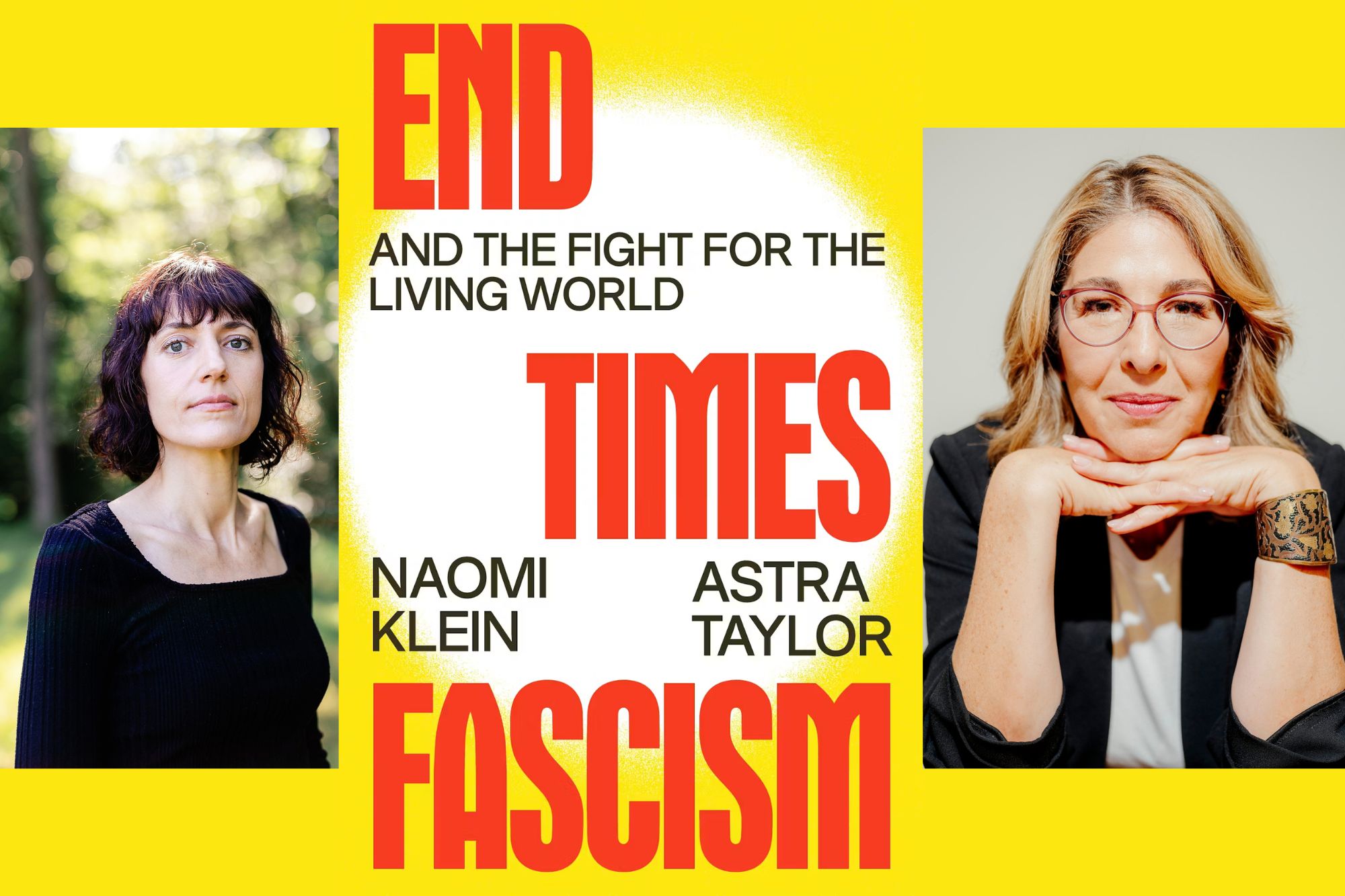
End Times Fascism: And the Fight for the Living World recounts this interview, just one of a dizzying array of similarly chilling insights given into the grotesque and absurd mindsets of many of the most powerful men on the planet. This is part of the authors’ quest to understand the rise of a fascist politics in today’s era, and to proffer a vision as to how it can be fought. Writing this time with her collaborator, Astra Taylor, Naomi Klein has delivered another prescient and searing analysis of the fascist threat, coming after her essential 2023 offering, Doppelganger: A Trip Into the Mirror World, which dug so incisively into the proliferation and modus operandi of conspiracy theories and far-right ideas since 2020 – conspiracies like anti-Vaccines that are now holding court throughout the Trump administration: it’s no longer a ‘mirror world’, it’s veritably 3-D.
A fascistic triumvirate
Klein and Taylor coined the term “End Times Fascists” as an overarching description of today’s iteration of the extreme right. From the quotidian news reports of billionaires building bunkers, or Próspera: a gated city on a Honduran island to prepare for apocalypse, “the private paradise of libertarians, tech entrepreneurs, and biohackers;” to Musk’s fantasies about inhabiting Mars; to Silicon Valley executives’ creepy and narcissistic bio-hacking experiments, as they simultaneously drool over their man-and-machine-merging wet dreams, and publicly profess as if it’s no big deal that they think AI may herald the end of the world; it’s easy to see where the titular description emanates from.
Focusing largely on the Trump regime and the fetid stew that makes up the wider and often internally warring MAGA movement, Klein and Taylor detail and roast a triumvirate of religious fundamentalists, Big Tech bros and ethno-nationalists – a messy, often contradictory and always horrifying, alliance that comprises the End Timers. Nowhere is this coalition of death and doom more evident than in Trump’s maniacal vision for ‘New Gaza’, to be delivered by the ‘Board of Peace’, with which the book opens.
Irish Times journalist Patrick Freyne recently imagined Orwell’s ghost complaining that he “shouldn’t have bothered writing books” because he doesn’t “want to be an adjective any more”. The Adjective That Cannot Be Named screams at us. In an AI generated abomination, Jared Kushner and Steve Witkoff at the World Economic Forum in Davos in January 2026, presented “clouds parting with golden light shining down…[and] a ‘master plan’ to turn Gaza, pummeled by Israel with US bombs for two years straight, into a Dubai-like resort city for the super-rich.” This power-point was presented and received with a warped religious fervour, evoking both a celestial promised land and a “beautiful piece of property” – in the words of Trump – on top of an unmentioned and presumably ‘victorious’ ethno-nationalist, genocidal campaign against Palestinians.
When Klein and Taylor were interviewed by a New York Times journalist about their book, he asked, much to the authors’ chagrin, whether they had any concern about using the terms “end times” or “fascism” in the context of developments. But Trump’s dystopian ‘New Gaza’ presentation at Davos, in front of many of the richest and most powerful in the world, shows that the tone and language of the book are wholly justified. Moreover, navel-gazing about the differences between fascism in Europe in the 1920s and the fascist threat today misses the point about the urgency of its dangers. For an analysis of these questions, see Trump, big business & the fascist menace that we wrote in the first months of Trump’s second term.
The nature of the beast? Shape-shifting ghouls that feast on human misery
Klein and Taylor explain how fascism can only gain mass support and power in the context of severe crisis. Of course, the system today is enmeshed in so many intractable and interlinked crises, not least the existential ecological one, a crisis that itself is an outgrowth of the insatiable imperialist extraction, expansion and endless growth mentality at the heart of the capitalist mode of production. These crises are in conversation with a further one, that of the most extreme wealth polarisation in history, where there exists an elite class, including one individual who possesses more wealth than the GDP of most countries.
The authors contend that fascist movements and victories are inconceivable without the scars of austerity and poverty. They give some insightful anecdotes about the workings of what has been deemed “eco-fascism” – a strategy within far-right movements to gain support amidst ecological breakdown. This is characterised by tapping into the fear and existential dread that comes with widespread climate catastrophe, by offering a diet of racial and xenophobic supremacist fear-mongering, and grim, ‘hard-man’ pledges about borders and mass deportations. The authors detail examples from both the Spanish state and the US where far-right forces have made skilful interventions while people are going through their worst hour, politically capitalising on extreme weather events that are in fact directly connected to the very ecologically destructive policies the far right support and wish to escalate.
In North Carolina in 2024, before the re-election of Trump, the authors indicate that heartwarming neighbourly cooperation and solidarity were the widespread initial human response to the hurricane and flash flooding disaster. This was suppressed and obliterated by a conscious intervention by far-right agitators skilfully saying that FEMA was refusing to help Republican voters as a form of voter suppression. Former congresswoman Marjorie Taylor Greene even contended that FEMA could control the weather, adding to the welcome climate that developed for white nationalist militias who showed up in many towns. The authors also detail how the Front National in France is capitalising on the fear around the threat to life and home from climate change and extreme weather events with a mendacious claim to exemplify love for the local environment, in a ghoulish policy that’s tied to their hateful xenophobia and racism.
This skilful shape-shifting of the extreme right, something that’s always hypocritical and contradictory – these are, let’s remember, the biggest climate change deniers going – is noteworthy. The extreme right may be rife with internal contradictions and strife, but new and awful crises of the system will keep presenting themselves for these twisted opportunists to seek to turn in their favour in ways we could hardly have imagined before they occur. Klein and Taylor contend that the myth-making prowess of the far right and fascists is as insidious as it is alluring. This is especially effective during these moments of extreme crisis – when so much about what you believed to be true is called into question; when you lack a framework to understand; when existing and deep-rooted prejudices against marginalised groups that you have absorbed by osmosis can be called upon by malicious actors seeking to both radicalise and proselytise. Citing the degree to which far-right conspiracies flourished at the height of the Covid pandemic as indicative of this, the authors quote the eye-opening statistic that nearly 20% of US Americans believed in the main tenets of QAnon by 2022.
Billionaire-owned social media & far-right “influencers”
Who is there to proliferate these myths among? In part, it’s the “boots on the ground” of the far-right movement today: those middle- and working-class people radicalised to the right, often young men. Today they are not all organised in a mass far-right party, but many exist in a murky online ecosystem where their radicalisation process is hastened, and their growing far-right activism often melds seamlessly into grift. I was struck by the description by a participant in the mass uprising against ICE in Minneapolis whom the authors interviewed. This activist described how the community was inundated with a rake of far-right influencers who descended upon the Twin Cities like a “plague of locusts.” Taking their lead from Trump, these entrepreneurial harbingers of hate used their social media accounts to further the proliferation of crazed, racist conspiracy theories about the Somali community that prefaced the regime’s ICE assault on the city.
The evangelical right is awash with grifters too, including “entrepreneurial preachers” who are busy “mixing prosperity gospel with prophecy” in “El Salvadorian barrios, Nigerian slums and lonely US shopping malls.” Trump himself has used the presidency to shamelessly enrich himself and his family from cryptocurrency schemes to subscription-only Truth Social posts available for $100,000 per month for wealthy supporters. The authors repeatedly note that today’s iteration of fascism has nothing to offer, even to its own anointed ‘in-group’ (white, male, cis etc.), and it’s certainly striking how profoundly unpopular Trump’s administration has become.
Any solace to be extrapolated from this is of minimal worth, however, precisely because the inexorable processes that are dragging politics to the extreme right are deeply rooted in capitalism today. This brings us to AI..
The fakery and real threat of AI
Arguably the most urgent hypothesis within this compelling book is how it analyses AI. They situate its meteoric rise within Big Tech and the global economy firmly within the extreme right shift. Klein and Taylor remind us how, up to recently, the Democrats, rather than the Republicans or Trump himself, were the ones closest to the movers and shakers in Silicon Valley. They expose how the AI boom represents a giant bubble. They show how the billions and trillions in valuations are so falsely inflated that the world economy is on precarious grounds, while the most obscene and extraordinary wealth polarisation and profiteering run rampant. AI companies, they elucidate, received nearly $300 billion in investment in the first three months of 2026. A significant proportion of this went to OpenAI, which, according to its own (optimistic) projections, will not have a positive cash flow until 2029.
The AI white elephant, moreover, has been built off the backs of stolen labour – that of artists and authors and often publicly funded research and development. And it has an insatiable thirst for people’s personal data, tying in neatly with increased surveillance and state repression. The wider capitalist class are high on the holy vision the Tech Bros have laid out for them, a promise of mass layoffs and the ability to massively reduce the pesky workforce they once had to pay and contend with. While Peter Thiel may have been writing obscure op eds way back in 2009 bemoaning women getting the vote, as an outlier amongst his elite peers – no longer! The speed of the volte-face that Silicon Valley and other billionaires have taken would give you whiplash to observe. Those outwardly professing eco-friendly, liberal, pro-LGBTQIA and anti-racist corporate policies (as a response to mass popular movements that put these issues on the agenda, we should note), have largely MAGAfied.
Mark Zuckerberg went from condemning Trump for his climate policies during his first administration, as putting “our children’s future at risk”, to a front seat in Trump’s second inauguration. Google went from its CEO speaking to camera about ecological crisis and climate change in a 2020 video to removing its net-zero pledge within a few years. The context? Google’s carbon emissions went up by 26% between 2023 and 2024 as a result of AI. Bill Gates’s shamelessness also merits a mention. He published a book in 2021 called How to Avoid a Climate Disaster, but by October 2025 felt the need to issue a memo indicating that the risks of climate change have been exaggerated.
Klein and Taylor allude to Biden’s mild regulation policies evoking ire, and being important to this shift. It is also rooted in the fundamental requirements to continue to inflate the AI bubble – for data from mass surveillance, and for an ever-expanding access to energy and water to power the ugly, soulless, eerily empty, whirring data centres that AI requires an endless proliferation of. The burning of fossil fuels, the fracking of gas, the guzzling of water supplies – extraction writ large – can only be fulfilled, they now see, by quelling democracy and the rights of communities and the environment.
The Trump regime’s imperialist atrocities in Venezuela and Iran can also be situated within these wider interests of the capitalist class – it’s the oil, stupid! Klein and Taylor hypothesise that much of the hype and hysteria surrounding AI – ubiquitous headlines about its power to destroy the world, usually with a source inside an executive suite of a Big Tech HQ – is a necessary ingredient to continue to fuel the astronomically profitable bubble for the billionaires. It’s also a mass distraction event so we may avert our eyes from the increasingly undeniable facts surrounding us of deadly heatwaves, extreme weather events, melting ice caps – the true looming armageddon that the AI boom is accelerating.
‘Hereness’ resistance as joyful, creative, humane
Klein and Taylor coined the term ‘hereness’ to evoke the antithesis to the fascistic coalition of ‘end timers’. They argue that those of us who are enriched by the ordinary beauty of connection to other humans and to nature have to build life-affirming social movements of resistance – movements that celebrate all that is precious about life on earth and what it is to be human. Such movements, they argue, innately serve as a retort to those who set their sights on colonising Mars, rather than entertain even the most minimal block on the proliferation of their already unfathomable wealth.
The authors tell stories of resistance, including the growing movement against the building of data centres across the US; stunningly creative campaigns such as “Your Cloud is Drying My River” in the Spanish state; the gleeful mocking of Bezos and the fellow billionaires and vacuous celebrities that populated his (second) wedding in Venice, by a city-wide campaign of workers, artists and students that significantly derailed the billionaire’s lavish $50 million nuptials; and of course, the uprising in Minneapolis that successfully expelled Trump’s ICE occupation. The latter was a deep-rooted social movement across the Twin Cities that activated communities and solidarity in truly moving ways. Various local institutions of all the major faiths provided havens for undocumented neighbours. Communities were inventive and courageous in their repelling of the ICE incursion. Crucially, a city-wide general strike was built from below, giving a glimpse of how working-class power must be a prime mover in a wider social resistance to the forces of fascism.
A chapter is devoted to Zohran Mamdani and the movement he inspired that secured his victory in the NYC mayoral election in November 2025. The authors remind us of the fact that a year before this stunning victory, he was at just 1% in polls. The authors extrapolate attributes of Mamdani’s campaign that contributed to his real-life “miracle” that surely has nuggets worthy of emulating by leftists internationally – not least the imagination and audacity of pursuing and achieving such an implausible victory. As well as making free buses, cheaper groceries, public childcare, and so on, pillars of his campaign, a phenomenally creative approach sought to activate people in their local communities: be that geographically, or as workers and trade unionists, or as members of the queer community, or migrant communities, in a way that was empowering and effective, and often playful and joyful.
This set the tone, a profoundly inspiring one, that was paired with a fierce retort to the politics of imperialist genociders, oppression and the rule of the billionaires. The authors contend that the left must “weave emotionally resonant and mythic narratives of our own, connecting the present to the past. We need stories that are both truthful and inspiring enough to help our fellow depleted humans fall back in love with our only home and defiantly recommit to defending it with all they’ve got.”
Mamdani’s quoting of Eugene V. Debs, the US socialist trailblazer whose activism spanned the 19th and 20th centuries, in his inaugural speech exemplified this. Likewise, his viral piece to camera in October 2025 commemorating Sylvia Rivera, NYC legend and Stonewall rebel, in his defence of trans folk today: “as we combat Trump’s politics of darkness, her legacy can light the path forward.”
Building the widest possible coalition against Trump – and issues that arise
It struck me that Klein and Taylor have written this book with the ambition of reaching a new audience, and it’s arguing for the building of the widest possible coalition against MAGA and the far right. This is apparent in the way religion is sensitively dealt with. As well as fiercely critiquing the evangelical right and other forms of religious fundamentalism that they group in the ‘end timers’ triumvirate, they are at pains to note the positive role played by people and institutions of faith in Minneapolis, in the ‘liberation theology’ movement in Latin America that was largely crushed by the Catholic Church hierarchy, and they contend that if you compare those engaging with organised religion online versus in-person, community-based worship, those who are part of the radicalising to the right are far more present in the former.
Regarding misogyny, more paragraphs are dedicated to the (admittedly interesting) phenomenon of women breaking from the MAGA movement because of Epstein and gender violence, than any developed treatment of how far-right and fascist politics are ideologically melded to misogyny and transphobia, as well as the degree to which the mass feminist, pro-queer global struggle of the 2010s has been integral to provoking “capitalism’s most ferocious threat response” – with anti-feminism and transphobia as a key thread in the growth of the far right.
Another way this goal of the authors manifests is in their evident impatience with cranky leftist splitters who have a propensity to arrogantly denounce almost every effort to build real working-class political action as not being radical enough, often with little sense of proportion, and even less humility. There is, however, a fine line between criticising the inveterate purveyors of “purity tests” who couldn’t read a room if their life depended on it, and curbing space for productive and necessary debate. Disagreement and healthy criticism are a requisite within what, by its very nature, has to be a profoundly democratic experiment of ground-up activism, resistance and working-class solidarity.
It felt that some of the arguments in defence of Mamdani leaned in the direction of attempting to curb constructive debate and valid criticism. The dazzling achievements he and his movement have so quickly accomplished speak for themselves. Specifically, I found it gratuitous that the authors note that Mamdani has found the public coffers to be in a much worse state than he had been led to believe due to the mismanagement by previous administrations. This felt like adding an insurance policy against future criticism of him. Such defensiveness is unnecessary and even felt to me as if the authors, in their righteous quest to inspire a movement, are to a degree themselves ‘myth-making’ that the struggle to defeat the fascist threat may be a more straightforward process than it in fact will be. Show me anywhere that a radical socialist movement is going to achieve a groundbreaking victory in which the state of public finances will be in anything but rag order.
Contested ground within the resistance
Similarly, on the movement against data centres sweeping the US, the authors illustrate how unifying the issue has been across the political spectrum and specifically in red states where the battle lines have been disproportionately drawn. This is huge, and it’s appropriate that the potential of the social movement against data centres as a uniquely concrete way in which Big Tech can be fought is emphasised.
It’s briefly alluded to that Steve Bannon (yes, that fascist friend of Epstein), is using his podcast to frequently platform anti-AI voices. I was intrigued by this, and it prompted me to look into the national US campaign against data centres. It’s chaired by a woman who was a key figure in the Tea Party precursor to MAGA. Bernie Sanders was speaking at a mass rally of this campaign in which Steve Bannon was also on the platform. While it’s absolutely the case that leftists must engage fully and build their credentials in the movement on the issue of fighting the proliferation of these anti-social monstrosities, I think it’s also necessary to explicitly warn about the dangers of infiltration by fakers whose politics are profoundly dangerous to the working-class and poor communities powering the movement. A key goal should be to win support from below to sideline and eject this ilk from the movement.
Similarly, while the book makes salient criticisms of the Democrats and their complicity in the genocide in Palestine, and on their impenetrable pro-capitalist nature, the book does not make explicit either the contradiction that the DSA is straddling by working within the Democrats, or more broadly, the need to build working-class and oppressed people solidarity and movements, and fundamentally, also political expression that is truly independent from all sections of the pro-capitalist establishment. Taylor and Klein make the vital point that one of the many crimes of Stalin and Stalinism includes its intervention in Germany that described the SPD, a social democratic party with a mass membership inside the working class, as ‘social fascists’ – a policy that essentially blocked the young KPD (communist party) from working in tandem with them in a united front to halt the rising Nazi tide. This failure to build a united front to fight fascism was a travesty and a tragedy.
It’s also worth noting, however, that a ‘popular front’ – building a movement that unites not only an array of social movements, working-class, and leftist forces, but also melds with elements of the capitalist establishment – has proven equally disastrous as an approach to block fascists, as evidenced, for example, by Franco’s victory against the Spanish revolutionaries.
Diagnosis & cure, a mismatch?
For me, there’s a mismatch between the brilliantly elucidated deep-rooted and systemic ways in which the system of capitalism is moving in an increasingly authoritarian and extreme-right trajectory, and the conclusion and fighting programme drawn by the authors. After laying out the inextricable link between the AI boom, the extreme-right shift, and ecological catastrophe, arguing for significant regulation of AI, as the authors do, reads as deflatingly insufficient. This industry simply cannot be left in private hands. Likewise, it’s especially jarring when the United Nations is invoked as a way forward – an institution that established the settler colonial state of Israel, that has shown its uselessness again in the face of genocide, and which has effectively handed Gaza over to Trump’s “Board of Peace”.
Furthermore, a focus on wealth taxes alone fails to address how humanity cannot allow these ‘end times fascists’ to continue to wield the levers of the economy. A fact we can’t ignore at this time is how the far-right wave sweeping Latin America, for example, shows how half-way houses of some reforms and tweaks to the system that favour the majority and enrage the capitalist class do not satisfy the needs of the working class and poor masses, while leaving space for a far-right and fascist resurgence – as seen at the time of writing this review, when Flavio Bolsonaro won the first round in the Brazilian elections in October 2026.
We do need an urgent united front against the far-right and fascism. We need to employ the full gambit of human creativity that ordinary people coming together in solidarity can muster, and, as Klein and Taylor argue, we need such a movement to engage and activate people whom our movements have not reached before. Within this, there’s a need for an explicitly socialist pole, one that has a clear-sighted view about the need for a rupture with the system that’s giving rise to the fascist threat – a rupture that can only be achieved by the mass participation of working-class and oppressed people in politics. Within this lies a new source of power that could rival the state institutions protecting the billionaire’s system – a global movement that sets its sights on taking the key levers of the economy out of private hands, to radically reshape the economy and society to centre the needs of humanity and the natural world.
Given the forensic and devastating exposition laid out in this thought-provoking, brilliant book of this heinous system of capitalism and the fascist direction of travel – how can we set our sights on anything less?

