



Ecosystems in Ireland and across the earth are in a state of total or near-total collapse. This is not an inevitable result of human activity, but rather a direct result of the capitalist economic system. In this article, OISÍN HILL looks at the ecological impact of capitalism in Ireland, from the Cromwellian conquest to the present day, and an eco-socialist response to this ongoing catastrophe
“One of the penalties of an ecological education,” wrote Aldo Leopold, pioneering American ecologist and conservationist, “is that one lives alone in a world of wounds. Much of the damage inflicted on land is quite invisible to laymen. An ecologist must either harden his shell and make believe that the consequences of science are none of his business, or he must be the doctor who sees the marks of death in a community that believes itself well and does not want to be told otherwise.”1
Leopold was writing in the 1940s, observing the destruction wrought on the American landscape by the rapid expansion of capitalist industry, mechanised cash-crop agriculture, and the enclosure of Indigenous American land. Eighty years on, in the midst of climatic breakdown and a mass extinction event, his words still resonate, with the caveat that the damage inflicted on the land is increasingly less “invisible to laymen”. In pursuit of profit, capitalism is ravaging ecosystems at a frightening scale and undermining the prospects for life, both human and non-human, to thrive. Within Western Europe, perhaps nowhere else are ecosystems as wounded as here in Ireland.
Vanishing ecosystems
I write these words in my home in South Belfast, half a kilometre from the banks of the Lagan river, set between the basalt crags of Black Mountain and Divis to the northwest, and the low, rolling craigantlet hills to the southeast. If you were to stand where I sit now five hundred years ago, and look out over the hills; you would view a very different landscape. In the 1500s, the Belfast hills would have been blanketed in a mosaic of biodiverse habitats. Upland forest, scrubland, wildflower meadows, and wetlands. Nights were permeated with the howling of grey wolves, and days with the whooping of bittern, cranes and a myriad other bird species. The Lagan ran with vast shoals of salmon, trout, and two-metre long Atlantic sturgeon. At the beginning of the modern period, Ireland teemed with a vast diversity and abundance of life.2,3
Fast forward to today, where has all of that life gone? If you look out over the Belfast hills, or indeed most anywhere in the Irish countryside, what do you see? Overgrazed hillscapes, waterways choked with toxic algae, “forests” consisting of endless rows of non-native conifers, farmland that although appearing verdant green is almost completely devoid of life. With few exceptions, the Irish landscape is an ecological dead zone, a green desert. An eerie silence pervades over miles of farmland, bereft of birdsong and the buzz of insects. The organisms that knit this island together and through their many symbioses produce and maintain the air we breath, the water we drink, and the food we eat, are being poisoned by pollution, dessicated by climate change, and destroyed by habitat loss.
The capitalist system, in its endless drive for accumulation and extraction is making a wasteland. To build the kind of mass ecosocialist movements necessary to address the numerous environmental crises facing this island and the world, we must first understand their extent, and the driving forces behind them.
A green desert
According to the National Biodiversity Data Centre, Ireland is home to around 31,000 different species of organism. Due to chronic underinvestment in conservation and monitoring, only about 10% of those species have had their conservation status assessed, but from that limited number a striking trend can be extrapolated. Of the minority of species that have been assessed, between a quarter and a third are classified as “threatened”, that is to say, at imminent risk of being driven to extinction in Ireland.^ 4 Already completely extinct are ecologically important species like wolves, and the essential role they play as predators has had a knock-on effect on the health of broader ecosystems.
For pollinating insects, among the most directly important species to human life, the picture is particularly bleak. One third of all bee species are threatened with extinction, with marked decreases in the populations of many butterflies too.3,4 On top of declining biodiversity, the sheer loss of abundance of insect life is staggering. A study sampling dead insects on car number plates found that in the North, insect numbers decreased 54% just between 2021 and 2025. Recent research suggests that worldwide, insect populations have declined by around 75%.5 As well as pollinating plants, insects play a role in the cycling of nutrients and maintaining fertility in soil, and are a vital link in the food chain. Their decline erodes the foundations of entire ecosystems, and the human systems of production that rely on them.
A quarter of all bird species in Ireland are threatened, with some already all-but extinct. Corncrakes, ubiquitous across the countryside as recently as the 1970s, are now reduced to a handful of relict populations in Donegal, Mayo, and Rathlin Island. While there have been limited success stories in recent years of reintroductions and recolonisations of formerly extinct birds like cranes and ospreys, the long-term viability of their populations is in jeopardy given the dire and worsening state of our ecosystems.
More vital still than any one particular species, whole ecosystems; dialectical webs of interaction between living and nonliving things, including humans, have been warped beyond recognition. Around 70% of Ireland’s peat bogs have been lost, with commercial turf extraction and land clearing for intensive agriculture and plantation forestry the main culprits. Functioning, biodiverse peatland acts as a long-term sink for carbon dioxide, sequestering twice the carbon globally as all forest ecosystems. Bogs also soak up rainwater, acting as an effective natural flood defense.6 The safety and wellbeing of working-class people in Ireland and indeed globally, from the worst effects of climate disasters; floods, storms and droughts, is intrinsically tied up with the fate of Ireland’s vanishing bogland.
The monoculture problem
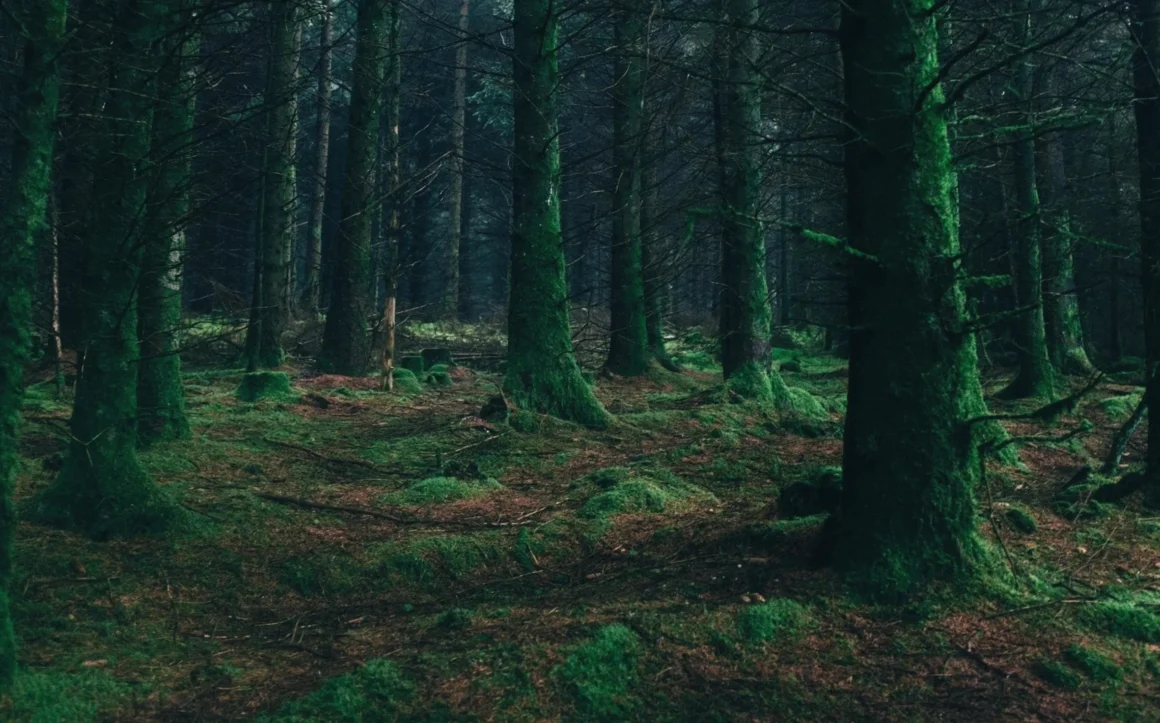
Also crucial for sequestering carbon, protecting biodiversity and providing flood defense are forests. Ireland is among the most deforested countries on the planet. In Europe, countries average around 35% forest cover, but only 11% of Ireland is forested. The vast majority (9% of the South) of that cover is barely worthy to be named “forest”. Sitka spruce, a fast-growing conifer from the Pacific Northwest of America, blankets much of the west of the country in huge plantations of densely-packed trees. More than 20% of the entire area of County Leitrim is covered by these tree farms, with the percentage set to grow substantially across the west of the county, North and South of the border. This growth is largely driven by absentee landlords and financial speculators. In contrast with the ancient deciduous woodland now all-but vanished from the country, industrial spruce plantations are sterile. Criticism of sitka forestry in Ireland often points to the fact that the species is non-native as the reason for the depleted biodiversity in spruce plantations. This is certainly a factor; native species, having co-evolved with and within an ecosystem for millions of years, are as a rule better for biodiversity and ecosystem functions than non-native ones.7, 8, 9
However, the lack of biodiversity in sitka spruce plantations has less to do with the trees themselves and more with how the forests are planted and managed. Sitka plantations are monocultures; homogenous landscapes where only one species is permitted to grow, severing the rich and interconnected web of species above and belowground, depleting ecosystems to their simplest possible state, all to extract the largest possible profit from the landscape. Large-scale monocultures of native tree species, treated as commodities for export or speculative financial assets would not be substantially better for biodiversity or carbon sequestration than sitka dead-zones.
Monoculture is now the defining feature of the Irish landscape. From silent fields of rye grass drowned in fertiliser to provide grazing and silage for dairy cattle, to the endless dark sitka farms. Intensive management of the land for profit has produced radically simplified ecosystems, contributing massively to global heating, and undermining the ecological conditions necessary for future generations. What wildlife survives ekes out an embattled existence on the margins of the land; hedgerows, roadside verges, or on the land of small farmers who still practice more nature-friendly agriculture. Without a radical change in how our land is managed, these marginal areas will not be enough to prevent the extinction of countless species in the near future.
Our broken, homogenous ecology is impacting regular people in the here-and-now too. Extreme weather events, made more vastly frequent due to climate change, kill and maim people, destroy homes, wreck electrical and telecoms infrastructure. Industrial agriculture is poisoning our waterways and fuelling new pandemics (see the article on the Lough Neagh in the previous issue for a more detailed analysis).10 Ireland is not a unique case. All across the world, capital is reshaping ecosystems to maximise the profits of a few, creating homogenous wastelands increasingly inimical to human and nonhuman life.
A sixth mass extinction?
Scientific opinion differs on whether the current global decline in biodiversity and bioabundance meets the criteria for a mass extinction event. Less controversial is the fact our planet is going through a period of major biodiversity loss, likely the most severe since the asteroid impact that ended the age of the dinosaurs.11 Whilst the exact extent and speed of biodiversity loss today is an important question, more important for socialists to grasp are the historical forces driving the present extinction event.
On this question, popular scientific accounts and mainstream commentators tend to fall short. The dominant strain of thought within establishment forces attempting to highlight and address environmental crises, from United Nations climate conferences to David Attenborough documentaries, posits that human activity, in general, is responsible for the decline in nonhuman species and ecosystems. In this analysis, human population growth is the primary driver of environmental change, from global heating to habitat loss. Woolly mammoths hunted to extinction in the mesolithic are viewed as being victims of the same fundamental process as the polar bears teetering on melting icebergs today. Here, environmental catastrophe is a direct result of “human nature,” expanding our ecological niche to the detriment of other species.
While this line of argument can be the basis for truly horrific, fascistic political “solutions”; such as population control and eco-apartheid in the Global South, it is important to remember that its basic premises are prevalent beyond just the far right. The idea that human society, (or “human nature”), has a fundamentally antagonistic relationship with other species and ecosystems, across all of history, is held by many sincere, progressive environmentalists.
To properly understand, and therefore to change the present era of mass extinction, socialists must reject this line of thought. A historical materialist analysis into human societies’ real relationships to nonhuman nature, and their development paints a much more complex, and less pessimistic picture. Our understanding of environmental change cannot ignore the process of history and how human relations with ecosystems have changed massively as different societies have developed. “Humanity in general” does not exist as a universal historical actor. For thousands of years humans have existed in class societies, where the metabolic relationship between society and nature is managed according to the needs of the ruling class first and foremost. Is the average working-class person in Ireland equally responsible for the state of Irish ecology as the CEO of Moy Park or Shell, or the Earl of Shaftesbury? The age of extinction that we are living through is not the product of human life in the abstract, or of population growth. It is the result of a particular historical era of human society: capitalism.
The climate crisis has become a driving force behind extinction, and is killing and displacing more people every year. However, capitalism has been ruining ecosystems and driving species to extinction since long before the first fossil fuels were burned at an industrial scale. Until recent history, rapid changes in land use formed the main factor driving extinction.12 Understanding today’s environmental crisis as a product of capitalism requires understanding capital’s relationship to the land and how it developed and spread through colonialism and imperialism. The history of Ireland is particularly illustrative of this process. In just a few centuries, starting from the beginning of early capitalist modernity in the 16th century, this island was transformed from a diverse mosaic of ecosystems to a cash-crop monoculture of pasture and sitka. While a comprehensive history of Irish ecology is far beyond the scope of this article, understanding the broad strokes of how this place became a wasteland can better equip movements of the working class and oppressed to fight for an emancipatory, biodiverse ecology on this island and beyond.
Cromwell and the wolves
The period beginning with the Nine Years War in 1593 and ending with the Cromwellian conquest of 1649-53 completed the process of British colonisation of Ireland. The horrific social consequences of this process are well-known; modern estimates put the death toll of Cromwell’s invasion alone at 15-20% of Ireland’s population, both from genocidal massacres, and the disease and famine that followed them. Early-modern colonialism also ushered in the most significant and devastating environmental change in Ireland’s history. This rapid ecological change pulled tens of thousands from the land and fuelled the epidemics of disease and famine that followed.
Pre-colonial feudal Ireland was far from an “unspoiled paradise”. From when the first humans arrived in Ireland in the mesolithic (around 10,500 BCE) to the turn of the 17th century, the great “Atlantic Temperate Rainforest” that once covered most of the island was slowly reduced through deforestation to around one sixth of its maximum extent.^7 Clearing land for peasant agriculture, both animal and plant-based, was the main driver. Notably however, this landscape change was not accompanied by widespread extinction of species or loss of ecosystem function. With the exception of a few predator species like the brown bear and eurasian lynx; both driven to extinction by hunting and habitat loss in the early medieval era, wild animal populations and wider ecosystems coexisted harmoniously with gaelic feudal society and peasant agriculture. In fact, there is evidence to suggest that human intervention in ecosystems had a net positive effect on biodiversity at this time.
Peasants clearing dense woodland for pasture and crops played the role of ecosystem engineers, creating a patchy landscape where grassland species ill-adapted to temperate rainforest could thrive. Low-intensity livestock grazing maintained scrub and grassland and distributed nutrients in the soil to the benefit of flora and fungi.13 The Brehon legal code held that forests, bogs, and wetlands were the property of no individual or clan. Instead they were common land, managed and maintained by an entire community. The food, fuel, and fibre that these habitats provided were generally harvested for need, not for profit. The provisioning of precolonial gaelic society was reliant on the preservation of biodiverse ecosystems. This relationship was undermined, then completely destroyed by the early British capitalist class.
The point here is not to romanticise pre-capitalist society or to suggest that the medieval gaels were inherently more “in harmony with nature” than their English counterparts. We cannot return to feudalism, even if such a thing were desirable, which clearly it is not. However, these points are illustrative of the fact that societies that were not solely oriented around the production of commodities for profit had different, more sustainable and democratic ways of managing the land than what exists today under capitalism. Human societies have been modifying Ireland’s ecology since the stone age, but the relationship only really became the massively destructive one we see today, with the violent entrance of capitalism to these shores.
Over the course of the 17th century, the British colonist class enacted a campaign of forced land seizures the island had never before seen. Biodiverse subsistence agricultural land was consolidated into massive cash-crop plantations, often at gunpoint. Maximising profits for the new class of plantation owners necessitated a new method for managing land. Bogs and wetlands were drained, forests were levelled, and species were hunted to extinction. In their place came monocultures, mostly of intensive grazing land for livestock, their meat and dairy to be sold at market. The plantation system violently integrated Ireland’s ecology into the emerging British imperialist economy.
Far from population growth driving extinction, depopulation and extinction were the same process, as wildlife was driven from the land, so were people. Just as Palestine is often likened to a laboratory for imperialist technologies and methods of social control today, Ireland fulfilled this role for early British capitalism. Famously, Cromwell’s government deliberately targeted wolves for extinction, as predators they threatened the profits of the new sheep and cattle plantations. Huge amounts were paid to wolf hunters by the state to eradicate the species from these shores. In the space of just a century, the island’s only top predator had been lost. The rapid deforestation of commonly-owned woodlands, as well as providing wealth in the form of lumber for the growing shipbuilding industry, undermined political resistance to the new social order. Both wolves and rebels took refuge in the forests, and both could be undermined by their clearance.14
Over the centuries, the disastrous process of extraction and simplification that began with Cromwell and the wolves has continued apace, in more and more technologically advanced forms. The plantation systems developed here were exported across the globe, from the cornfields of America to the vast palm oil farms of Southeast Asia. In Marx’s words, Ireland has “fulfilled her true destiny, that of an English sheep-walk and cattle pasture.” Independence and partition in the 20th century did little to change this fundamental fact.15 The English colonial class were replaced with Irish cattle-barons, American finance capital, and multinational agribusiness conglomerates. The recent growth of data centres for the American tech sector, using vast quantities of energy and water is just the most recent manifestation of the same process of wealth extraction.16 Capitalism has made a new ecology on this island, one where the productive forces of human labour and nonhuman nature are oriented to produce profit for a tiny minority, to the detriment of a liveable, free planet for all.
Socialism or extinction
British colonialism on this island was socially and ecologically ruinous. The wasteland that has been made here is increasingly a daily feature of life, fuelling extreme weather, new pandemics, and reducing access to clean water. Suturing this island of wounds will require a radical change in how land is owned and managed.
In recent years, a new consciousness has emerged around “rewilding” in Ireland; restoring ecosystems by allowing forests to regrow, and reintroducing extinct species like wolves and cranes. Writers like Eoghan Daltun and the late great Manchán Magan have provided inspiring insights into the potential for regeneration of forests and wetlands, and how this process can coexist with human habitation and agriculture.17 However, without a fundamental change away from a system based on the pursuit of profit, efforts to restore ecosystems will be severely hampered and the bulk of the land will remain monoculture. The rewilding of Ireland cannot be decreed from on high, nor can it be the private pursuit of a handful of progressive landowners. It must be part of a broader movement for socialist change, including a transition to a democratic agroecological food system. This movement must take up issues of rural poverty, depopulation and austerity.
Over the last number of years, campaigns have emerged on both sides of the border that provide an example of how an emancipatory, livable ecology can be fought for. From the campaigns against the poisoning of Lough Neagh or expansion of sitka forestry in Leitrim, ordinary working-class people are getting organised to fight capitalism’s assault on their ecosystems, and build a publicly-owned and democratically controlled alternative. A revolutionary socialist programme for the land must draw together community campaigns, rural workers, small farmers, and oppressed people across this country. A more detailed view of how this could be built will be the subject of a future article.
Capitalism has made this island into a wasteland. As socialists, it is our task to organise to reverse its tide of extraction and extinction. To build a new, truly democratic relationship with the land, so that we may once again hear the howling of wolves and booming of cranes over the hills.
Notes
1. Aldo Leopold, 1949, A Sand County Almanac, Oxford University Press
2. Lee Raye, 2023, The Atlas of Early Modern Wildlife: Britain and Ireland between the Middle Ages and the Industrial Revolution, Pelagic Publishing
3. Padraic Fogarty, 1 May 2018, ‘The Slow Death of Irish Nature’, Cassandra Voices, cassandravoices.com
4. Dr. Liam Lysaght, ‘IPBES & Ireland’s biodiversity crisis’, National Biodiversity Data Centre, biodiversityireland.ie
5. 30 April 2025, ‘Bugs Matter survey shows ongoing decline in UK flying insects’, Buglife, buglife.org.uk
6. Irish Peatland Conservation Council, ipcc.ie
7. Eoghan Daltun, 2024, An Irish Atlantic Rainforest, Hachette Books
8. Martha O’Hagan Luff, 24 Feb 2023, ‘ Ireland has lost almost all of its native forests – here’s how to bring them back’, The Conversation, theconversation.com
9. Tommy Greene, 2 Feb 2025, ‘The last fragments of ancient Irish rainforests may face a new threat … trees’, The Guardian, theguardian.com
10. Oisin Hill, 2025, ‘Lough Neagh: A case study in how capitalism kills the environment’, Socialist Alternative #19
11. John Wiens and Kristen Saban, April 2025, ‘Questioning the sixth mass extinction’, Trends in Ecology and Evolution, https://www.sciencedirect.com/science/article/pii/S0169534725000023
12. Prolekult, 2025, For Land: Capital as Extinction, Iskra Books
13. Jonathan Gordon, Brennen Fagan, Nicky Milner, and Chris Thomas, 2024, ‘Floristic diversity and its relationships with human land use varied regionally during the Holocene’, Nature Ecology & Evolution, https://www.nature.com/articles/s41559-024-02457-x
14. Sharae Deckard, March 2016, ‘World-Ecology and Ireland: The Neoliberal Ecological Regime’, Journal of World-System Research, https://jwsr.pitt.edu/ojs/jwsr/article/view/641/710
15. Karl Marx, 1887, Capitalvolume 1, chapter 25
16. Patrick Bresnihan and Patrick Brodie, 2025, From the Bog to the Cloud, Bristol University Press
17. Manchán Magan, 2022, Listen to the Land Speak, Gill Books


