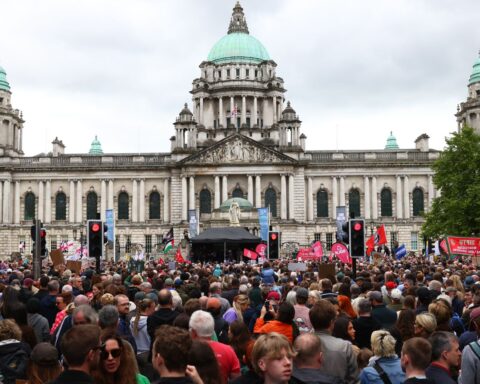
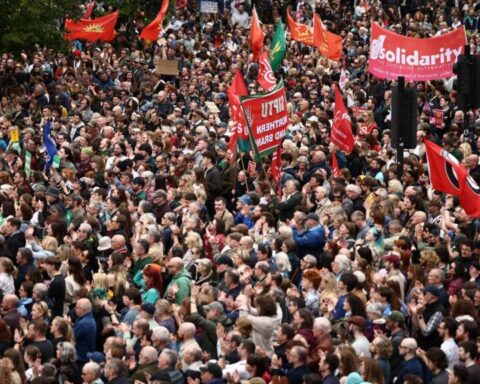
Statue to courageous abolitionist Frederick Douglass unveiled in Belfast

By Mara Clanahan

Last month, Belfast City Council unveiled a statue commemorating legendary American Abolitionist Frederick Douglass. The statue stands near the First Presbyterian Church on Rosemary Street; a site which itself holds significance for not only hosting Douglass during his time in Belfast, but also was the base of the successful outcry against slave ships being commissioned in Belfast in the late 18th century, some 50 years before Frederick Douglass’ arrival. Douglass, a widely renowned orator, gave many speeches at the invitation of the Belfast Anti-Slavery Society. 

During his travels, Douglass wrote to a friend describing the brutal poverty he’d witnessed in Dublin in the time leading to the Irish Famine. Douglass stated: “Men and women, married and single, old and young, lie down together, in much the same degradation as the American slaves. I see much here to remind me of my former condition… but that I know the cause of humanity is one the world over.”

The poverty described by Douglass, and the uncaring nature of those in power and the Church, still persist to this day. This is clearly evident in the growing class divide, the poverty experienced by too many of the working class and the stoking of anti-immigrant rhetoric that echoes when Douglass himself fled slavery and sought asylum. 

Total
0
Shares
Previous Article

Billionaire Tim Gurner's contempt for workers: A case of saying "the quiet part loud"

Next Article

Cybersyn in Allende's Chile: Revolutionary technology and the limits of reformism

Related Posts
Read More

70th anniversary of the assasination of Leon Trotsky

Seventy years ago the greatest living revolutionary of the time, Leon Trotsky, was murdered by Josef Stalin’s hit man Ramon Mercader. There had been a number of failed previous attempts on Trotsky’s life but this time a fatal blow from an ‘ice pick’ successfully destroyed the ‘brain’ of the working class and the symbol of implacable opposition to capitalism and totalitarian Stalinism. This event, celebrated in the Kremlin by Stalin and the bureaucratic elite he represented, also brought joy to the capitalist governments of Europe, America and the world.

Read More

Answering common questions – Socialism FAQs

With the rise of the Occupy movement, opposition to the existing political and economic order has gone mainstream. It’s hard to imagine that the bandana-clad woman on the cover of Time magazine – representing “The Protestor,” Time's “Person of the Year” – has many nice things to say about capitalism, and the ubiquity of the Guy Fawkes mask – popularized by “V for Vendetta” – further underscores how widespread the idea of revolution has become.