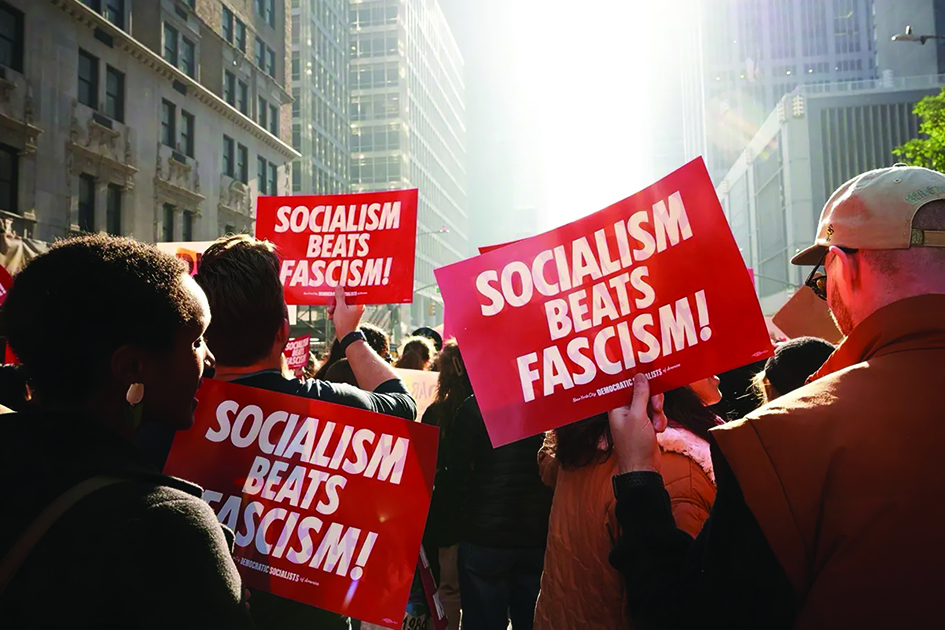
The following article was written before the US mid-term elections, which saw a crushing defeat for Trump and the MAGA movement. A broader analysis of these results is available here. These elections resulted in 7 DSA members being elected to Congress and significant breakthroughs elsewhere, including winning the mayoral positions in Washington and LA. Following the elections, there has been much debate over the decision to support Hakeem Jeffries for Speaker of the House of Representatives; both AOC (Alexandria Ocasio-Cortez) and Zohran Mamdani supported his nomination, while the newly elected DSA members of Congress opposed it. The new victories for DSA will once again bring into sharp focus the limits of the strategy of working within the Democrats. While AOC’s potential bid for the Presidency can galvanise many into political activity, her increasing shift to the right will be displayed.
Trump 2.0 has been more aggressive and nakedly authoritarian than most people expected. Despite feelings of shock and awe by many on the receiving end of the regime’s attacks, resistance has been taking shape, in multiple forms. One reflection of this is in the rising support for radical candidates on the left of the Democrats. Donal Devlin analyses this trend and what it needs to do to meet the challenges it faces.
At the beginning of September the following Republican inspired motion was passed by 220 Members of the US Congress with eight Democrats voting in favour:
“the House of Representatives… condemns and denounces socialism in all its forms, including the Democratic Socialists of America, and opposes the implementation of socialist policies in the United States.”1
Such a hysterical statement coming from the US branches of government is eye opening. For students of the history of the US ruling class, however, the motion had an eerie familiarity to it – echoing the red-baiting rhetoric of the late 1940s and 50s, notably that of the infamous anti-communist witch-hunter Senator Joseph McCarthy of Wisconsin. This time, however, it is the Democratic Socialists of America (DSA), not the Communist Party that is being singled out for attack.
McCarthy’s chief legal assistant was the lawyer Roy Cohn, who later helped Donald Trump amass his fortune through corrupt deals in New York City in the 1970s and 80s. Cohn was also the prosecutor during the infamous Rosenberg case, when he ensured that Julius and Ethel Rosenberg, two members of the Communist Party accused of being Soviet spies (and parents of two young children), were sent to the electric chair.
Trump learnt much from his erstwhile mentor. He engaged in his own piece of anti-communist hysteria when delivering his speech on 4 July, on the 250th anniversary of the Declaration of Independence:
“There is now a resurgence of the communist menace in our land, including from newcomers to our country who embrace ideas totally opposed to our way of life and our great success. These are not mere political disagreements like differences over taxes or regulations. Communism is a mortal threat to American liberty.”2
Declining empire
These comments reflect three deep factors at play within the US empire today:
First, Trump and his supporters in the US ruling class are accelerating a rapid shift to the right, even more than during his first term. He is waging a major war on migrants by massively beefing up ICE – a fascistic and highly militarised force which is terrorising the most vulnerable sections of US society. The trans community is also living in dreaded fear in Trump’s US, with the number of anti-trans bills introduced in various legislatures coming to 840 in 2026 alone.3 Environmental policies have been gutted to allow drilling for oil and the building of data centres – linked to the AI boom – to be ramped up.
Second, there is an unprecedented crisis facing US imperialism globally, with its power and prestige drastically undermined, as it faces intensifying competition with China. It is in this context that Trump has lashed out in all directions since the beginning of the year, starting with the kidnapping of Nicolas Maduro, the threats against NATO allies, and followed by the disastrous war on Iran. If the McCarthyism of the 1950s reflected a US empire at its zenith of both economic and military power, the new campaign against the left is coming from a US empire in decline. And an empire feeling threatened invariably leads to more murderous aggression abroad and vicious repression at home.
Third, is a growing radicalisation within the US itself. Trump’s agenda has not gone unchallenged – this was witnessed in the mass uprising in Minneapolis in January against his war on its migrant community, particularly in the aftermath of the killing of Renee Good and Alex Pretti by ICE agents. There is now massive anger against Trump himself over the cost-of-living crisis and the war on Iran (a war that enjoys record low levels of popularity). At the time of writing, Trump is likely heading for disaster in the mid-term elections. This is combined with plummeting support for Israel in the wake of the Gaza genocide, notably amongst the young, including amongst Republican voters under 50, and even more significantly amongst young Jews.
This shift in US politics is also reflected in a significant decline in the support and influence of the Democratic Party establishment; polls show its congressional leadership has net favourability of minus 33%.4 Amongst important layers, it is still regarded as the party of war, the Gaza genocide, and being pathetically beholden to corporate interests. Nevertheless, the two-party system remains deeply entrenched in the United States.
What is the DSA?
Linked to the radicalisation outlined above is the rise in support for the DSA, whose membership has now reached over 130,000. This group, which operates within the Democrats, has made important gains in Democratic primaries in recent months. DSA-backed candidates have won in over 123 local, state legislative, statewide and congressional elections. This follows the historic breakthrough by DSA member Zohran Mamdani, who was elected Mayor of New York City in November last year on the back of a 100,000-strong volunteer campaign.
The DSA came to prominence in the mid-2010s during the Presidential bid of self-described “democratic socialist” Bernie Sanders, a campaign that galvanised tens of thousands in mass rallies across the US. From 5,000 before the campaign, DSA membership rose to 90,000, before declining during Joe Biden’s presidency. However, it has grown again in the Trump 2.0 era. All of this is reflective of a left-wing sentiment that exists amongst millennials and Gen Z, conditioned by US capitalism, which has created enormous wealth inequality, dead-end jobs, unaffordable homes, deepening oppression and seemingly unending wars abroad.
The DSA was established in 1982 under the leadership of Michael Harrington, an influential writer in the 1960s. His book, The Other America, described the scale of poverty in the US and was seen as influencing the Johnson administration’s poverty programme.5 He initially joined the Socialist Party of America, which, like the DSA, sought to replicate a European-style social democratic party and political programme. In essence, this meant a desire to gradually reform the capitalist system through increased social expenditure, a larger role for the state in running the economy via greater public ownership or regulation, and limiting the excesses of private capitalists.
Linked to this outlook is a rejection of the revolutionary agency of working-class people and Marx’s famous aphorism that the “emancipation of the working classes must be conquered by the working classes themselves”. Left reformist governments would slowly carry out from above what masses of workers and oppressed people could not carry out from below. This position, however, ignores the rich history of the workers’ movement and campaigns of the oppressed to win reforms through struggle. In the US, this was witnessed in the momentous labour revolts of the 1930s, the black liberation struggle of the 1950s, 60s and early 70s, and the feminist and queer liberation movements and labour militancy in this same period.
Social democracy also ignores the nature of the state – an organ which ultimately defends the interests of the capitalist class, a fact that was tragically illustrated in 1973 when the left-wing government of Salvador Allende was overthrown in a murderous coup backed by the CIA. Allende refused to mobilise the working class against the right-wing military and figures such as General Augusto Pinochet, fearing it would only provoke a collision. In fact, failing to confront the forces of reaction, who were clearly conspiring against Allende, ensured the Chilean working class suffered a major and bloody defeat.
Social democratic influences
For Harrington, and for people like Mamdani and Bernie Sanders today, key reference points for how society can change include administrations such as the Labour government in Britain (1945-1951), which notably introduced the NHS, and other post-war social democratic governments in Europe, particularly in Scandinavia. These governments took power amid a major expansion of post-war capitalism, driven by the destruction of the Second World War. The gains they made for working people were driven by the strength and actions of an organised working class. Another factor was the existence of the Soviet Union, which emerged as a major ‘superpower’ after 1945. Although it was ruled by an authoritarian bureaucracy, it seemed to offer an alternative to capitalism and enjoyed immense authority among many workers, given the decisive role Soviet workers and soldiers played in defeating Nazism. This put pressure on capitalist governments to provide some gains to their populations.
Another reference point is FDR’s presidency in the 1930s and the introduction of the New Deal. Again, a crucial context was a major upturn in class struggle in the United States, with the formation of a new trade union confederation, the CIO, and later in the decade, a series of sit-down strikes in the car industry in places such as Detroit, Michigan. Although the Roosevelt administration was forced to make concessions to this movement, it fundamentally defended the interests of US capitalism. The clearest proof of this was the numerous occasions when the federal army was deployed to break strikes.
In the context of the post-war boom, real living standards rose in Western European states and the US; however, the onset of capitalist crisis in the 1970s saw the system go on a counter-offensive. As US imperialism became bogged down in its war in Vietnam and military spending rose, the aforementioned poverty programme was dismantled. In the 1970s and 1980s, Western capitalism more broadly attacked the welfare state, wages and conditions, and trade union rights, to stem falling profit rates.
The labour and social democratic parties of Europe all capitulated to this brutal logic of what is sometimes referred to as “late-stage capitalism”, and adopted neo-liberal policies of slashing and privatising public services. An unwillingness to end the rule of capitalism and the capitalist class’s private ownership of wealth and resources invariably meant betrayal and capitulation in a period of crisis.
Enduring political weaknesses
Historically for social democratic parties, capitulation and adaptation to the system at home went hand in hand with support for Western imperialism abroad. For the DSA and the broader reformist left in the US, this manifested as echoing the US ruling class’s ‘anti-communism.’ In the early 1950s, Norman Thomas, a leading light in the Socialist Party of America, was on the board of the CIA-controlled American Committee for Cultural Freedom (ACFC). In the 1960s, Harrington was slow to oppose the war in Vietnam and the demand for the withdrawal of US troops.6 The DSA itself, upon its foundation, was pro-Zionist and supported the Israeli State, a crucial ally of US imperialism in West Asia.
The DSA today has been radically transformed and has taken a principled stance against Zionism and the Gaza genocide. Many of its candidates centred the demand for Free Palestine in their election material. This reflects that a young generation of US Americans has rejected the insidious, and frankly racist, idea that people on the left could be “progressive except Palestine”. However, DSA member (albeit a loose one) Alexandria Ocasio-Cortez (AOC) has voted in favour of funding for the Zionist State’s Iron Dome, crucial military hardware.
While the composition and outlook of the DSA have changed significantly over the last decade – today it is a multi-tendency organisation and its politics are more radical than the tepid reformism of Harrington and co. – its political weaknesses are still apparent, especially among its leading factions, such as Socialist Majority. It maintains what can be best described as an ambiguous relationship with the Democrats. In 2017, the DSA adopted the strategy of the “dirty break”: working within the Democrats, contesting its primaries and standing as part of its ballot, but, over some indefinite timeframe, breaking with the party to form a new working-class party, independent of the capitalist class.
This reflects a general method of the DSA leadership: seemingly radical and (sometimes) revolutionary in words, but reformist and compromising in practice. Inevitably, when working inside the capitalist machine that is the Democratic Party, which is anything but democratic, there is a pressure to engage in backroom deals and compromises that go against the interests of the working class and the oppressed. The DSA and its elected representatives have shied away from really mobilising those enthused by the demands and messaging of Sanders, AOC, Mamdani et al., and using this as a basis to form a new left-wing party. For example, it meant, in the case of Sanders and AOC, supporting Joe Biden and Kamala Harris in 2024, despite both being thoroughly complicit in the Gaza genocide.
Mayor Mamdani’s balance sheet
Mamdani launched his campaign after Trump’s election in November 2024, centring on affordability and calls for free and fast buses, a rent freeze, free childcare, and a $30-an-hour minimum wage. His rise in the polls was meteoric, going from 1% to winning the primary election and defeating the disgraced former Governor Andrew Cuomo in the general election last November. His campaign illustrated that Trumpism could be challenged not only by his economic programme, but also by his willingness to support trans and queer rights, oppose ICE raids, oppose Islamophobia, and oppose the Gaza genocide. He has celebrated New York City’s rich diversity, a city where over 800 languages are spoken, in contrast to the white supremacist, ethno-nationalist, racist, fascistic vision of the US that Trump has championed.
His election campaign and victory had an electric impact, and Mamdani still enjoys considerable authority and support. He has won important victories since taking office, notably: a two-year rent freeze, a $1.2 billion investment in free childcare, the abolition of the IHRA definition of antisemitism (that effectively equates anti-Zionism with antisemitism) and laws against BDS; establishing an LGBTQ office; and filling 220,000 potholes in New York City.
However, there are real reasons for Mamdani’s support base to be disappointed. One example that has epitomised his approach and the pitfalls that it results in was his decision to reappoint Jessica Tisch as NYC’s Police Commissioner. Tisch was appointed commissioner by Mamdani’s predecessor, Eric Adams, and during her reign the NYPD was used to brutally break up the Palestine solidarity encampment at Columbia University. She also pioneered the draconian and sprawling surveillance camera system that exists across New York. She is an ardent Zionist and was more than happy to march in the Israel Day Parade, the annual celebration in New York of the apartheid state, which Mamdani correctly boycotted. As a billionaire heiress, her family ranks 38th on the 1,000 Forbes Rich List and exemplifies the deep ties that bind different sections of the US ruling class. She has close connections to the Trump family, is personal friends with Ivanka Trump, and her family is a major donor to Democratic New York Governor Kathy Hochul.
Tisch’s role has come back into sharp focus recently with the shooting of Oscar Belgal, a 28-year-old migrant, in front of his five-year-old child by ICE agents in the Bronx. Thankfully, Belgal survived but disgracefully remains in ICE custody. The NYPD was shamefully deployed to arrest protesters opposing these actions and to protect ICE vehicles, despite there being a law prohibiting the force from collaborating with ICE. The same NYPD was used to arrest those protesting the visit of the genocidal war criminal, Benjamin Netanyahu, in September.
After these events, Mamdani doubled down on maintaining Tisch, despite the outcry over her actions. He has calculated that he’s better off not antagonising the Trump regime, fearing it might engage in a Minneapolis-like invasion of the city by ICE. He would also like to continue courting favour with Governor Hochul, who has worked with him on providing his childcare programme. He has likewise declared that he will support the nomination of Hakeem Jeffries for Speaker of the House, despite Jeffries being in the pocket of AIPAC (the pro-Israel lobby). All of this is a poor and deeply shortsighted approach. Mamdani’s talents and capacity to make deals will soon meet the fundamental opposition that representatives of US capitalism have to his programme.
Rupture needed
No doubt there is still goodwill toward Mamdani, and understandably so; however, his approach of compromising and conciliation with the class enemy can eventually demoralise his supporters and play into the hands of Trumpian reaction. Tisch is one example, but so is Hochul. While he stood on the picket lines with striking nurses in NYC in January, as he has with other workers fighting back, he has endorsed Hochul in her gubernatorial race, despite her strike breaking in this dispute. These very workers and young people will be crucial for him to build a resistance and win gains for working-class and oppressed people. Whether Mamdani and his DSA supporters are inclined or prepared to build that resistance is the question.
But such a struggle will be needed, and it will need to be connected to building a new working-class party that ruptures with the Democrats, and struggles for wider systemic change in the US and beyond. Capitalism is unleashing the most noxious ideas and forces, exemplified by Trump’s gang, and is creating a hellscape in Palestine and beyond. In the words of the Marxist writer Walter Benjamin, we need to “pull the emergency brake” on the catastrophe capitalism is leading us towards, and socialist revolution is the only brake we have. Real change cannot come through a slow process; it must be based on the urgent necessity for working-class people to use their agency to end this rotten order.
Notes
1. House of Representatives, 1 September, 2026, www.congress.gov
2. Donald Trump, 4 July 2026, presidency.ucsb.edu/documents/
3. 2026 anti-trans bills tracker, translegislation.com/
4. Yougov, 27 Jan 2026, ‘Opinion of congressional Democrats plunges thanks to flagging support within their own party’, yougov.com
5. Jim Creegan, 7 Sept 2017, ‘The Left Wing of the Permissible: the Politics of Michael Harrington’, counterpunch.org
6. Ibid