

Before capitalism, major societal crises stemmed from literal scarcity. Shortages of food, water, and material goods caused widespread suffering due to plagues, famines, or wars. Capitalism is the first social formation in which economic catastrophes and mass impoverishment result from overproduction. That is, too many goods are made for the market to absorb, but commodities are produced blindly, in the hope they will sell when they enter the market. This is true of every capitalist industry, but the hopes currently placed in artificial intelligence’s near-future profitability are particularly reckless and delusional. Dane O’Farrell investigates the growing speculative bubble around AI.
Depending on your age, you may or may not remember the devastation of the 2008 financial crash. People had been told that if they worked hard enough, they’d have more comfortable lives than their parents’ generation. So their world was turned upside down when the recession ruined hopes for the future. Irish artist CMAT’s “Euro-Country” gives a sense of the fear instilled by sudden mass unemployment: “I was 12 when the das started killing themselves all around me.”
For many people right now, it feels harder to keep your head above water no matter how hard you work. The price of fuel, food, electricity and rent increases perpetually, in part, thanks to the war on Iran and the AI data centres colonising our electrical grid. It’s becoming more expensive for the average person to live a basic life. All this at a time of economic growth and low unemployment. The last thing we need now is another serious downturn. Don’t worry, though; all our hard work and sacrifices are helping boost the profits of faceless corporate shareholders and enriching Musk, Thiel, Bezos, and Zuckerberg.
Manufactured hysteria
The media hype around AI has reached a fever pitch. Just look at the news headlines. The BBC asks, “Is it too late for humanity to take back control from AI?”, while CNN reports, “Ex-Anthropic insider tells CNN how AI could kill all humans by 2030”. Meanwhile, Trump hosted a “Super Intelligence” summit involving the bosses of big tech companies promoting AI. Nvidia chief executive Jensen Huang, whose company is a central player in the AI investment boom, declared that data centres should be called “super intelligence factories”, as they are supposedly “reindustrialising the United States.” On the same day, Trump signed an executive order instructing US government departments to stop using the term artificial intelligence, and to use the terms “super intelligence” or “SI” instead.1
Large language models (LLMs), whether called artificial intelligence or super intelligence, can be described as very powerful word-guessing programmes. To be sure, being really good at guessing which word is statistically most likely to come after the previous word is a powerful tool that can appear to have human intelligence or “consciousness”, but it is an inanimate tool nonetheless. In reality, the hype around AI is driven less by philosophical questions about what constitutes “consciousness”, and more by growing anxiety in the tech and business world that AI investments are failing to turn a profit.
For all the talk of swarms of AI agents enslaving humanity, by far the biggest threats from this technology are its carbon footprint and the speculative bubble it’s creating that could collapse the economy.
Volatile AI companies
The biggest tech firms are betting big that AI will eventually become profitable. Microsoft, Amazon, Meta and Alphabet invested a combined $410 billion in AI infrastructure (including data centres) in 2025 and spent at least $725 billion in 2026.2 However, these companies haven’t published information that documents returns specifically from their AI investments. There is little evidence that AI will dramatically boost profitability any time soon. OpenAI and Anthropic are two of the three biggest AI-first (AI-only) companies in the world and have still not made any profit. In truth, OpenAI is making an operating loss of $14 billion in 20263 and lost $21 billion in 2025,4 while Anthropic made an operating loss of $8.06 billion in 2025.5
Even the International Monetary Fund (IMF), a capitalist institution that has spearheaded market deregulation, published a report warning that “the consequences of an AI correction could be global… the exposure of the rest of the world to US assets, particularly AI, is the highest it has ever been”. The report also warned that the integration of LLMs into the economy “may not require investment on the massive scale being undertaken by ‘hyperscaler’ firms”.6
History of speculative bubbles
The hype machine of big tech CEOs is a product of the AI companies’ lack of profitability. Previous tech breakthroughs, such as high-speed internet connectivity, social media apps, and the Google search engine, didn’t need the same level of hype to convince investors of their power, as people quickly started using them and they began generating profits. The gap between investment and profitability suggests an expanding AI investment bubble, but investment bubbles around new technologies are nothing new.
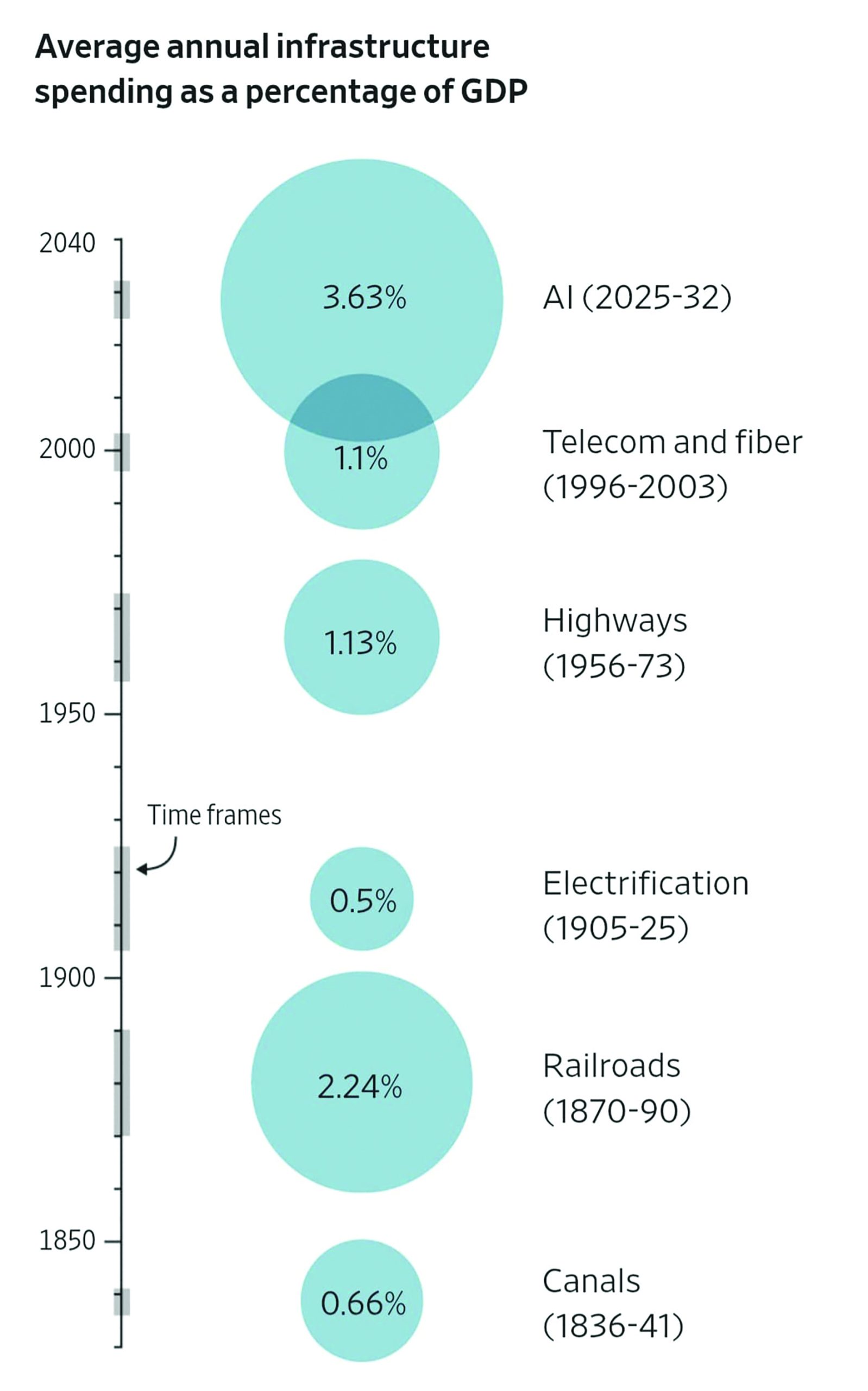
The AI bubble is easier to understand when framed within the context of capitalism’s previous stock bubbles. Time and again, we’ve seen overinvestment in certain industries and commodities traded at vastly inflated prices. The Dutch Tulip Mania of the 1600s saw wild speculation. At its peak in 1637, some tulip bulbs sold for more than ten times a skilled worker’s annual income.7 There was a “Canal Mania” in the 1790s, a railway bubble in the 1840s, and a major stock market bubble revolving around electrification and electric utilities in the 1920s. We saw the dot-com bubble of the 1990s and early 2000s, as well as the housing and banking crash of 2008.
The railway bubble echoed what we’re seeing today around AI. In 1845, railway ads covered half the space in many British newspapers, with overly optimistic revenue projections and inflated claims about investment returns.8 Unlike the Tulip Mania, however, the railway and dot-com bubbles left an infrastructural legacy in the form of railway tracks and fibre optic cables that later benefited economic productivity. LLMs may eventually become an important feature of workplace activity across key economies, but that is most likely to happen long after this bubble bursts.
Unprecedented overinvestment
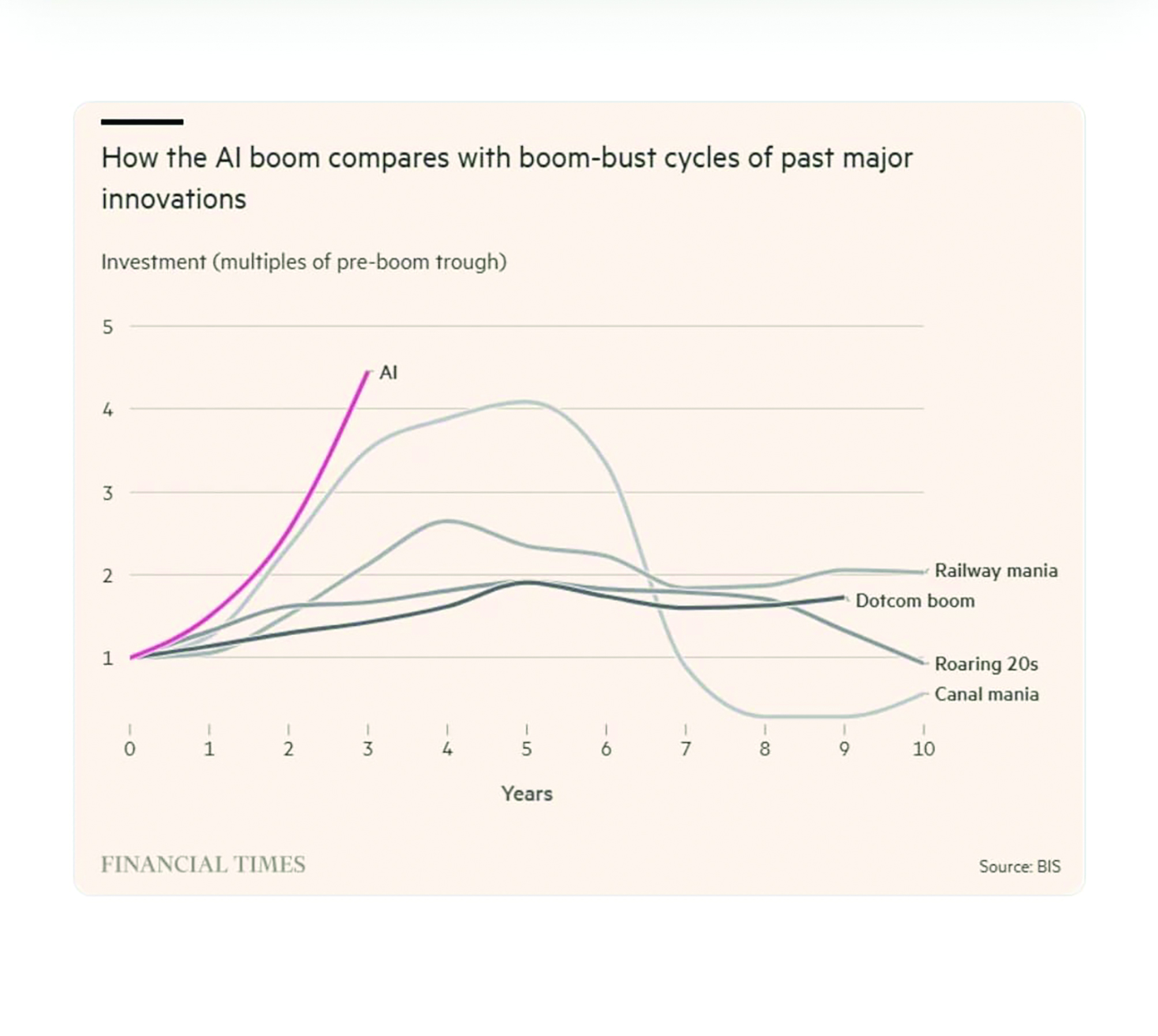
The scale of the AI boom, compared with the other technology booms, is worth reflecting on. Tech consultant Joel Miller has outlined:
“AI spending against four famous booms: the canal mania of the 1830s, British railway mania, the electrification boom of the Roaring 20s, and the dotcom bubble. Each line starts at 1 and tracks investment as a multiple of its pre-boom low. AI has hit 4.5 times its starting point in just three years. Canal mania peaked at 4.1 over five years, railways at 2.7 over four, while electrification and dotcom both topped out near 1.9. AI is steeper than all of them, and it hasn’t peaked. These historic booms typically broke around year five, then dragged their economies into recession. We are at year three.”9
Is AI already an essential workplace tool?
The workplace productivity gains from the introduction of personal computers (PCs) took a long time to show up in the macro data. The PC was commercialised in 1981. Many companies began adopting information and communications technologies in the early 1980s, but productivity remained flat until the late 1990s. A Goldman Sachs report argues that if ChatGPT’s 2022 debut is the equivalent of the PC’s 1981 launch, the productivity payoff of LLMs could arrive by 2030 at the earliest, peaking around 2034.10
An MIT study found that 95% of AI deployments in companies in the US failed in 2025.11 Also in the US, 40% of occupations have half of workers using AI in the workplace. But while usage is widespread, it is shallow, as those workers only use AI for 3% of job tasks.12
A “State of Digital Adoption” report by WalkMe surveyed 3,750 workers and managers across 14 different countries and found that “54% of workers bypassed their company’s AI tools… and completed the work manually instead… roughly eight in 10 enterprise workers are either avoiding or actively rejecting the technology their employers are spending record sums to deploy.”13
This isn’t the first time workers have been slow to adopt a new technology. Nor is it the first time workers have refused or sabotaged a new technology designed to replace elements of human labour for profit. The Luddite movement of the early 1800s saw handloom weavers organise against the introduction of power looms that could produce far more textiles in less time, with less human labour. The relationship between workers’ labour and the machinery, workplace buildings, tools, and technology they use plays a central role in the expansion of capital and in capitalist crises. But before investigating this relationship, let’s look at labour’s role in the capitalist economy.
Workers are the real wealth creators
Karl Marx opened Capital with this line: “The wealth of societies in which the capitalist mode of production prevails appears as an ‘immense collection of commodities’; the individual commodity appears as its elementary form.”14 Anyone living in 2026 won’t need much convincing that our world today is full of commodities, but what is a commodity exactly? If you bake a loaf of bread for yourself and your friends to eat, then it’s just a loaf of bread. However, if you bake it to sell at a local farmer’s market, it becomes a commodity, because you’re producing it with exchange-value in mind rather than use-value.
If you’re going to sell the commodity you produced, you need to consider its value before you set a realistic price. So, what determines the value of a commodity? Most economists believe that the value of any commodity is governed by the laws of supply and demand. That is, if there were a severe shortage of bread, you could charge considerably more for it, but if there is an ample supply of bread in supermarkets and bakeries, you have to factor in the average price to get any buyers. Prices can fluctuate depending on particular circumstances in an economy, including the balance between supply and demand, but labour determines the underlying exchange-value of a given commodity. The prices of cars and bread may vary, but a high-end sports car will always be more expensive than a loaf of bread, because more labour time goes into creating a sports car than a loaf of bread.
Marx argued that a commodity’s exchange value is determined by the socially necessary labour-time required to produce it. If I set off to build a chair, given my lack of furniture-making skills, it might take me ten hours to complete the process from start to finish. Whereas if the average chair-making company takes two hours in a factory, that will govern the value of chairs in general, and I will sell my chair at close to the price of the two-hour chairs. In other words, two hours constitutes the socially necessary labour-time of a chair. Therefore, my extra eight hours of labour will have been wasted.
In pre-capitalist societies, most economic activity centred on people labouring to produce things for their immediate use. The value of the food and clothing that people produced was in their use value. Under capitalism, by contrast, most economic activity revolves around producing commodities to exchange in the market. Capitalists need to hire workers to produce goods or services to sell in the market. And because workers generate value for the capitalist, the working class is the goose that lays the golden egg for capitalism.
The ideology that proliferates to justify the status quo describes capitalists as “wealth creators” or “risk takers”, when in fact capitalists can’t make continuous profits without exploiting workers somewhere along the way. Exploitation is necessary because capitalists generate surplus value by paying workers only part of the value they create through their labour in the form of wages. If you work in a bar, you might get paid €120 in a shift, but you might make more than €120 for your boss in less than an hour selling pints and cocktails. You can’t just go home after you’ve sold €120 worth of drinks; you have to stay for another six or seven hours. Therefore, after you factor in the cost the publican spent on electricity, heating, your wages, the cost price of the beer, etc., they make a profit from the unpaid labour, or surplus value, that you and the other staff created.
“Cash rules everything around me”
Marx argued that money reflects the value of commodities. As markets developed throughout history, money became a necessary and convenient substitute for trading through a barter system. Money measures and reflects the values of commodities by providing a price tag, and that value is created by labour and determined by how much labour it takes to produce a given commodity. In this way, money conceals the true nature of value. So, when you go to the supermarket, you don’t think of it as trading an equivalent amount of your labour-time with an equivalent amount of someone else’s labour-time. Instead of human relationships, we see economic relationships between inanimate goods.15
For capitalists, their aim is always to make more money than they start with. They invest in labour by paying workers part of the value they create through their labour in the form of wages, and they invest in other necessities such as a workplace building or factory, machinery, computers, AI applications, and so on. The property that the capitalist owns, whether it is human labour time, the commodities being produced, or the tools, buildings, machinery, etc. all constitute a boss’s capital. But Marx used terms to distinguish between different forms of capital for an important reason. He defined human labour as variable capital, whereas he termed tools, warehouses, machines, software, and so on, as constant capital.
Every capitalist in every industry is driven by the urge to beat their competitors for a bigger slice of the market. Even if a huge company dominates the market, it always fears it may start slipping and lose out to competitors. Marx pointed out that the capitalist class “cannot exist without constantly revolutionising the instruments of production.”16 One way capitalists attempt to remain competitive is through investing more heavily in constant capital.
The tendency for the rate of profit to fall
Because socially necessary labour time determines the value of commodities capitalists sell, companies that invest quickly and heavily in labour-saving technology can produce goods or services most cheaply. But once one capitalist in an industry invests in the new labour-saving technology, others will then follow to remain competitive, and prices will drop accordingly. Marxist author Hadas Thier describes how the above process played out with computers:
“Huge, clunky, and much less powerful computers used to be more expensive because a lot more labour went into producing them. Now the technology that is used to make computers has vastly reduced production time. Your smartphone can do more than the old clunkers used to do, and for less cost. The reduced labour time required to produce them is reflected in lower value and, therefore, cheaper prices. Labour-saving technologies, by definition, squeeze out the number of workers employed relative to machinery.”17
The problem for the capitalist industry in question is that if they all race to reduce the value of their commodities, the overall rate of profit will decline to the point where it’s no longer worth investing in those commodities. This shows one of capitalism’s fundamental contradictions: capitalists seek to reduce the rate of labour-power in the production process to compete with cheaper commodities, but labour-power is what produces new value. Hadas Thier explains that: “Constant capital simply embodies and passes on the existing value of previous generations of labour. Essentially, you can’t squeeze extra value out of a piece of machinery: you get what you pay for.”18 In other words, as the ratio of investment in variable capital drops and investment in constant capital rises, the part of the investment that generates new, added value drops. Therefore, the surplus value per unit of capital falls. Marx called this phenomenon “the Law of the Tendency for the Rate of Profit to Fall.”
The pronouncements by the tech oligarchs that LLMs will replace all human labour speaks to capitalists’ fantasies about replacing workers who they fear may go on strike, disagree with them, get ill and need sick pay, etc. But fundamentally, the idea of AI completely replacing workers is just a fantasy, because new, added value comes from human labour, not machines. This is not to say that machines won’t replace many tasks currently done by humans. We already see LLMs widely replacing graphic designers, coders, and call centre workers. But there’s a fundamental limit to how much labour capitalists in general can replace with machines and still make a profit.
It’s important to underline that while the tendency for the rate of profit to fall is a significant and inherent driver of economic crisis within the capitalist mode of production, it doesn’t mean that every industry’s rate of profit inevitably drops to zero. Capitalists use countervailing methods to negate the falling rate of profit. One such method is increasing the rate of exploitation by getting workers to work longer for the same wages or less, or by not giving workers pay rises to match inflation. Another method is through reducing the quality of the commodities being produced. We see this with “shrinkflation”, where, for example, a chocolate bar is sold at half the size it was sold for 20 years ago for the same price, adjusted for inflation. Capitalists will also reduce the amount of cocoa in chocolate bars, replace milk with milk powder and use more palm oil to cheapen the production of chocolate bars or other ultra-processed foods. Another way to improve profitability is to move production to another region or country with lower wages and lower tax rates.
Big businesses’ fingers in many pies
To hedge their bets, capitalists will also shift their capital investment to other businesses they view as more profitable. The US company General Electric (GE) became the world’s most valuable company in the 1990s. GE made light bulbs, refrigerators, plane engines and medical equipment, but by the mid-90s, it expanded into the financial sector. GE’s financial services arm was called GE Capital, and it provided brokerage services, retail banking, home loans, credit cards and insurance. By the year 2000, the bulk of GE’s profitability and almost half of its revenue came from GE Capital.19 GE’s fortunes declined sharply after the 2008 financial crash as its finance arm was negatively impacted.
This example offers useful insight into companies that branch into various industries as profit rates fall while still trying to expand. Over time, the tendency for profit rates to fall puts increasing strain on companies, industries, and the economy as a whole. At first, the tech industry saw significant growth rates, with innovations such as the Google search engine, social media apps, Amazon logistics, and so on, but profit rates declined, so they are investing in LLMs as an industry they project will pay off eventually. Some AI critics like to say that the tech oligarchs “have run out of new ideas”, which is true, but their bet on AI is less about a lack of creativity and more about falling profit rates in established tech businesses.
Readers may remember the Metaverse, Mark Zuckerberg’s project to build a profitable virtual reality platform that was pitched as the next step in the evolution of the Internet. After $73 billion was invested in it and it went nowhere, it was abandoned in late 2025. Citigroup had predicted that the Metaverse would have five billion users by 2030, and that it would have “a total addressable market of between $8 trillion and $13 trillion”.20 At one point, many investors thought the Metaverse was unstoppable, although investment in AI is on a much bigger scale.
The AI debt mountain
The core feature of capitalism is that it needs growth, growth, growth, but can’t always achieve it. Banking plays an important role in the economy by lending to companies and industries to keep their show on the road when profits are falling, in anticipation of greener pastures in the future. Financiers are capitalists who don’t invest in producing services or goods themselves, but instead enable production by lending money to other capitalists. In return, financiers or banks are paid back what they loan plus extra money – in the form of interest. Hadas Thier explains the nature of this process: “These payments come out of the productive capitalists’ realised profits. In a sense, productive capitalists must share out their profits because they need finance in order to operate.”21
Banks ensure that funds productive capitalists would otherwise keep in cash reserves are put into circulation. And in reality, capitalists are never guaranteed a profit when they invest in any business or commodity. However, the availability of large pools of credit allows financial capitalists to take on far riskier behaviour than they would if they relied only on their own capital. Here’s a current example of some risky behaviour. As outlined earlier, OpenAI and Anthropic aren’t profitable at the time of writing, and 80% of those two companies’ revenue comes from 1% of their customers, and most of those customers are venture-backed AI start-ups that run their services at a massive loss.22 These start-ups can only continue to exist as long as venture-capitalist investors keep propping them up with investment. Essentially, the economy is sitting precariously on a house of cards.
Stocks are claims to the total value of a company (its assets minus its debts). Companies can try to raise more money by selling shares of their company as stock. Four of the biggest tech companies (Amazon, Google, Microsoft and Meta) have reported record spending in the third quarter of 2026 as they dramatically increased spending on AI infrastructure. Because they are spending more on data centres than they earn from their businesses, they are now taking out loans and selling more stock to raise the cash they need.23 The US central bank, the Federal Reserve, has raised interest rates on borrowing, in part, to slow down the big tech bubble, but big tech’s spending is only accelerating despite the higher interest rates.24 Instead, households and small businesses are being hit harder by higher borrowing costs, on top of higher fuel and food costs linked to data centres that hoover up energy from fossil fuel power stations.
The seven big AI-linked tech companies now account for at least 35% of the US stock market, and many other companies and people own shares in them, so if they fail, many people’s retirement savings could be affected.25 62% of US adults reported owning stocks in 2025,26 and pension funds of countries such as Sweden, the Netherlands, Denmark, the UK and Canada are invested in AI Big Tech companies.27
No final crisis of capitalism
In the aftermath of the 2008 financial crash, the term “too big to fail” was often used to describe how governments from Ireland to the US bailed out banks and financial institutions with public money. Whether big tech can get governments to bail them out remains to be seen. We can’t predict the timeline of the next capitalist crisis or what will specifically trigger it, but we can predict that ordinary people will bear the brunt of the pain from the next downturn, so organising the power of the working class to resist the attacks on our living standards and rights is crucial.
There is never a final crisis of capitalism. The biggest corporate monopolies and institutions get to consolidate and expand their power when the economy retracts into recession. To stop the further decline in quality of life for most people, we need a socialist, planned economy where the majority own and control society’s resources. Society’s wealth needs to be taken out of the hands of mega-wealthy tech and banking oligarchs and managed instead by working-class people who create the wealth and value. James Connolly’s words ring as true today as ever: “The day has passed for patching up the capitalist system; it must go!”
Notes
1. Osmond Chia, 30 Sept 2026, ‘Super Intelligence: Three takeaways from Trump’s tech summit’, bbc.com
2. Chris Dorrell, 1 May 2026, ‘Tech titans fuel bubble fears with $725bn budget for AI’, The Times
3. Jeremy Laird, 21 Jan 2026, ‘OpenAI’s own forecast predicts $14 billion loss in 2026 but Nvidia-style $100 billion revenues by 2029 according to new report’, Yahoo Finance
4. Jim Edwards, 16 June 2026, “OpenAI’s financial’s have leaked, showing $21 billion in losses against $13 billion in revenue’, fortune.com
5. Omor Ibne Ehsan, 30 Sept 2026, ‘Anthropic’s prospectus shows a giant loss and an even bigger ask’, Yahoo Finance
6. Heather Stewart, 13 Oct 26, ‘Threat of AI share crash puts world financial stability at risk, says IMF’, theguardian.com
7. Hadas Thier, 2020, A People’s Guide to Capitalism, Haymarket Books, p 199
8. Oliver Reynolds, 30 July 2018, ‘Railway Mania: The largest speculative bubble you’ve never heard of’, focus-economics.com
9. Joel Miller, 3 July 26, ‘The AI boom compared’, exobrain.co.uk
10. Nick Lichtenberg, 14 July 26, ‘Goldman economist offers a reality check AI adoption: it took 15 years for computers to really show up in the data’, fortune.com
11. Sheryl Estrada, 18 Aug 26, ‘MIT report: 95% of generative AI pilots at companies are failing’, fortune.com
12. Alexander Bick, 1 Sept 26, ‘What work does generative AI do?’, stlouisfed.org
13. Nick Lichtenberg, 9 April 26, ‘White-collar workers are actively rebelling against AI as 80% outright refuse adoption mandates’, fortune.com
14. Karl Marx, Capital: A Critique of Political Economy, Vol 1, Penguin, p 125
15. Hadas Thier, 21 Mar 2021, ‘What is Money?’, Haymarket Books YouTube channel
16. Marx & Engels, 1848, Manifesto of the Communist Party, marxists.org l 17. Hadas Thier, 2020, p 177
18. Ibid
19. Joseph Giglio, 15 Jan 22, ‘Once the most valuable company in the world, GE is making dramatic moves to survive’, Northeastern University (15/01/2022), josephgiglio.sites.northeastern.edu
20. Edward Ongweso Jr, 18 Jan 26, ‘The rise and fall of the metaverse: What went wrong?’, fastcompany.co.za
21. Hadas Thier, A 2020, p 191
22. Darryn Pollock, ‘1% of AI users drive 80% of spending leaving the boom very fragile’, Yahoo! Finance
23. Karen Weise, 29 Oct 26, ‘Big Tech’s data centre blitz is now burning through cash and scaring Wall St’, ”New York Times
24. Colby Smith, 5 Oct 26, ‘High interest rates aren’t slowing the A.I. boom. That’s a problem for the Fed’, New York Times
25. Cory Doctorow, 2026, The Reverse Centaur’s Guide to Life After AI: How to Think About Artificial Intelligence Before It’s Too Late, Verso, p 202
26. Gallup, 1 May 26, ‘What percentage of Americans own stock?’ news.gallup.com
27. Business and Human Rights Centre, 19 Mar 26 ‘Saving for the future or threatening the future: Are pensioners funding the militarisation of AI?’, business-humanrights.org

