
By Philipp Chmel
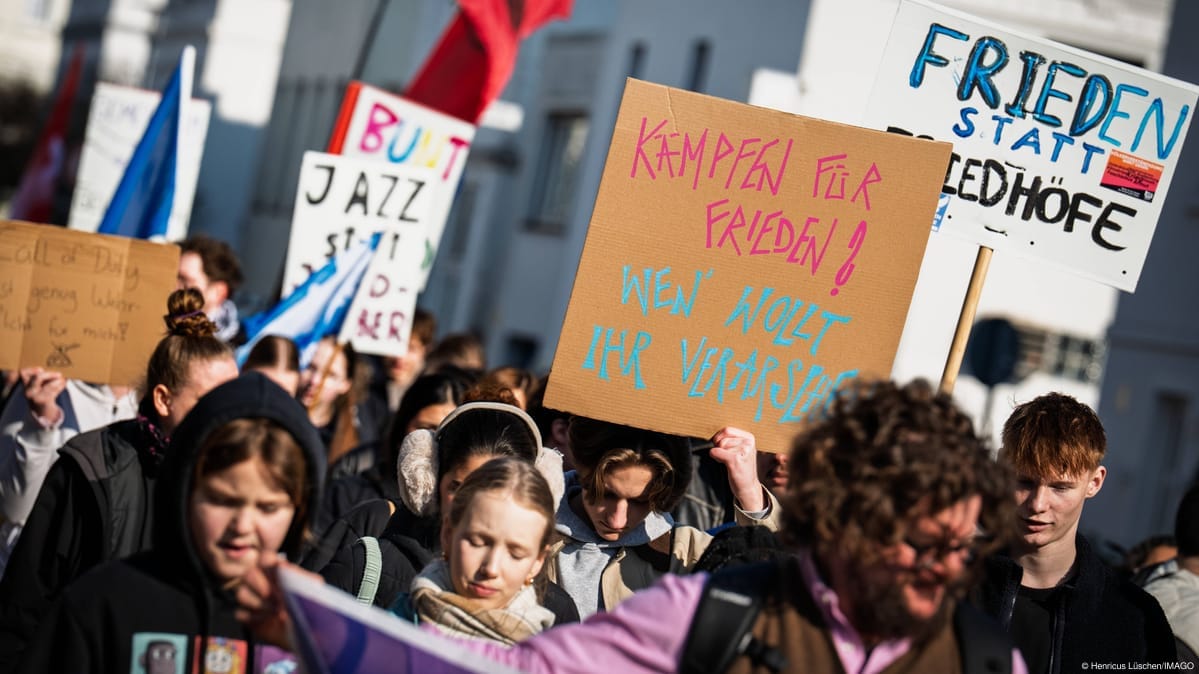
On Saturday, 31 October, over 120.000 young people protested in more than 34 cities across Germany against escalating militarisation and conscription. The demonstrations were called by “Gen Z regelt” (Gen Z takes charge), which was formed only three weeks prior and has since then spread with many local groups. In the weeks before and since, several schools and universities have been blocked, national and local “universities against war” groups have started forming, and new “Gen Z regelt” demonstrations have been called for 14 and 20 November, the day of the next international youth strike against militarisation.
The demonstrations have demanded the resignation of Chancellor Friedrich Merz and have also been animated by opposition to racism, the oppression of women and LGBTQI+ people, imperialism and Zionism, climate breakdown, and austerity. In several cities, these peaceful protests experienced severe police brutality, which was intended to provoke, intimidate and sow division.
Four school strikes against conscription over the last year have contributed to this explosive development. Each time, around 50,000 young people participated in over 100-150 cities. Local and national structures have been established and national school strike conferences have been organised. This collective organising, and the solidarity and support from teachers, the education union GEW, as well as left-wing parties such as Die Linke and smaller revolutionary groups, will have helped the movement withstand the massive levels of intimidation and repression. This includes media smear campaigns, police arrests at demonstrations, intimidation by domestic secret service agents and school authorities locking in students.
The immediate trigger and inspiration for the “Gen Z regelt” protests was the other Gen Z revolts that have erupted across Europe this autumn, first and foremost the youth and social revolt in France. Many of us will have seen videos of French students calling the youth in Germany to intensify their struggle. The call was heard. On 13 October, students of a French school in Berlin brought the method of school blockades to Germany. The following day, students at a school in Hamburg followed their example and more schools and universities in several cities have been blocked since then.
Many German young people also went to France to join the school blockades and demonstrations. During the national strike on 5 November, a banner at the monument of Place de la République read: “Ohne Streik wird sich nichts verändern” (without strike, nothing will change). Referencing the strikes in France, students from 30 schools across Hamburg participated on 6 November in a day of action – which included demonstrations, blockades, leafleting, rallies and info tables – against militarisation and social cuts. In some places teachers and parent representatives joined in solidarity.
Intersectional convergence of demands and struggle
The school strikes against conscription and the “Gen Z regelt” protests are an expression of a growing anti-system consciousness among young people (and in turn have further strengthened it) that is bringing together opposition against the myriad horrors of capitalism. To prepare the reintroduction of conscription, the German state had sent out conscription questionnaires to the 300,000 young people coming of age this year; only 0.18% of those joined the army. The number of conscientious objectors during the first ten months of 2026 (16,869) is already more than four times higher than during the entire year of 2025 (a bit under 4,000). A recent survey showed that among 18-34 year olds, 29% support Die Linke (however, the AfD ranks second with 21%, reflecting the growing polarisation). And support for Palestine liberation has been strong, loud and visible at the demonstrations just like demands against the far right, patriarchy and racism.
The fact that these youth protests bring together demands in an intersectional way and are in direct opposition to the fundamental interest of German imperialism – unprecedented militarisation and conscription to become a superpower with Europe’s largest conventional army that can enforce its interests more independently of the US – explains the radically different reaction of the ruling class compared to the Fridays for Future climate demonstrations and school strikes. Back then, students could get exemptions to join the school strikes and the general discourse around the movement was largely positive. Now, young people are met with unprecedented levels of repression and police violence.
Authoritarian measures and racism against an alleged “left-islamist” alliance
Another feature of the recent protest movement is the more diverse background of young people entering the political struggle. In Italy and France, that development has been particularly pronounced with significantly more racialised youth and vocational school students present in the protests and taking leading roles. The fact that those who are most oppressed by the system fight together with left-wing forces, and the wider movement against the racism and divisions on which the system depends, scares the ruling class.
Their response: blatant racism against (young) migrants, Muslim and Arab people to sow division, delegitimise the protests – a survey found that 83% of people in Germany support the Gen Z protests – and defend increasingly authoritarian measures and restrictions of democratic rights.
Federal Minister of the Interior Alexander Dobrindt (CSU, Christian Social Union, center-rightwing) spoke of “left-wing groups and troublemakers from the ‘migrant milieu’” and Hesse’s Minister for the Interior, Roman Poseck (CDU, Christian Democratic Union, center-rightwing), called for a demonstration ban on 20 November, and to take stronger action against “networks of people with a migrant background who are prone to violence”. Similar racist comments were made by senior police officers and amplified by the established media. The youth organisation of CDU even called for the army to be used against the demonstrations.
This trope of “left-Islamists”, which has been an ideological tool of the ruling class for many years in France (in French: islamo-gauchisme), is becoming an increasingly popular ideological tool for the ruling class in western countries. It was also used after the election victories of Zohran Mamdani in New York and Die Linke in Berlin.
Convergence of struggles
The movement should support and build connections with the workers going on strike in the health care sector, and the metal and electrics sector. Joining the striking workers at their pickets and rallies could give a real boost and could help link the struggle of workers against militarisation from within the car and metal industries (workers and IG Metall union members at VW and Mercedes have organised against social cuts, arms production, job losses and for better working conditions) and the energetic youth protest movement.
Such concrete solidarity and support between the different groups involved would not only strengthen each individual struggle, but also open the possibility to build something larger than its individual parts. In addition to the school and university assemblies, inter-professional assemblies aimed at including workers in struggle, could become a lively space of discussion and help to go beyond solidarity actions towards building shared struggles and collective demands. They could also be a space to discuss with members from trade unions and Die Linke about how meaningful opposition to their respective bureaucratic leaderships could be built.
A powerful and militant movement bringing together young, oppressed and working-class people in a struggle against militarisation and imperialism, racism and oppression, as well as social cuts and for real improvements, would be a meaningful step forward in the class struggle in Germany.

