
By Jonathan Diebold
Solidarity activists across Ireland are closely following the inspiring waves of mass protests which have spread to Europe in recent weeks and months, collectively dubbed Gen Z revolts.
In France, secondary school students are protesting for their education, and have met with ruthless police brutality. So too in Belgium and Greece. In the Spanish State, sparked by the eviction of 89 year-old Maricarmen Abascal, 24-hour protest encampments have sprung up demanding an end to the housing crisis; these protests have also spread to Portugal. In the cases of both France and the Spanish State, trade unions (due to pressure from their rank and file) have called general strikes for November.
In Germany, the issue of conscription is just beginning to erupt. In Albania, there’s the Flamingo revolution: a heroic, months-long campaign of daily protests and running battles with the police, sparked initially by Trump’s son-in-law Jared Kushner’s plans to build a golf course over protected wetlands. In Serbia, students have protested for two years, and the movement, after fielding its own list of candidates in the election, just won a majority in parliament – unseating Aleksandar Vučić after 14 years. In Italy, protestors are opposing the far-right Meloni government, the cost-of-living crisis, and the genocide in Gaza.
These actions follow on from, and frequently take direct inspiration from, protests of young people elsewhere in the world in the past two to three years, beginning in Sri Lanka, Bangladesh, Nepal, Indonesia, and spreading across Africa and Latin America. The spread of Gen Z protests can be charted by the appearance of the “Straw Hats’ Jolly Roger”, a flag from anime series One Piece, which was first flown in Indonesia in 2023 and has since appeared at every one of these protests.
In places like Nepal and Madagascar, these have not merely been protests, but rather outright revolutionary uprisings. Important movements like the massive Cockroach Movement in India are ongoing. In Brazil, we’ve also just seen a movement on the streets which prevented the election of wannabe Trump impersonator Flavio Bolsonaro, returning Lula in spite of open election interference by billionaire Mark Zuckerberg’s Meta – we hope to see this movement continue, and to put demands on Lula, but the defeat for the far right in the largest state in Latin America is absolutely something to applaud and be inspired by.
The growth of the Democratic Socialists of America and popularisation of self-described socialists like Zohran Mamdani in the US should also be understood as being part of this global trend – albeit on a lower level, because not yet reflected generally as a mass movement on the streets.
Fighting for a future
What connects the Gen Z revolts? Seemingly nothing; actually everything. Scratch the surface of one of these demonstrations and the demands of another emerge. The housing protests are also about education. The education protests are also about housing. Young people everywhere are furious about the reign of fascistic billionaires, who hate humanity and see no future for us on this planet.
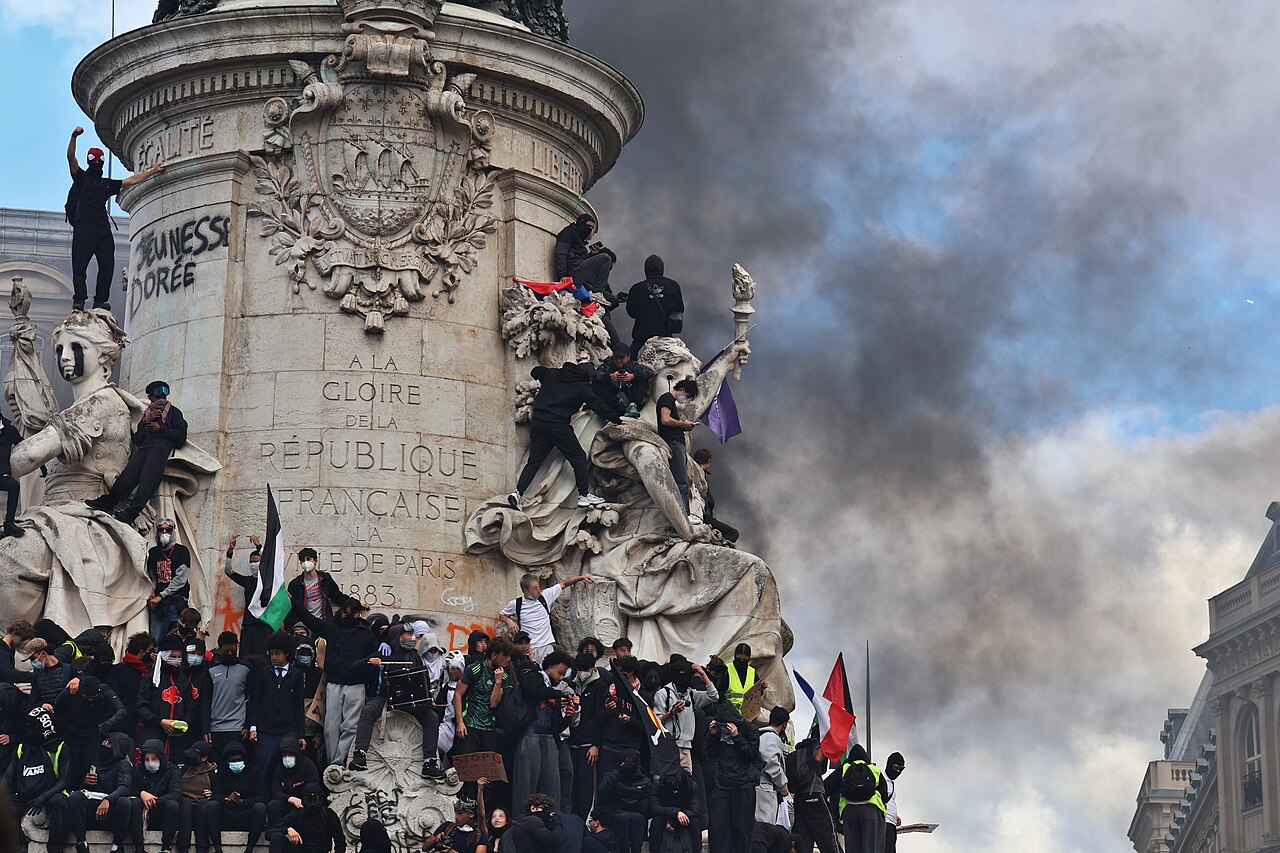
Solidarity activists travelled to Paris to participate in the protests there and experienced this first hand: people may initially have turned out onto the streets because schools were undersupplied with teachers and oversupplied with rats, but chants and placards and people we talked to were channeling a collective anger at myriad issues: climate change and the far right, Palestine and police brutality, the cost of living and capitalism. Likewise in other protests across Europe, where chants about any one issue are equally as common as chants about the system as a whole.
It’s in France and the Spanish State where these protests have found their sharpest European expression. In France, protests began (as has become the case increasingly in the last decade) in the state’s far-flung colonial holdings, in Mayotte and in French Guiana, perennially the most oppressed and underfunded regions. By the end of September, they soon spread to working-class suburbs of Paris, where school students came out in solidarity with striking teachers. October saw them being joined by workers and other young people, bringing millions out onto the streets.
The violence meted out by the police against protestors – largely children – has been extreme, with tear gas fired with wild abandon. One teen lost his hand to a sting-ball grenade lobbed by riot police. He was 15, protesting for the right to an education. A 14-year-old had their teeth shattered by riot police. A 16-year-old lost an eye to a rubber bullet. Solidarity activists witnessed tear gas being indiscriminately deployed in a crowded metro station. As of early October, over 5,000 had been arrested, just shy of 90% of whom were minors. None of this has weakened the protest, far from it; many of those we talked to turned out onto the streets precisely because they are so outraged by the repression and attack on the right to protest. On the largest day of action, as many as two million joined the protests.
In Madrid, in the capital of the Spanish State, Maricarmen Abascal had lived in her home for seven decades. At 89, she had lived nearly as much of her life under the Franco dictatorship as not. When a vulture fund purchased her apartment and quadrupled the rent, she was evicted. Police had to carry her out of her apartment: she was a wheelchair user. Her case became a cause célèbre in the Spanish State, representing all the pain and rage that the housing crisis has produced. Now over 50 cities have seen protest encampments blossom. This in the context of an 80% increase in rents over the last ten years. Tragically, Maricarmen died shortly after her eviction, having been hospitalised due to the extreme stress. The movement has no doubt where the blame lies: the chant “it’s not a death, it’s a murder” could be heard at protests across the country.
As in France, and indeed everywhere where young people have started mass protest movements, the movement was sparked by something specific, but rapidly became a general expression of anger at everything impacting young people, from the cost of living, to the climate, to the rise of the far right, and every other attack on young people’s futures.
A thousand threads
Across Europe and the world, protests haven’t emerged out of thin air. These are movements in a long line of movements. In France protestors have alluded to the Yellow Vests movement, the movement of 1968, and even the 1872 Paris Commune. In Spain,we’ve seen years of anti-AirBnB protests, but also a previous encampment movement, the anti-austerity Indignados movement. No doubt if these movements came to Ireland, we’d see the water charges movement or Repeal invoked.
The 2010s – the mass protest decade – saw more on-street protests than any decade in human history. But if the 2020s started at a disadvantage with widespread pandemic lockdowns, the decade seems doggedly determined to catch up despite this. The LGBTQ+ activist Leslie Feinberg once said that “my right to be me is tied with a thousand threads to your right to be you.” No issue in our time has demonstrated that so profoundly as the genocide in Palestine. Palestine flags are ubiquitous on these protests. It has exposed every bloody tie of capitalism and imperialism.
When the Macron, Burnham or Trump governments attack public services while sending billions to Israel; when seemingly every multinational corporations in the world has links to the occupation of Palestine; when the US and Israel engage in brutal imperialist war on Iran, causing fuel shortages and price spikes around the world; when the same AI systems causing mass job losses are used to target missiles at Palestinian families; when solidarity protestors are brutalised by the police and declared terrorists by the state; when the super-rich line up to support Israel and use their wealth and privilege to silence dissent; all these things show how each issue is linked to each other, how our rights are tied by a thousand strings to the rights of ordinary people in Palestine, how the whole system is to blame.
Another quote, this time from Palestinian Marxist Ghassan Kanafani: “The Palestinian cause is not a cause for Palestinians only, but a cause for every revolutionary, wherever he is, as a cause of the exploited and oppressed masses in our era.” This was written in 1972; it’s even more true today.
Confusion and possibilities
We should be clear: these are not all explicitly socialist or left movements. Their demands are often unclear or contradictory. Some demonstrators we spoke to in Paris certainly did call for socialism, others for a change of government or merely for government action. Moreover, getting out onto the streets and demanding socialism cannot alone call it into being. However, if confusion and lack of a concrete programme for socialist change understandably prevails among protestors, this in no way diminishes the desire for freedom and dignity which moves them. Nor should we place artificial limits on how far these protests will conclude.
In his study of the protests of the 2010s, journalist Vincent Bevins wrote that they “start over something very specific; then they explode to include all kinds of people, accommodating numerous competing or even contradictory visions; finally, the resolution imposes very specific meaning once more. In the middle, infinite possibilities present themselves.” For better or worse, these movements will come to some form of resolution, and superficial commentators will retrospectively try to define them entirely by how they started and how they ended. But now, today, we are in the period of infinite possibilities, limited only by how conscious the movement is of its power to reshape society. How far these movements will or can go remains to be seen. A generation of students and young workers are trying to take history into their own hands. It is the role of socialists to try to inject Marxism into the movement – in short to make people conscious of their own power as a collective to transform society
Gen Z and Ireland
It’s far better to experience a mass movement than to write about it. Doubtless anyone here in Ireland who has felt themselves moved by these protests wants to know when they will come to these shores. It’s not easy to predict which spark will light the fire, but the fuel for such protests already exists. Anger at Fine Gael and Fianna Fáil is endemic. The housing and cost-of-living crises are acute. Government budgets are overflowing while public services are chronically underfunded. While the government grovels to big tech, data centres soak up more and more of the country’s energy.
More and more young workers and students understand innately that a future under capitalism is utterly hopeless. The public sector strikes which brought 300,000 workers onto picket lines in response to the rising cost of living should be read as a prelude to any potential Gen Z protest in Ireland. So too should the fuel protests earlier this year: those protests were very far from a Gen Z revolt, and unfortunately led by some horrible individuals, but it should at least be granted to them that they have put down a marker in Irish society that militant and disruptive action can win gains.
As a parting remark, we send our heartfelt and unwavering solidarity to every participant of these Gen Z revolts. Your determined bravery and tenacious fighting spirit – frequently in the face of unprecedented state violence and repression – inspires us to fight too. Socialists in Ireland share the same spirit which animates you: the uniting demand underneath everything, sometimes conscious, oftentimes not, echoed by all those wherever they are in the world who oppose oppression and exploitation. It’s that most modest of all demands: We Only Want the Earth.

