
By Manus Lenihan
In October 1956 a revolution swept the Hungarian government from power. On the 23rd, protesters filled the streets of Budapest in their hundreds of thousands. For five days rebel groups held barricades and ambushed tanks. They fought against the domination of Hungary by the Soviet Union, against the gruesome activities of the secret police (State Defence Authority or ÁVH), and against the economic misery that prevailed under the Communist government of Mátyás Rákosi.
But what is meant by this word ‘Communist?’ Historian Norman Stone writes of the outbreak of the revolution: ‘In most settlements Communism ceased to exist, and self-governing committees emerged to manage local affairs.’1 Stone appears unaware of the irony in his choice of words. Elected councils of working people took over workplaces and local areas, ran food supplies and medical aid, and debated the future of the country. That is communism, in the sense described by Marx and Engels in The Communist Manifesto or Lenin in The State and Revolution.
But the workers’ councils of Hungary enjoyed only a few days of peace. At dawn on 4 November the Soviet Union launched a full-scale invasion of Hungary and overthrew the government of Imre Nagy. The working class resisted for months in the form of a general strike before the new Soviet puppet government led by János Kádár crushed them too.
Around the world, horror at the Hungary events caused many to leave Moscow-aligned communist parties. People of that generation spoke of ‘pre-56’ and ‘post-56’ communists. Even today people speak of ‘tankies’ – hardline Stalinists who see no issue with columns of tanks destroying all opposition.
This article will give the reader a sense of the sequence of major events, but its main aim is to get across one crucial point: that the Hungarian Revolution was a socialist and working-class movement.
Background
Hungary is extremely rich in arable land. Its population was under 10 million in this period, one in two of whom worked in farming, one in five in industry. After centuries of Russian, Turkish and Austrian oppression, independence came in 1918 with the downfall of the Austrian Hapsburgs. After a short-lived Soviet Republic in 1919, the country’s landlord class made a vengeful comeback in the form of the dictatorship of Admiral Miklós Horthy. Socialist organisations survived only in the underground, communists only as refugees in Moscow. Fascist gangs persecuted trade unions. The Horthy regime sent thousands of young men to freeze and starve with Hitler’s armies on the Stalingrad front during World War Two, and this shameful war came to a shameful end: by 1945 Hungary was in ruins and occupied by the Soviet Union’s Red Army.
But the late 1940s were a time of optimism, pluralism and relative freedom. Post-war reconstruction, spearheaded by the Communist Party, was a rapid success. The government was a coalition of the majority Smallholders’ Party (a broad agrarian party which had socialist currents) along with the two workers’ parties (Socialist and Communist, who each won about 17% of the vote) along with others. In 1944-5 the holdings of the landlord class were shared out by the communist Agriculture minister (Imre Nagy, whom we have already mentioned). Banks and heavy industry were brought into public ownership. The old ruling classes were discredited, defeated and ruined by the war, and the socialist direction in which the government was travelling was popular.2 This was in spite of the fact that the Communist Party had no popular base in Hungary prior to 1945.
‘Salami tactics’
From about 1947-9, things turned sour. The Communist Party muscled out the other parties through the infamous ‘salami tactics’ of prime minister Mátyás Rákosi.3 Their conduct was typical of the Stalinist method: small groups of office-holders make secret decisions and manoeuvres, lying and manipulating instead of relying on the strength and intelligence of working-class people. When they entered the coalition in Hungary in 1945, the one ministry they insisted on controlling from top to bottom was not that of education, welfare or labour – it was the Ministry of the Interior, which was in charge of the secret police. They leveraged this repressive apparatus (and the Soviet occupation) to neutralise or eliminate all opposition.
Next they put the Hungarian people through the wringer. A five-year plan for heavy industry reduced workers’ consumption by one-fifth for the sake of a programme that churned out defective products. Housing conditions were terrible, and there was the constant pressure of ‘production norms’, piece-work, and frequent accusations of ‘sabotage.’ Meanwhile farmers endured mass collectivisation and compulsory deliveries, which brought hunger. The Ministry of the Interior earned its keep: more than one in every ten Hungarians was up in front of a tribunal during the years 1948 to 1953.4 Many hundreds of thousands were imprisoned. Hundreds were executed.
Imre Nagy was thrown to prominence by the zigzags typical of Stalinist politics. In 1953, leaders in Moscow hand-picked him as Prime Minister of Hungary from the second or third tier of Hungarian communist politicians when they wanted to chastise Rákosi. It’s hard to write about intra-Stalinist politics without cynicism, but the warm response of the Hungarian people to their new prime minister was entirely sincere. Nagy radically slowed down the hectic programmes for industry and farming, and released thousands from prison. For eighteen months Nagy struggled for his programme against the party apparatus controlled by Rákosi, then Stalinist cynicism reasserted itself: in April 1955 during a new ‘turn,’ Nagy, refusing to ‘self-criticise’, was ousted from leadership and expelled from the party.
A working-class and socialist revolution
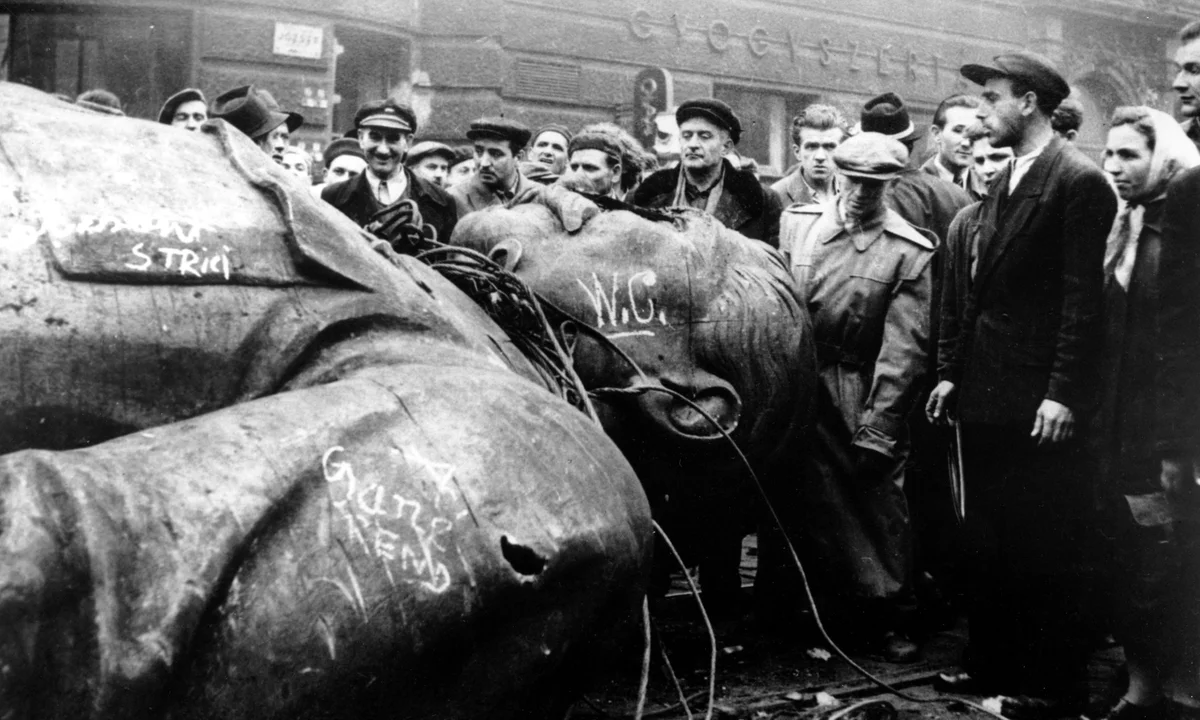
Three major events set the stage for the Revolution of 1956: the death of Soviet dictator Josef Stalin in 1953, his denunciation in February 1956 by his successor Nikita Khrushchev, and defiance of Moscow by the leaders of neighbouring Poland. 1956 in Hungary was a year of lively popular debate, of funerals that turned into mass anti-government demonstrations. The Hungarian Revolution began on 23 October with a protest of students in solidarity with Poland. This protest presented 16 demands for independence, economic reform and democratic freedoms, and swelled to 300,000 as workers joined in. The crowd tore down a massive statue of Josef Stalin (There is no record of anyone present complaining that ‘whatever you think about Stalin, it’s wrong to erase history’) while elsewhere the first clashes with the Ávh began. Five days of war followed in Budapest and roughly a dozen provincial towns, between the Soviet Red Army and the ÁVH on one side and a popular insurgency on the other. Around 2,000 fighters, led by people such as intellectuals, communist factory foremen and rebel military officers, fought a legendary battle, holding barricades and ambushing tanks in narrow streets. Fraternisation between rebels and Soviet troops was a notable feature.
Very early on, Imre Nagy was elevated to the presidency to appease the masses. But he was on the Stalinist side of the barricades for the first few days. He redeemed himself some way when he refused to legitimise the Red Army’s presence, and more when he dissolved the Communist Party and formed a new party composed of opposition communists; declared a new government bringing in opposition parties; and left the Soviet-aligned Warsaw Pact, declaring Hungarian neutrality, along the lines of Sukarno’s Indonesia and Tito’s Yugoslavia.
What was the class basis of the revolution? Were the insurgents drawn from the bourgeoisie or the church? From 1944-47 the commanding heights of the economy were nationalised and the landlords’ holdings shared out among the poorest peasants and farm labourers. So by 1956 the landlord and bourgeois classes in Hungary had been extinct for years and were in no position to take power. The working class on the other hand had grown and wanted to make good on the promises that had been made to it. They were arrayed against a tiny upper crust of office-holders within the state, backed up by a foreign army. Many of these officials went over to the side of the working class.
The 16 demands which were raised at the outset included absolutely nothing about returning the land to the landlords, or the factories to the bourgeois; they were mostly demands for democratic rights and Hungarian sovereignty. There was in fact an explicit demand for a planned economy ‘under the direction of specialists.’5 The protesters who raised these demands on 23 October marched singing the ‘Marseillaise’ and the ‘Internationale.’6 Everywhere revolutionaries tore down red stars from public buildings and cut the communist crest out of the middle of the Hungarian flag. Did this represent a rejection of socialism, or just of alien symbols that had been foisted on them by a government that treated them with brutality? Consider that the revolution’s foremost leader was Imre Nagy, 40 years a Communist, and that Communists were to be found in key positions in the central government, in the revolutionary committees and in the militias.
In passages from the writings of István Bibó, the last member of Nagy’s government to remain at his post after the Soviet invasion, we see the perspective of a non-communist revolutionary leader who came from a religious, petit-bourgeois, professional background. Bibó insisted that nobody inside Hungary wanted the country to be the first battlefield in a Third World War, or a ‘fifth column of world capitalism.’ Capitalist restoration was undesirable in itself, but it would also upset the global balance of power and bring disaster. Ferenc Feher and Agnes Heller, well-informed leftist writers, remark that this ‘expresses the views of most – perhaps even an overwhelming majority of – sections of Hungarian society.’7
Eyewitness accounts bear out these points. Peter Fryer describes a revolutionary committee in the town of Magyaróvár, population 22,000: the 20 members were all local men, some of them rank-and-file communists, most former social democrats. This committee was set up after the ÁVH opened fire on an unarmed and multi-generational crowd of 5,000, killing many, including a baby. In Györ (population 66,000), the committee was led by a metal-worker and an academic from Bibó’s party. At a large collective farm, Bábolna, one speaker called for the banning of the Communist Party, but this proposal was rejected.8
Another eyewitness, police officer Sandor Kopacsi, describes a group of 20 insurgents he captured early in the fighting:
‘Your papers.’
They showed them willingly.
Seventeen years old. Young Communist card.
Nineteen years old. Factory worker.
‘What does your father do?’
‘He’s a farmer. It’s on the card, you only have to look more closely.’
There were four metalworkers among them, two students, an apprentice caster, and two farmers’ sons. One of them showed me a party membership card […] What was going on? He was a Communsit Party member like me. How could we be on opposite sides of the same barricade?
It was not just the youth. Kopacsi later met an old Hungarian communist who had served as Lenin’s bodyguard shortly after the Russian Revolution. He said that this revolution was ‘the first time I’ve experienced the true atmosphere of the “ten days that shook the world.”‘9
More negative features of workers’ revolution in other times and places map onto Hungary as well. Accounts of the Russian and Spanish revolutions describe ugly incidents of mob violence and summary executions. Hungary saw similar episodes, and naturally the Stalinists used such incidents to justify sending in the tanks. But in practically every revolution, there is mob violence, as well as attempted interventions by reactionaries and foreign intelligence services. If we judge Russia 1917 by the same standard, there should have been no October Revolution to begin with, and thus no Soviet leadership to stand in judgement over the conduct of the Hungarian masses.
Historian Miklós Molnar argues that Nagy’s programme of ‘communism with a human face’ was out of step with the general mood, which aspired to a ‘decisive break with communism.’ He adds that it is ‘romantic’ to see the workers’ councils as nascent Soviets – perhaps he forgets that even Russia’s Soviets were very heterogeneous and began life as strike committees. On the other hand, he acknowledges several key points: that in the street fighting of 23-28 October “the vast majority of insurgents treated in hospital for wounds were workers,” emphasising the class basis of the revolt; that the opposition within the Communist Party was “not swept away” by the Revolution, but joined it and became its leadership; and that “all things considered the general trend was not moving towards the re-establishment of capitalism”, though he reckons Hungary was headed for a “mixed economy.”10 Nobody can say for sure where Hungary was going, but there is simply a lack of evidence that the people were clamouring for bourgeois restoration or foreign intervention.
It can be argued that the revolutionaries would have unintentionally opened the door to capitalism, fascism, World War Three, etc. But this is like those people who say we can’t have socialism because there were famines in Communist China. It might suit that person’s argument to reduce the debate to a strange thought experiment in which a rich spectrum of possibilities is collapsed into just two extreme scenarios, but we don’t have to proceed on those impoverished terms. Since Khrushchev’s Soviet Union put a brutal end to the Hungarian experiment after just a few days, we can only speculate. History is rich and complex, and revolutionary situations are dynamic, diverse and alive. The best we can do is take the concrete situation as a foundation for any speculating we want to do.
If the vast majority of Hungary’s population wanted capitalism in 1956, it would still be undemocratic to deny them by force of arms. But as it happens, the people were motivated by a range of 100% legitimate demands around democratic rights, sovereignty and economics. Not only could these demands be accommodated within a socialist programme – they would be essential.
Why were these demands not realised? First, the Soviet leadership took the course of total aggression. A regime that boasted of its revolutionary origin decided that a revolution on its doorstep could not be tolerated. Second, the Nagy government lacked revolutionary will. Civilian and military leaders literally did nothing for hours while the Soviet tanks rolled across Hungary on 4 November; meanwhile the popular militias fought to the bitter end. Kopacsi even describes dismissing Hungarian tanks which had massed to defend the government.11 Third, he Western powers did not lift a finger to help the Hungarian masses.
It would be fair to point out that the brutality meted out to Hungarians was matched and even exceeded in these years by the capitalist powers – for example in Malaysia, Kenya, Algeria. This undermines the simple binary between “capitalist democracy” and “communist dictatorship.” In Hungary, communists were fighting to the death for democracy; meanwhile in Kenya ‘democratic’ Britain ran a concentration camp system rife with torture, mutilation and killing. The Hungarian Revolution invites us to dispense with these simplistic binaries, which are so convenient for people who want to dismiss the possibility of radical social change.
Political Revolution
Before 1956 it was widely believed that it was impossible for a Stalinist state to face a revolutionary challenge inside its own borders. Hungary proved this wrong. It also raised in concrete terms a programme put forward by the Soviet oppositionist Trotsky in the 1930s. For Trotsky, the Soviet Union, like Hungary, was a ‘deformed workers’ state,’ that is, a state that has thrown off capitalism and made serious gains under a planned economy, but one whose real potential is thwarted, and survival threatened, by the tyranny of a self-interested layer of bureaucrats. The bureaucracy must be overthrown by the workers in a political revolution – keeping in place the socio-economic regime but restoring democratic rights. The remnants of Trotsky’s Left Opposition had no presence in Hungary, and elsewhere some of them did not recognise the events of Hungary 1956 for what they were: an important idea coming to life, the idea of a political revolution against Stalinism.
In one Stalinist version of events,12 the bogeymen were Cardinal Mindszenty, fascists, Radio Free Europe, Horthy-era officers, kulaks, even sex workers and bookmakers. The reactionary forces were active but had little effect on the course of events. But in its way, the emergence of a healthy and democratic workers’ state in Hungary would have been much more threatening for the Soviet leadership. It would have provided an example for the masses in the Soviet Union to follow.
Notes
- Norman Stone, Hungary: A Short History, Profile Books, 2019, p 195
- Miklós Molnár (trans Anna Magyar), A Concise History of Hungary, Cambridge University Press, 2003 (1996), p 300
- Described in Peter Fryer, Hungarian Tragedy, 1956, ‘Chapter 3: Background to October.’ (https://www.marxists.org/archive/fryer/1956/dec/3_background_to_october.htm)
- Molnár, p 303
- The text of the 16 demands can be read in full online: https://en.wikipedia.org/wiki/Demands_of_Hungarian_Revolutionaries_of_1956
- Molnár, p 312
- Ferenc Feher and Agnes Heller, Hungary 1956 Revisited, George Allen & Unwin, 1983, p 13
- Fryer, ‘Chapter 2: Magyaróvár’, ‘Chapter 5: Györ,’ ‘Chapter 6: Bábolna’
- Sandor Kopacsi, In the Name of the Working Class, Fontana, 1986 (1979), p 140, 177
- On casualties of the five days of fighting: Molnár, p 314. On prospects of capitalist restoration: Molnár, p 317-318
- Kopacsi, p 217-221
- The Counter-Revolutionary Forces in the October events in Hungary, Volume 1, Hungarian Government publication, 1957 (https://www.marxists.org/subject/hungary/archive/1957-v01-counter-revolutionary-forces-in-hungary.pdf)

