By Philipp Chmel
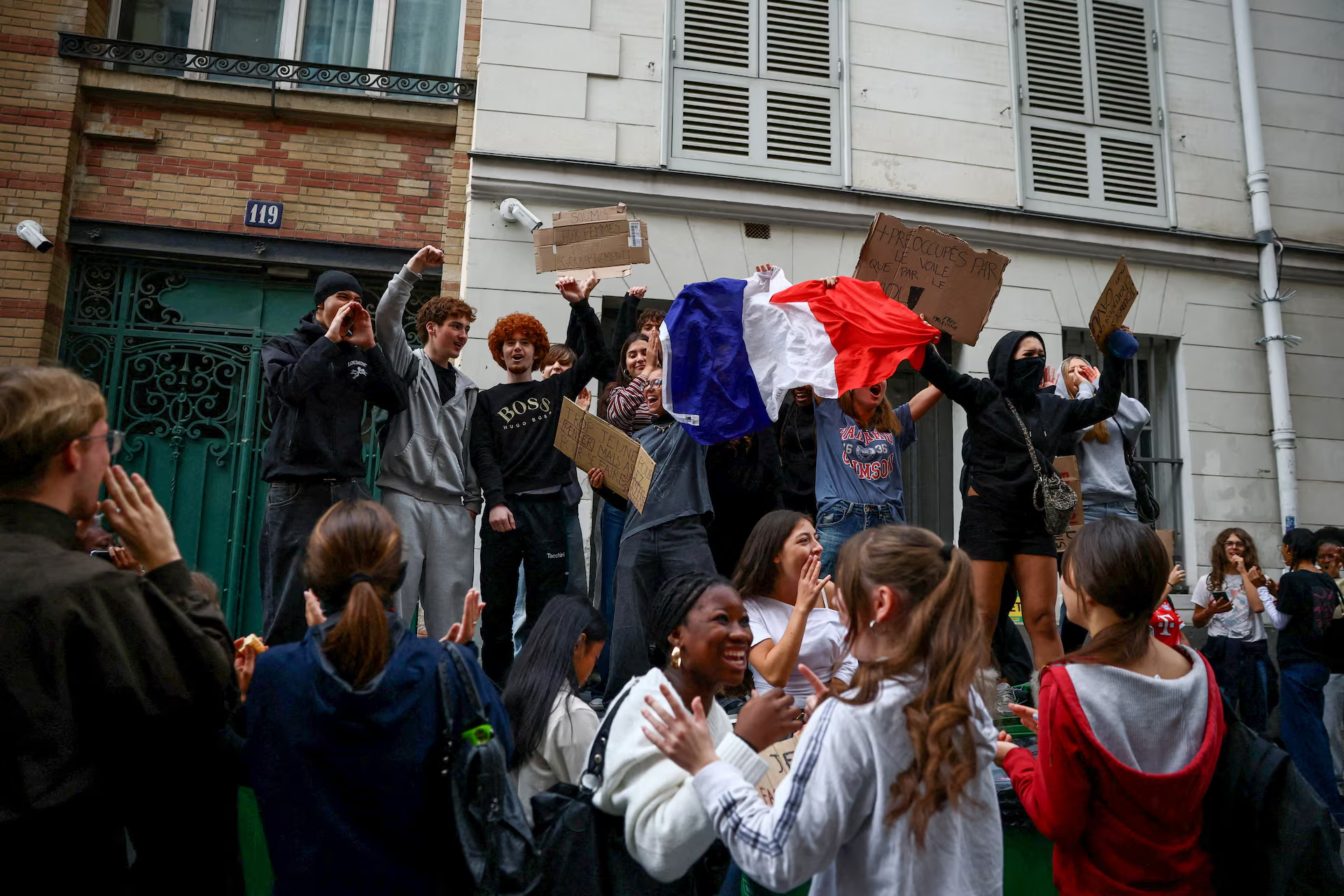
A momentous youth revolt has swept France over the last three weeks. Despite unprecedented police violence, it is gaining in intensity and has sparked tremendous solidarity and active support from wide layers of the working class. This is creating an explosive mix of collective anger, hope and enthusiasm that has the potential to become the driving force of something much larger.
Mountains of accumulated anger, fury, hurt and humiliation stemming from systemic racism and massive inequality fuel this phenomenal revolt against the brutality of the status quo, which the students are no longer willing to accept. Similar to Gen Z revolts in other countries, they demand their right to a future worth living. A right that the French state and ruling class are not willing to grant them.
Instead, students in most public schools, particularly in economically deprived suburbs, are forced to deal with dilapidated buildings (collapsing ceiling panels, buckets catching rain leaks, broken toilets, broken heating and cooling systems, meaning unbearable heat in the summer and jackets in the winter); rats and cockroaches (!); severe lack of teachers and other school staff (overcrowded classes with up to 36 students, some lose a full year of lessons in central courses); extremely long school hours from 8am to 6pm and the hated Parcoursup system to compete for spots in higher education. The government has tried to divert attention and sow division with racist measures – such as the ban on the abaya in 2023 – and symbolic measures like this year’s ban on phones and other smart devices in schools, while further cutting teacher positions and worsening school conditions.
All this comes in addition to other racist measures like the “license to kill” draft law, passed by the National Assembly in July. On 19 and 20 September, tens of thousands marched against this law proposal, which “would mean that officers who killed someone in a shooting incident would be presumed to have acted within the limits of the law, unless there was proof to the contrary.” Students also oppose the newly introduced racist “Bienvenue en France” (Welcome in France) plan, which enforces higher study fees for non-EU citizens.
The spark that finally lit the fuse was a solidarity action by students of the Antoine de Saint-Exupéry secondary school in the banlieue of Créteil (an economically deprived suburb of Paris). On 17 September, they supported their teachers and school staff on strike against a lack of staff and poor school conditions by blocking their secondary school. From there, school blockades and protests spread across Île-de-France (Paris region) and from there across continental France. Since the beginning of September, before the movement kicked off in continental France, school students, teachers and parents have been fighting for better conditions in the education sector in some of the still colonised territories of France. Depending on the region, actions ranging from protests to school blockades and strikes have taken place in Antilles, Guyane, Réunion, and Mayotte – where the Lycée du Nord has been blockaded for five weeks.
Videos of massive police brutality, teachers and education assistants going on strike in solidarity – and forming the first row in blockades to protect their students – went viral. As well as teachers, education assistants and parents, the left-wing party France Unbowed (LFI) and the revolutionary left have also supported the students from the start. They were soon joined by firefighters, railroad workers and others in the streets, often marching in the first row to protect the students, and solidarity calls from the CGT Education Union and other unions started pouring in. In turn, student blocs joined and sometimes led the demonstrations of the national strike of teachers and public sector workers on 29 September, which brought 300,000 onto the streets in more than 170 protests across France.
The following weekend, France’s largest unions called on workers to support the students in the streets with solidarity strikes and protests on 6 October. The day became a phenomenal show of force and collective solidarity: 450,000 people joined across France, 1,800 secondary schools (around ⅔ of public secondary schools) and 90% of the universities were blocked. A video of Bally Bagayoko, LFI mayor of Saint-Denis (an economically deprived suburb of Paris), taking the first row to shield students from the brutal police, who in the end tear-gassed the students and the mayor anyway, went viral. In several cities, farmers followed the call from the left-wing Confédération paysanne (Farmers’ Confederation) “to join the high school students’ blockades by tractor this Tuesday, October 6” and to “unite our anger”.
The French state’s mask slips again
The French state tried to quell the swelling youth revolt with brutal force. On 2 October, French interior minister Laurent Nunez said “there are no orders to exercise restraint, and no orders not to use all the weapons available to the internal security forces”. By Friday 9 October, over 7,000 were arrested (>80% minors), more than 2,300 are being prosecuted (>80% minors) and more than 200 youths were injured. The most brutal examples include the police blowing the hand off of a 15-year-old by firing a stun grenade against him, blinding a 16-year-old in one eye with a rubber bullet, and breaking the jaw and shattering the teeth of a 14-year-old with a tear gas grenade. One police officer has been recorded electro-shocking a student against the jaw, who said “I’ve never felt pain like this before”. Moreover, at least two cases of sexual aggression by police have been recorded and complaints filed – in Metz against a 15-year-old girl and in Paris against a woman, both of whom protested in front of schools – and a military-style police SUV charged into a demonstration, hitting and injuring a 14-year-old girl.
This police violence is more extreme than anything seen in years, even decades, in France, and gives us a glimpse of what we can expect from the ongoing right-wing authoritarian turn of capitalism globally. This has also been seen in Germany and Britain, where we have mass arrests and brutal treatment meted out against the Palestine solidarity movement. Instead of ensuring that basic needs (right to an education, affordable housing, not dying in wars) are met and human rights respected (stopping a genocide, protection against oppression, right to asylum), Western governments increasingly resort to methods that resemble those of authoritarian states and dictatorships. The Iranian regime, of course, happily seized the opportunity to point out the hypocrisy of Western values and teach France a lesson in moralism; they summoned France’s ambassador in Tehran over the “violent treatment” of student protests.
Neither carrot nor stick
Neither the police violence nor the school lockouts managed to break the revolt; they only fueled its flames. Protests, blockades and general assemblies at secondary schools and universities have continued throughout last week. On Thursday, 8 October, over 130,000 demonstrated across France according to the CGT. In Le Havre, students joined the strike of oil refinery workers at TotalEnergies. In Paris, there were student blockades, spontaneous demonstrations across the city and a huge crowd of youth, workers and oppressed people meeting in a collective march to retake the revolutionary Place de la Bastille. Gathered around the foot of the column honouring the 1830 Revolution, they withstood police violence – one police officer was filmed knee striking a protester in the face – and forced them to retreat in some cases.
The Government has also been forced to make concessions. It suddenly promised 3,000 extra teachers and banned the use of stun grenades. Failing to break the movement, they now hope to calm it. But so far, neither the carrot nor the stick seem to work. Students are denouncing the weak offers for dialogue, hypocritical statements against police violence and vague promises for improvements as what they are: tactics to break the dynamic and gain time. “As long as we do not have €10 billion on the table, we will continue our action,” said Sabrine Kharbach of the Union Étudiante (Student Union), who demands 10 Emergency Measures, which are supported by the school Students’ Union, UNEF, FAGE, and Solidaires étudiant.e.s:
- An Emergency Plan to Renovate Schools and Universities
- Large-scale hiring of education, health care, support, and guidance staff
- Rethinking School and University Schedules
- End the admissions process through Parcoursup and Mon Master. Create 250,000 spots in higher education.
- Overhaul of school democracy to truly enable school students to participate in decision-making
- Increase scholarship amounts and restore and increase housing assistance payments (APL) for everyone
- Effectively ensure that all students have access to a 1-euro meal
- Repeal the “Bienvenue en France” plan, which establishes differential tuition fees for international students, and eliminate the CVEC
- CROUS [public, government-subsidized university residences] Rent Freeze, Ensuring the Long-Term Sustainability of Rent Controls, and Large-Scale Renovation and Construction of CROUS Housing
- End the crackdown and police violence against the high school and college student movement
But the demands of the young people go way beyond education. They reject militarisation and demand welfare instead of warfare. They denounce the racist headscarf ban for girls at French schools and stand in solidarity with Palestine. With political rap performances, dance and aura battles they infuse the movement with a joyful militant atmosphere. This has been beautifully captured in a video showing hundreds of students singing the working class song “Emmenez-moi“ of Charles Aznavour ” – popular during 1968 – while waving Palestine flags.
Young people are pushing the entire working class forward
Structural racism and inequality were also at the heart of the youth revolt following the racist police murder of young Nahel in Nanterre (economically deprived suburb of Paris) in 2023. Back then, the state quelled the movement through police violence, state repression and a rightwing victim-blaming media campaign that turned the narrative from the legitimate anger against racist police and state violence to the rioting elements within the revolt.
The Government has tried to use the same playbook again, but has been failing so far. Why? More anger has accumulated; LFI and trade unions have been way quicker this time to actively support the students, and the international Palestine movement and the struggle against the pension reform in France have increased people’s politicisation and anger against the brutality of the system. And of course, the fantastic solidarity between students and workers, which has been motivated by the extreme courage of students fighting for their rights despite the brutal police violence, has been indispensable. Surveys show 72% support the demands and 54% support the movement as a whole.
While the trade unions have supported the movement so far, the announcement by the Interprofessional Union Coalition (CFDT, CGT, FO, UNSA and FSU) for a new national day of strikes for higher pay, public services and jobs on 5 November – a follow-up of 29 September – on the day before the massive mobilisation of 6 October, can be seen as an attempt by the trade union bureaucracy to de-emphasise the youth mobilisations taking place before and regain control.
However, at the moment, the anger and dynamism of the youth mobilisations are still pushing things ahead. “If nothing changes, we’ll keep going for much longer. On 17 October, there will be a big demonstration, with high schoolers, students and farmers. So it’ll be a bit like a new revolution.” (Rose, 16, high school student, quoted in Al Jazeera). And in the meantime, the high school and university student general assemblies have launched a call for Tuesday 13 October, to march on Matignon (official residence of the French Prime Minister), which the militant CGT and Union syndicale Solidaires trade unions and several others are supporting by calling for another day of strikes. Young people are pushing the entire working class forward, increasing the pressure.
In addition to the very real and important support unions and the LFI are already showing, they have the capacity and responsibility to help the movement reach a qualitatively new level. They have the resources, organisational structures and connections across all sectors of the economy to set up workplace assemblies, invite student representatives and facilitate the collective grassroots planning by young people and workers for the next steps of the struggle.
“Let’s do it as in France”
The youth revolt in France is a real step forward in the united class struggle driven by its youngest and most oppressed layers. On 4 October, RED Jeunes announced the creation of a secondary school students union for young people from the banlieues. Soumaya Sarré (spokesperson of RED Jeunes) said: “We want to be represented by people like us, and we don’t want anyone speaking on our behalf!”
The struggle inspires and gives so much hope to millions across the globe, expressed through international solidarity and calls to follow the French example. Students in France are also aware of the catalytic potential of their movement; several appeals for German students to intensify their school strikes have gained wide traction on social media.
In Germany and Austria, there have been solidarity rallies organised by left-wing groups. The campaign and school strike against the hijab ban at Austrian schools for girls under 14 years sent solidarity messages to France, and so did the school strike against conscription movement in Germany, with some students also going to France to support the struggle. And on 12 October, students of a French school in Berlin started to block their school with hundreds of students; police reacted violently. In Italy, students in Turin and Rome have occupied schools under the slogan “Faisons comme en France” (“Let’s do it as in France”) and sent solidarity from an action in Genoa together with dockworkers. In Greece, students have called school actions for similar reasons as in France across the country (from assemblies to walkouts, demonstrations and maybe occupations), in one demonstration, students carried a banner “Victory for the fight of the students in France”.
And most impressively, the revolt has organically spread to the French-speaking part of Belgium. Since 1 October, school students have been protesting against bad conditions and budget cuts in the education sector in Liège. They used militant tactics, including barricades and spontaneous demonstrations and were also met with very heavy police repression. Afraid of the revolt, the social democratic mayor of Liège announced a ban on assemblies of more than three people lasting from 8-16 October. Mobilisations by school students also took place in Brussels, Mons and Charleroi, and the energy of the student revolt has amplified the struggle against the right-wing Arizona government, as expressed during the national day of action on 9 October called by the socialist and Christian trade unions.
We can already see the electrifying effect that the courage of students in France has on struggles in other European countries. As well as the examples above, students are also taking up this energy to mobilise for the international youth strike on 20 November. Under the slogan “Fight for our future, not their wars”, actions have already been announced in Spain, Portugal, France, Italy, Switzerland, Britain, Slovenia, Austria, Germany, Belgium, Netherlands, Denmark and Sweden. And in Chile and India, there are also mass movements ongoing with young people fighting for better education and a right to a future, while in Spain, the two largest trade unions, UGT and CCOO, jointly declared a general strike – the first time in 14 years, since the 15-M movement – on 11 November, following the call by the movement against the housing crisis.
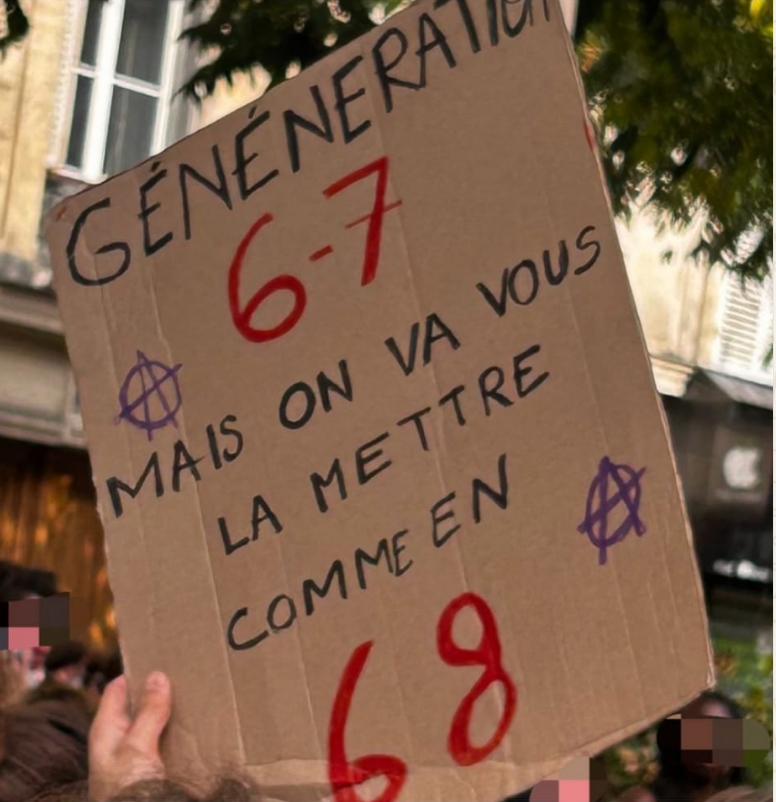
‘Generation 6-7, but we’re going to give it to you just like in ’68’
The French ruling class is becoming increasingly nervous. As Contre Attaque reported on 10 October, “elite schools, catholic universities, conservative strongholds, and engineering schools have joined the movement”, many have been blocked for the first time since 1968 or in their entire history. For example, a private elite catholic school has been blocked, with students chanting “cathos, pas fachos” (catholics not fascists) and “privilégiés mais solidaires” (privileged but in solidarity), and in front of the blocked elite law school Panthéon Assas, a bastion of the far-right, students sang the Internationale! “May ’68 – October 26” was written on several placards.
Fearing the movement and its effect on next year’s presidential elections (in the last survey, Mélenchon (LFI) received over 20% and was shown to qualify for the 2nd round against Le Pen (Rassemblement National, far-right) in all scenarios, and LFI election campaign rallies already draw tens of thousands of supporters), the ruling class is denouncing the youth as extreme-left barbarians, and the RN says LFI wants civil war. To discredit the movement, the right-wing media also invite far-right and neo-fascist youth to talk shows, presenting them as regular students.
The last resort tactic is, of course, blaming it on “Islamisation”. Trump said, “this isn’t about schools, this is about Islam wanting to take over a once great Country!” Similarly, Le Point blames “islamists” to amplify the movement, and the NZZ (Neue Zürcher Zeitung, “New Newspaper of Zurich”) had an article titled “How the far left and terrorist sympathizers are infiltrating the student protests in France”. 100 years ago, there was the myth of “Judeo-Bolshevism”, today, the ruling class use the trope of left-Islamists (in France, islamo-gauchistes) to whip up hate and fear and scapegoat Muslim people for the horrors of capitalism. But they should be afraid. France shows that the collective struggle of young and oppressed people pushing forward the entire working class can change the world.