A statement from Solidarity
The notification of an Orange Order parade along the Garvaghy Road in Portadown, following the recent High Court decision overruling the Parades Commission’s ban on the route, has re-opened painful wounds and left residents fearful of what comes next. We send our solidarity to the residents of the Garvaghy Road, who have a right not to be subjected to sectarian bullying and retraumatisation. This is an attempt to force a parade onto a community that has no wish for it. Residents should not have to accept this.
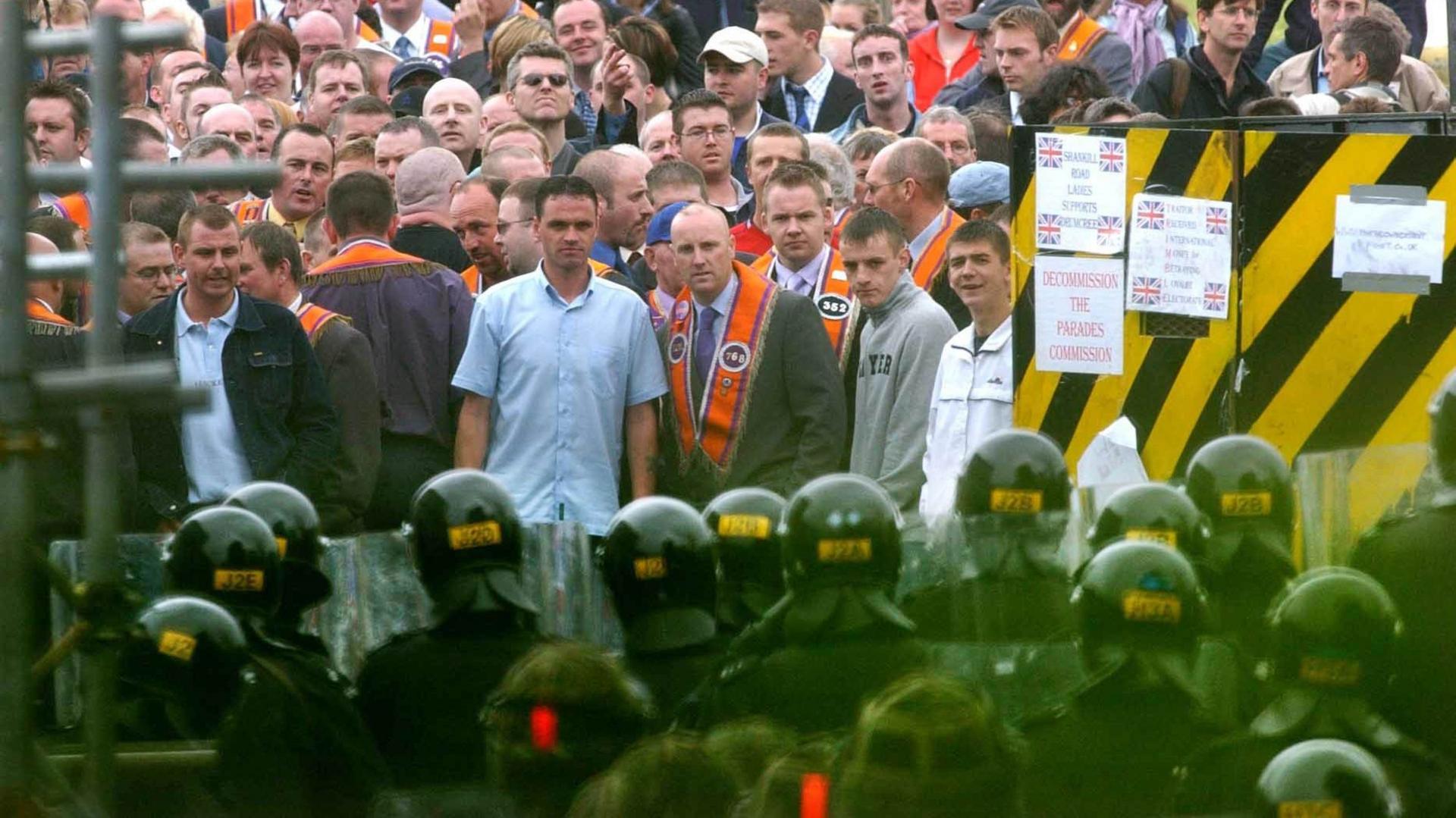
Drumcree stand-off: darkest chapter of 1990s
The Drumcree crisis entered its most violent phase in 1995, and spilled over into broader sectarian conflict across the North, ending with the UVF murder of three Catholic children, Jason, Mark and Richard Quinn (aged 9–11) in Ballymoney in 1998. For many Garvaghy Road residents, memories of violent standoffs, rioting, and assaults against residents by the RUC and British Army to force Orange Order parades through the area are still very much alive. Many lived through the events. Others suffer the very tangible effects of inter-generational trauma. The sectarian forces who are hell-bent on whipping up division pose a threat to the whole local community; who they would happily drag everyone back into conflict. This is a residential area, and local residents have overwhelmingly objected to this parade being forced on their community, with nearly 4,000 people signing a petition in opposition.
Orange Order parades, particularly through areas where they are not welcome, remind many people from a Catholic background of the Unionist state and all that entailed. To be clear: the Orange Order is a sectarian, sexist and LGBTQIA+phobic institution. Its foundational identity is one of Protestant supremacism and throughout its history it has been integral to violent anti-catholic pogroms. The ‘old-boys club’ (women are not allowed to join the Orange Order) facilitated the locking out of Catholics from jobs and ensured the discriminatory practices of the Unionist state were cemented. The Orange Order, like many institutions in Northern society as a result of Feminist movements like MeToo, has also had a light shone on how widespread and pervasive the issue of misogyny and abuse is within its ranks.
Smoke and mirrors of Unionist establishment
Political representatives across all major Unionist parties have jumped on the question of Drumcree. They are purposely whipping up tensions in an attempt to shore up their own political positions ahead in the context of an upcoming Assembly election. DUP MP Carla Lockhart, who has placed herself at the centre of this issue, has said: “This issue will only be finally resolved around the table, with goodwill on all sides. There is a pathway to achieving that objective, building on recent positive cross-cultural events. This involves proportionately balancing the rights of all citizens, within the correct legal framework, rather than the rights of any one community subjugating the other.”
This is nothing more than a pantomime. The Unionist coalition have tried to frame the Orange Order’s scaling back of the march as evidence of their reasonableness, but in reality they are trying to impose a march on Garvaghy Road residents against their will. Rather than first reaching an agreement with residents, the Orange Order submitted a fresh application to the Parades Commission for a parade on 27 September, well before the traditional marching season, seeking a determination that would allow it to proceed.
If the Unionist establishment were in any way serious about resolving the dispute around the table (which to be clear, they’re not), then their efforts would be concentrated on genuine reconciliation and mediation with residents. If our society is to move forward and heal from the past, that means there must be recognition of the harm caused by the perpetrators and sincere apologies made. In this case, the Portadown Orange Lodge should be apologising to the Garvaghy Road residents for their role in the violence of the 1990’s and for trying to impose a march on residents; trampling over their right to reject it as if the only question in discussion is how many marchers, bands or drums should be permitted. You cannot call for dialogue while treating dialogue as optional.
The sectarian double standards of the Orange Order and Unionism’s approach here is glaring. Earlier this year the Orange Order objected to dual language signage in the Drumcree/Garvaghy Road area on the grounds that the Irish language is supposedly “provocative” and “divisive”, despite the majority of local residents saying they wanted them. Representatives of the Unionist establishment now hypocritically wish to present themselves as defenders of the “rights” of all citizens to cultural expression, but in reality they are attempting to impose their will on the local residents from above.
Zero-sum logic of sectarianism
The majority of society, including people from both Catholic and Protestant backgrounds, regardless if they are supportive of a parade happening or not, do not want to see a return to the violence of the past and outright sectarian conflict. Tensions and division are being purposely whipped up by Unionism in an attempt to go on the offensive. The re-opening of the Garvaghy Road case is clearly a spearhead for Unionism to challenge other previously-thought settled parading routes. Behind this is the desire to roll-back the supposed “victories” of Nationalism and begin to re-establish political Unionism as a fighting force that can beat back Nationalism in the eyes of their voter base.
This is the “zero-sum” logic of sectarian politics, which only points in the direction of conflict. In practice this means that contentious issues such as flags, parades, and dealing with sectarian atrocities committed in the past are continuous sectarian flashpoints, leading to tensions and often erupting in violence. Each time, the sectarian temperature is raised, and nothing is resolved.
The current situation also exposes the fundamental limitations of the Parades Commission. Rather than a body of democratically elected community representatives, it is made up of members appointed by the British Secretary of State for Northern Ireland, who are also paid incredibly high wages. As a product of the Good Friday Agreement, it exists within a context of institutionalised sectarianism. Inevitably, it is only capable of imposing rulings that are favourable to one “side” or the other, reinforcing division and leaving the underlying issues unresolved. We do not believe that a state based fundamentally on sectarian division is capable of dealing with these issues in any meaningful way.
Working-class people in the driving seat can be a real force for change
Often contentious issues such as parades are seen as ‘problems without a solution’. Where one ‘side’ must win and the other must lose. In truth, working-class people have a tremendous capacity to find meaningful resolutions that deliver lasting peace and mutual respect for all cultural traditions. In Dromore, in 1997, concurrent to the violence at Drumcree, a meeting was convened on 6 March 1997 by the local Church of Ireland rector, Rev Don Gamble, and Catholic parish priest, Fr Thomas Breen. It brought together local Orangemen, Catholic residents, local community figures and representatives from both the SDLP and Sinn Féin. There, agreement was reached. The local Orange Lodge did not attempt to railroad a decision onto residents, instead there was meaningful dialogue and discussion that resulted in a lasting agreement that satisfied both communities.
The same is possible along the Garvaghy Road. Breandán Mac Cionnaith, the Garvaghy Roads Resident Coalition’s spokesman, stated that in the 1990s they offered the Orange Order a chance to walk down Garvaghy Road if 32 Catholic children in GAA county colours could walk with them. In the 90’s the Orange Order rejected the offer, refusing to negotiate with Breandán Mac Cionnaith because of his conviction for bombing a Royal British Legion community centre in Portadown. Despite this, he said they would be prepared to bring forward the same proposal today.
Sinn Féin have from the start pushed for a “no-negotiation” approach. This is ultimately disempowering and acts as a block on local working-class people’s ability to find paths to ease tensions. Neither Sinn Féin nor Unionist politicians should determine the community’s position for it; residents themselves should decide whether and on what basis they negotiate. We believe that if working-class people are given the space to discuss and find solutions to contentious issues, we have the ability to overcome sectarian division and build a powerful class unity.
A society without sectarianism and division
The celebration of the 12th of July and marching culture holds significance for many people from a Protestant background. To simply dismiss that will drive many people into the hands of the Unionist establishment. For this reason, in general, we are in favour of mediation led by ordinary working-class people to find genuine solutions. We are confident that ordinary people from across the sectarian divide are capable of coming together to build a better and radically different society, overcoming and resolving tensions in the process of finding a way forward. Our history is filled with such examples, but even more recent ones like the attendance at the Fleadh Cheoil na hÉireann of the Shankill Defenders and other orange marching bands show the possibility for cultural acceptance and a shared celebration is there, when consensually agreed.
We believe that an alternative to the dysfunctional sectarian status quo must urgently be built. It is in that vein that we campaign alongside other socialist, feminist and anti-racist activists to build movements against all the issues that working-class people face in our day to day lives; whether that’s the cost of living or housing crises, the gutting of our public services, femicide and gender violence, or the rise of racism and the far-right. Such movements can be the basis for bringing all working class people together to fight in our own interests, which would be capable of breaking people from the pro-capitalist politicians of Green and Orange, who ultimately serve the interests of big business and landlords and have very little to offer ordinary people.