By Conor Keary
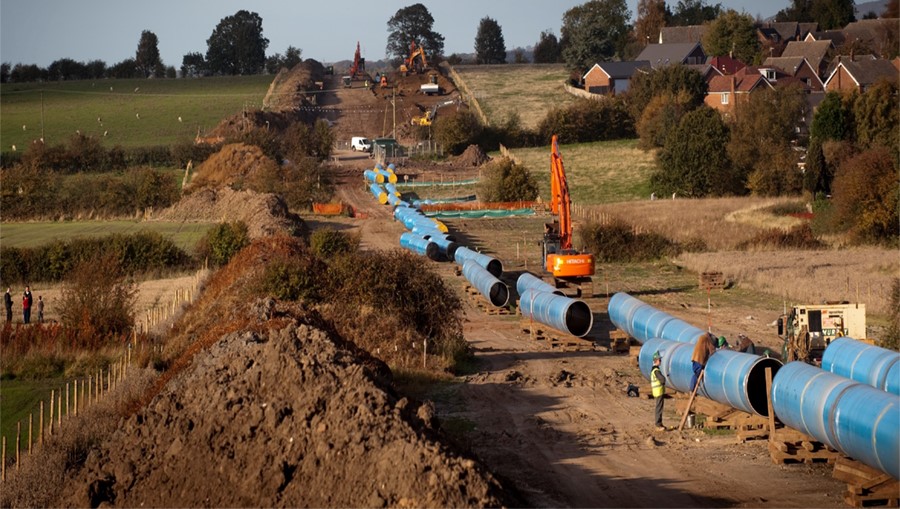
Ruthless extraction of raw materials is one of the defining features of capitalist accumulation. As industry grows, so too must exploitation of the Earth’s natural resources, often with little regard for the consequences. As the great socialist Rosa Luxemburg put it, “capital, impelled to appropriate productive forces for purposes of exploitation, ransacks the whole world…” Such an extractive project is planned by Uisce Éireann, the commercial semi-state body responsible for water utilities in the south of Ireland. This project is officially known as the “Water Supply Project, Eastern and Midlands Region”, but is more commonly referred to as the River Shannon Pipeline, a name which correctly emphasises the resource being taken, rather than the destination it is intended for.
Uisce Éireann plans to abstract (the removal of water from its source) 300 megalitres (ML) of water per day from the River Shannon at the Parteen Basin, an artificial weir built in 1929 to facilitate the Ardnacrusha turbines, and pipe it to a new reservoir at Peamount, west of Dublin. The project will cost at least €10.4 billion with the Greater Dublin Area of Dublin, Meath, Kildare and Wicklow being the primary intended beneficiary. There will be takeoff points along the route in Tipperary, Offaly and Westmeath, while water currently used by Dublin will be redirected to Carlow and Louth. The project has been met with fierce resistance from locals due to the harmful impact it will have on the environment, while their concerns have been met with stonewalling and flimsy arguments from Uisce Éireann.
Ecological issues
There are numerous ecological issues associated with the pipeline, which in their totality amount to a human-made disaster waiting to happen. The problems begin with the discrepancy between the abstraction rate (volume of water piped) promoted by Uisce Éireann and the more realistic rate put forward by activists from the River Shannon Protection Alliance (RSPA). Uisce Éireann claims that the rate will equal 2% of the river’s “average flow”. This percentage is not a relative figure; it is a fixed figure based on Uisce Éireann’s estimates of how many cumecs (a unit of water flow) are currently flowing down the Shannon. Uisce Éireann have not sufficiently elaborated on how they arrived at this estimate nor have they revealed what their estimate actually is. Instead, they rely on the vague wording of “average flow” and insist that the flow is substantial enough to allow for safe abstraction.
The available evidence, however, says otherwise. Data from the Environmental Protection Agency (EPA) reports that the flow of the River Shannon is 12.53 cumecs during drought conditions. Precisely the kind of drought conditions which prevailed in the country during the historically hot summer of 2026. If Uisce Éireann were to abstract its intended 3.82 cumecs during the weather the country experienced in July, it would actually amount to 30% of the flow. This would be a staggering depletion of the natural environment which local wildlife requires to survive. Uisce Éireann claims that it will only abstract a maximum of 300 ML during extreme conditions such as drought, but it is during these conditions that abstraction will cause the most harm. Furthermore, research by Drs Claire Bergin and Peter Thorne of Maynooth University indicates that temperatures of 28°C+ can be expected to occur every three years sometime during this century. When the damage is surveyed, it will likely be too late to course correct, as local populations will have become dependent on the pipeline for their source of water.
One can only begin to assess the harmful effects this project will have on the native habitats of the River Shannon. The Parteen Basin sits within the Shannon’s Special Area of Conservation (SAC), which is home to fish such as the Atlantic salmon, brown trout, sea lamprey and European eel. When Ardnacrusha opened in 1929, its effect on these fish populations was devastating. Salmon travelling up the artificial canal to spawn found the way blocked by the power station, while newly spawned Salmon travelling down the same way were atomised by the turbines. A fish pass installed in 1959 failed to stop declining salmon populations. In 1964, the number of fish using the pass was recorded as 12,000 and by 2024 it had fallen to just 123.
The Shannon Connectivity Project aims to renovate the existing fish pass and possibly add a new one; however, the effectiveness of these passes will be severely undermined once 300 ML of water is abstracted daily from the river. The River Shannon Pipeline will therefore be an enormous impediment to any existing or future conservation projects. And it is not just species of fish that are threatened by the pipeline. Water birds that winter on the lower Shannon such as the Light-bellied Brent Goose, the Dunlin, the Black-tailed Godwit and the Redshank are already on the endangered species list and are now faced with the potential destruction of their wetland habitat. Ardnacrusha delivered a crippling blow to River Shannon wildlife and the blow struck by the pipeline could be fatal.
Data centres and AI
One would ask why such a large quantity of water must be so recklessly abstracted. One potential answer is given by the explosion of AI and data centres in the last five years. According to the consultancy firm Bitpower, there are 107 operational data centres in this state, with the vast majority of these located in Dublin. There are a further 43 data centres which have been granted planning permission, and 29 in some stage of the planning process. A number of these new data centres are planned for Offaly, Meath, Westmeath, Kildare, Wicklow and Louth, which are precisely the counties that will be served by the pipeline. Meath is already home to Meta’s huge Clonee data centre campus.
Data centres require enormous amounts of water for cooling, yet Uisce Éireann have remained obfuscatory with regard to the percentage of water being used for this purpose. A government report in July 2022 claimed that 0.13% of drinking water was going towards data centres, which was based on data collected in 2021. In 2026, a spokesperson said that 0.3% was being used by data centres, a figure which was not accompanied by any new data. The 2021 data was collected before the AI gold rush, when there were only 70 operational data centres in the country. AI data centres run at particularly high temperatures and therefore require water-based cooling systems, unlike other types of data centres which can use air cooling. Additionally, when the temperature outside climbs above 25°C, data centres typically require peak cooling in the form of water vapour. As mentioned previously, Ireland recently experienced two and a half weeks of 25°C+ weather, which is a symptom of the climate change that data centres are actively contributing towards.
The 2021 figure couldn’t have been correct in any event as Meta reported that 928 million litres (ML) of water was used for its campus in Clonee, which was greater than the 810 ML figure Uisce Éireann claimed for the entire country. As reported by The Journal, which investigated data supplied by the EPA, 999 ML were used by data centres in 2025, the majority of which can be attributed to just two campuses: Clonee and the Equinix campus in Dublin. Only data centres which pass certain thresholds are required to submit an Annual Environment Report, meaning the actual figure must have been higher.
Uisce Éireann’s refusal to submit comprehensive data to back up any of its claims has been a recurring feature of the project since it was first announced ten years ago. Information cannot be gathered via FOI requests as its status as a commercial semi-state renders it immune. On July 29th, Uisce Éireann held a community engagement clinic in Castleconnell, Co. Limerick, which was attended by a Solidarity activist. The Community Liaison Officer sent by the company repeatedly downplayed the concerns of those present while alluding to figures that they did not have with them. The choice to have the clinic from 5-7 pm on a Wednesday drew criticism as this made it difficult for working families to attend. Interestingly, the next ten community engagement clinics are all planned for Wednesdays at 12-2 pm and 5-7 pm.
The water supply crisis has also occurred because successive Irish governments have allowed overinvestment to occur in Dublin to the detriment of the rest of the country, illustrating the chaos and destructive nature of capitalist development that it stands for. At present, the eastern and midland region contains nearly half of Ireland’s population and is reliant on the Liffey for water. The region is also growing at a rate that is 2% faster than the north, south and west. With such a high concentration of people in one area, utilities were bound to become strained. This does not mean, however, that the River Shannon Pipeline is a good solution. Parts of Dublin’s underground water mains date from the Victorian Era which leak at a rate 14% higher than the EU average. These leaks needed to be fixed years ago and doing so would be orders of magnitude less expensive than the Shannon Pipeline. Uisce Éireann could also diversify the rivers in the east that it abstracts water from, rather than putting the strain on one ecosystem. Groundwater sources are another potential solution that Uisce Éireann has dismissed without sufficient explanation.
The most environmentally friendly solution would of course be for people to move to where the water is, rather than moving the water to them. But to encourage population redistribution would clash with the government’s eternal priority of obtaining foreign direct investment for the eastern and midland region. The River Shannon Pipeline is what George Monbiot describes as a “technofix”: A quick technical solution to a problem that is cultural, political and technical. Technofixes will never solve problems like climate change, as they exist to maintain business as usual for as long as possible while catastrophe erupts in the background.
We must therefore demand more. Uisce Éireann was rammed through by the Fine Gael/Labour government in 2013 at the behest of the Troika, in order to make working-class people pay for the gambling debts of the rich. The privatisation of water and implementation of water charges did not occur owing to mass working class resistance from below in 2014-2015, but Uisce Éireann continues to be a disaster that faces little to no accountability for its decisions. Why does it continue to exist long after its original purpose has been eliminated? Uisce Éireann should be dissolved, and its River Shannon scheme scrapped, while authority for water utilities should be returned to the local councils.
The River Shannon Scheme fiasco calls into question the entire, utterly unsustainable model of development pursued by the state and capitalist class in Ireland, which makes every possible effort to court a small number of massive tech companies while underfunding so many essential services, including water. This is a model of development which puts the super-profits of companies like Apple and Meta ahead of the wellbeing of ordinary people. What is needed is a complete moratorium on data centres. Currently existing data centres should be reviewed and the number of data centres in operation reduced. We need housing, but this should be done on the basis of sustainably building public and affordable housing in every part of the country. Crucially, we need a socialist alternative which breaks with the destructive rule of capitalism where private profit will always be given priority over our needs and those of our ecosystem.
Sources:
2.https://ccriverassoc.org/shannon-connectivity-project
5.https://salmonwatchireland.ie/wp-content/uploads/2026/05/MKO-Shannon-Abstraction.pdf
6.https://clarechampion.ie/drought-a-risk-on-lough-derg
7.https://www.thejournal.ie/investigates-data-centre-water-use-7110966-Jul2026
8.https://www.thejournal.ie/how-much-water-do-irish-data-centres-use-7101544-Jul2026
11.https://www.dublininquirer.com/does-irish-water-even-know-how-much-water-data-centres-are-using
12.https://www.rte.ie/brainstorm/2025/0806/1527161-july-2025-mini-heatwave-rapid-climate-attribution-study
13.https://www.documentcloud.org/documents/28302051-meta-2025-environmental-data-index/?ref=dublininquirer.com&q=water&mode=document#document/p9
14.https://www.water.ie/news/public-are-asked-continue-be-mindful-water-use-ahead-another-warm-weekend
15.https://www.eesi.org/articles/view/data-centers-and-water-consumption
16.https://www.bbc.com/news/articles/cm2gnvyj7m5o
19.https://www.cso.ie/en/releasesandpublications/ep/p-fdi/foreigndirectinvestmentinireland2023/keyfindings