Reviewed by Chris Stewart
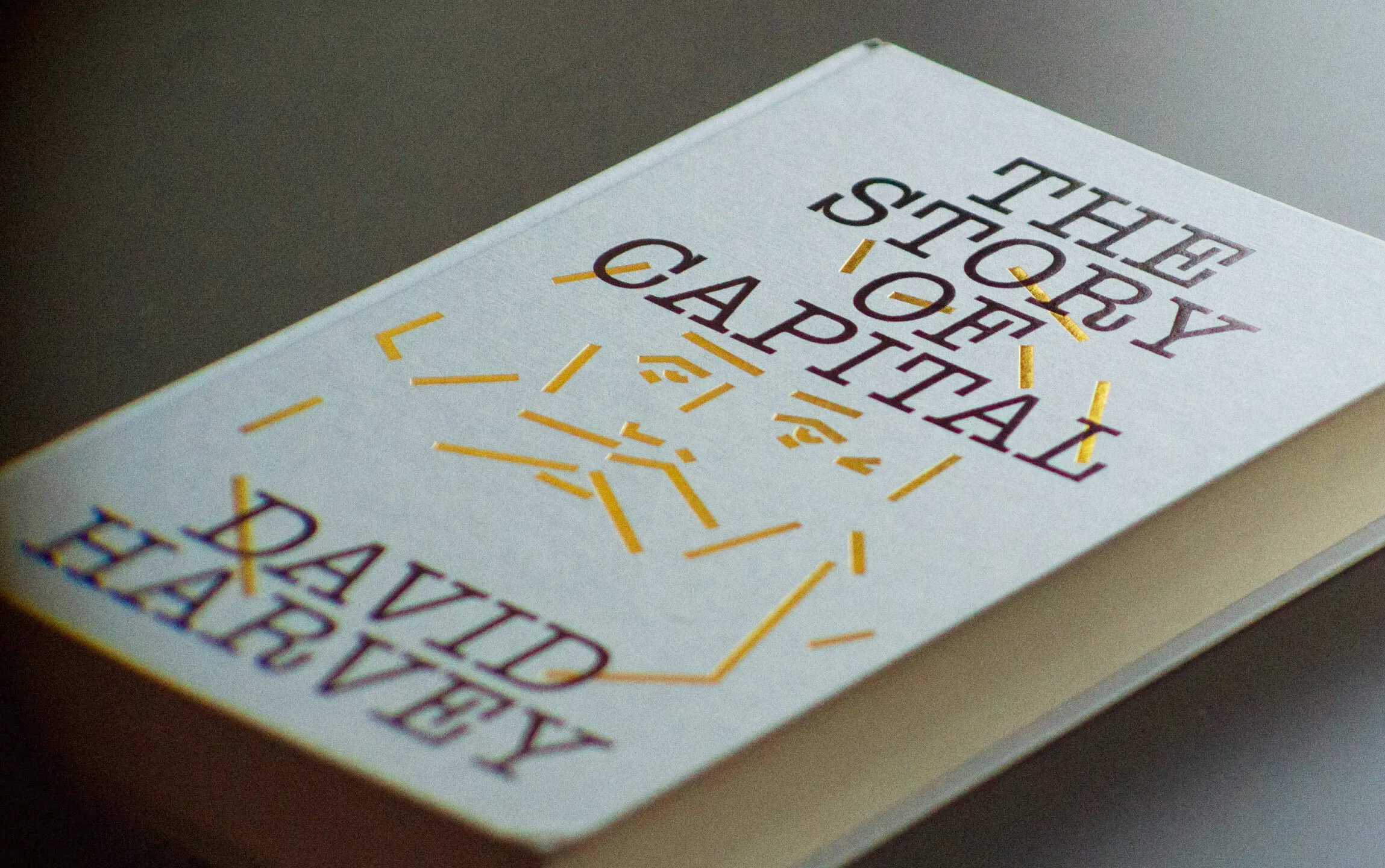
Influential Marxist geographer and economic theorist, Professor David Harvey, has helped millions of people gain an understanding of how capitalism works through his many books and online lectures. In The Story of Capital, Harvey sets out to elucidate the central ideas of Marx’s Capital, explaining how they relate to what he calls the “capitalist totality” today.
Harvey notes that Marx’s goal in Capital was to analyse the “inner structure” of capitalism’s mode of production, in order to help working-class people understand the “laws of motion” of the system that exploits us. His analysis of commodity production in Capital, Volume I was primarily based on industrialism in 19th-century Manchester, where he saw first-hand the reality of labour exploitation in factories and workshops linked to the rising global markets of capitalism. It was this that allowed Marx to uncover the “secret” of capitalist production: that the source of the capitalists’ profits lie in the surplus value created by workers.
Today this fact is visible in the exploitation of workers all over the world; from garment workers labouring in sweatshop conditions in Southeast Asia, to Amazon fulfillment centres using surveillance tech to squeeze value out of every millisecond of the working-day. As Harvey points out, much of the basis of capitalist growth over the preceding decades of neoliberalism has come from the reduction of the share of wealth going to the working class (the two biggest capitalist economies, the US and China, are leading in this regard).
But the “inner structure” of labour exploitation at the heart of capitalism exists within a “broader field of material and social relations” that go beyond just the sphere of production. For one, there is the “metabolic” relationship between human beings and the earth, which under capitalism is defined by extraction, extinction and ecological collapse. There is also the daily and generational unpaid labour in the home and beyond, done primarily by women, which is necessary to reproduce, educate, and sustain workers so that they can continue to produce surplus value for capitalists. As Harvey puts it, capital exists within and moves through a complex “social formation” across metropolitan, national, and global scales.
Keeping track of all this is next to impossible; but Harvey helpfully depicts capital, which he defines as “value in motion”, through a map showing its constant flows through stages of circulation; from the production of value, to the sale of commodities on the market where that value is realised, and then its distribution throughout the social formation. He likens capital’s constant flow through changing forms to the earth’s hydrological cycle. However, in contrast to this “closed cycle”, the process of capital accumulation acts as a “spiral in constant expansion”. This is because capitalists are subject to the “coercive laws of competition” on the market, forced to search for ever greater profits at the risk of losing out to their competitors.
Capital constantly pushes to bring the “absolute mass” of human labour and natural resources into its orbit, commodifying every aspect of life from which value can be squeezed. The result has been a gargantuan increase in material throughput and pollution that is rapidly driving the earth’s eco-systems to extinction. As capital accumulates, this hunger for mass output only grows. In just two years between 2011 and 2013, China consumed 6.6 gigatons of cement, a major source of greenhouse gases. In comparison, the US consumed 4.5 gigatons over the last 100 years.
Capital’s expansion has, as Marx predicted, “chased the bourgeoisie over the whole surface of the globe”, creating geographies of inequality and imperialist exploitation, in which value is transferred from the working-class and poor masses of the world to the capitalist elites. Capitalism has fundamentally transformed life on earth; through transport and communications revolutions, urbanisation and the transformation of space, the proliferation of consumer goods that are central to modern life etc. Its growth has also brought an astonishing concentration and centralisation of wealth and power in the hands of a few. The Covid pandemic saw the most “dramatic surge” of wealth centralisation ever, as the total wealth of billionaires worldwide rose by $5 trillion to $13 trillion in just 12 months.
But this huge rising “mass” of profits presents capitalism with a problem. Capitalists are compelled to invest in cutting-edge machinery and technology (forms of “fixed capital”) to replace human labour and increase productivity. Today we are seeing this with the rise of AI, with Meta recently announcing 8,000 layoffs after having workers train their AI replacements. But the competitive advantage gained by an individual firm replacing human labour with technology is quickly erased as their competitors follow suit. So across the economy, the proportion of investment in fixed capital to labour must continuously rise. But because human labour-power is the ultimate source of profit, this creates a “tendency” for the rate of profit in proportion to investment to fall over time, even as the overall mass of profits rises.
In The Story of Capital Harvey contributes to debates between Marxists on how exactly this “double-edged law” relates to capitalist crises. Such debates are beyond the scope of this review, but regardless, the relevance of the law is clear. Today, production increasingly requires huge initial investments worth tens of billions of dollars in fixed capital such as robotics and AI systems. Profitable investment outlets are increasingly hard to find, and huge masses of capital sit dormant, or they flow into the financial sector (stocks, real estate, and debt) as “fictitious capital” where they can appropriate speculative wealth without contributing to the production of new value at all. Marx’s analysis of “interest-bearing capital” in Capital Volume III is the basis for numerous chapters about what Harvey calls the “malignant mutant masters” of the finance capital oligarchy today. Whereas in Marx’s day industrial capitalism was the most powerful “faction” of capital, today it is the monopoly power of finance and the monopsony power of merchant capital that dominate. Huge economic bubbles, financial crises, relentless privatisations, parasitical monopolies engaging in “rentierism”; it all signals a deep rot in the inner structure of a crisis-ridden global capitalism.
Harvey’s often meandering style and his penchant for convoluted academic concepts make The Story of Capital a challenging read in parts, especially for those who are new to these ideas. But his ability to explain the core concepts of Marxist political-economy, and to weave them through a wide-ranging analysis of life in the rotten capitalist “social formation” today, make it a worthwhile contribution that many readers will benefit from.