Reviewed by Conor Tormey
Over the course of nearly three years, there have been countless horrific images, videos, and accounts of death, destruction and devastation from the Gaza Strip. All of which expose the unimaginable cruelty of the Zionist state’s ongoing genocide of the Palestinian people. One of the most affecting glimpses into this nightmare is the story of Hind Rajab – a five year-old girl killed by Israeli forces on 29 January 2024. The horrifying recording of her call to the Palestinian Red Crescent Society, before and during her cold-blooded murder, is something no one who hears it will ever forget.
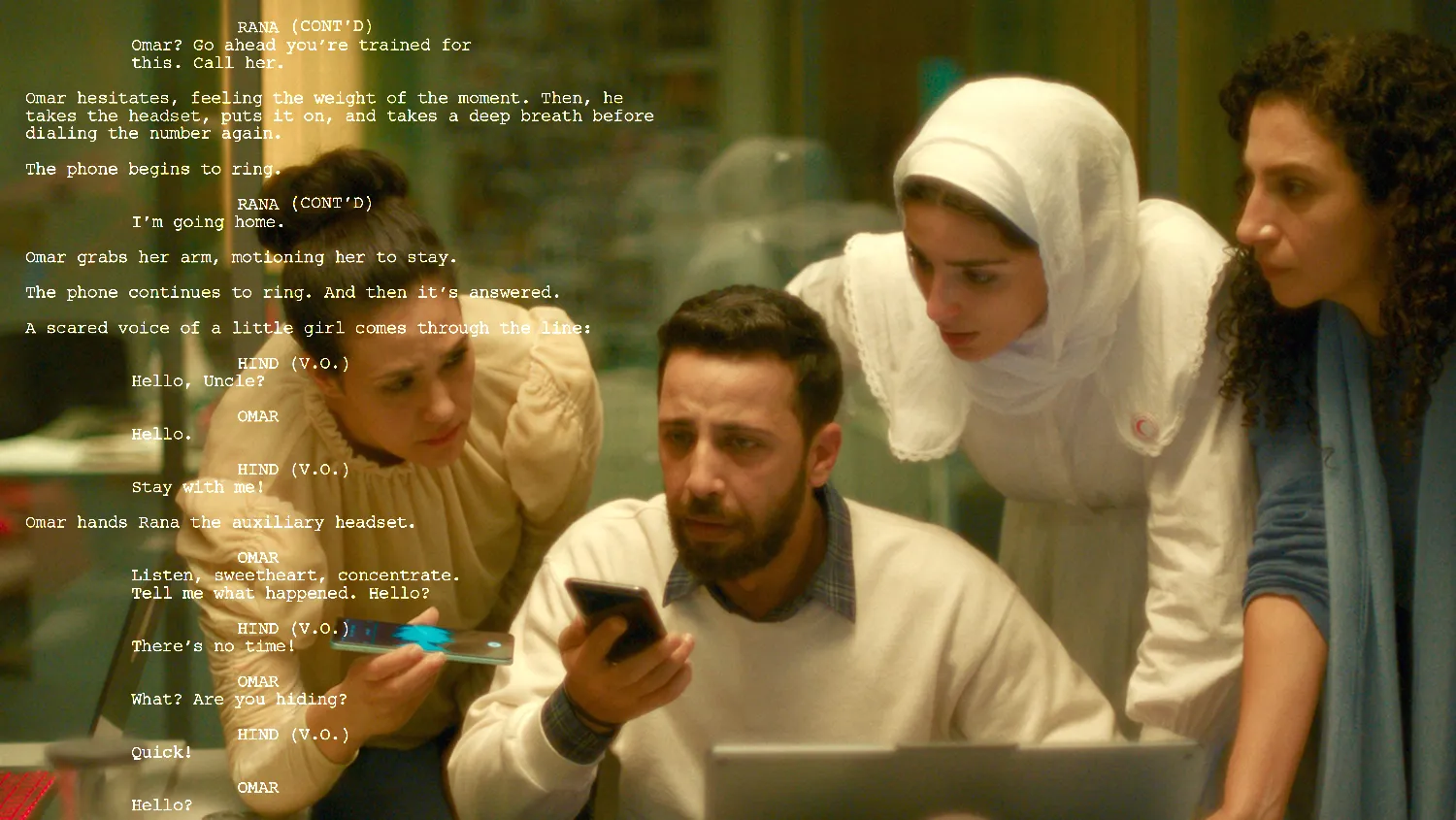
The events around this call have been recreated in The Voice of Hind Rajab. The film starts with the initial call from Hind’s 15-year-old cousin Layan Hamadeh. Hind and six other members of her family were fleeing from Tel-al-Hawa, as the Israeli forces were moving north towards Gaza City. The phone call from Layan came after the car was shot at by Israeli soldiers, killing her uncle Bashar, aunt Ana’am, and three of her cousins: Raghad, Sarah and Mohammad.
During the call the car was shot at again, killing Layan, leaving only Hind in the car alone and terrified. One of the many harrowing moments in the film was Hind saying that her family members were sleeping, and then saying a few minutes later “they’re dead, they’re all dead, there are only dead bodies, my whole family. She pleads for help: “You will come and take me?” Adding: “I’m so scared, please come.”
It’s absolutely crushing to hear the call. Hind, like so many other children in Gaza, should never have experienced such appallingly traumatic moments. Some of the other unbearable moments of the call also show just how young she was. She said that she had a happy childhood. She said she was in the “butterfly class” in pre-school. At one point she says: “What time is it? I’m afraid of the dark”.
The tension and trauma of the phone operators is central to the film. Omar, the phone operator who first spoke with Hind, and Mahdi, the manager, are often in conflict with each other. Omar, hearing the cries and pleas from Hind, desperately wants paramedics to get to her as soon as possible by any means necessary. Mahdi says that nothing can happen without the “green light”, otherwise paramedics risk being killed by Zionist forces: “because if we don’t… they could shoot at our ambulances and say it’s our fault” – a chilling foreshadowing of what is to come.
The rigmarole that the Red Crescent Society has to go through to save people is also shown clearly: despite an ambulance being eight minutes away from Hind, Mahdi has to call the Red Cross and the Israeli Ministry of Defense, which contacts the Israeli soldiers on the ground, who send a route to COGAT, who sends it back to the Red Cross and back to the Red Crescent Society. And even then the green light isn’t given.
The most heartbreaking part of the film is the last 20 minutes. After three hours, they finally got the green light, the ambulance was on the way and you could sense a hopefulness that something could be salvaged from the carnage. Even in the most harrowing fiction, there might be a storybook happy ending of sorts. But like so many Palestinian children, Hind wouldn’t get the storybook ending that she deserved. After hearing her voice, how close the ambulance was, the hopefulness in the Red Crescent centre, the final explosion cuts so deep.
Hind, her family, and the paramedics were considered missing for 12 days until the Israeli forces withdrew. In the aftermath of the murders, the Zionist propaganda machine used all of its tactics to deflect blame. Despicable, shameful, and shameless lies.
It’s absolutely clear that this was calculated, with over 355 bullet holes being found in the car and the route given to the paramedics signed off by the Israeli forces and soldiers on the ground. This is shown clearly in the film when Omar says, “do you really think they haven’t seen her? Their tanks have infrared sensors, corpses don’t show up, she’ll show up in red on their sensors, they can probably hear her.”
Hind Rajab and her family’s killings happened only four months after 7 October, but the genocide continues to this day. No one has been held accountable for Hind’s death, or any of the other tens of thousands of deaths carried out with the same sadistic brutality. Hind’s voice disappeared at 7:30pm on 29 January 2024, but her story – bravely and brilliantly told in this film – will forever show the world the inhumanity of the Israeli regime, and all of the states, corporations, and politicians that support it. For Hind, and all victims of Zionist terror, we must continue to fight for justice, and for a truly free Palestine where all children can finally live without fear.