By Jake O’Brien
“This heatwave is a dress rehearsal… they are getting more frequent, stronger and lasting longer. Every summer we fail to prepare for them is a summer we pay for in lives.”
These are the words of Dr. Hans Henri P. Kluge, the WHO’s Regional Director for Europe. He goes on to urge more investment in heat-prevention measures. This should be done. Yet, realistically, are such measures, coupled with individual action, enough? And do they in any way work towards the necessary change in economic and social systems that got humanity into this situation?
Devastating impact
For the first time ever in Ireland, temperatures have reached 30°C in three different months in one year as we are hit with heatwave after heatwave. Creches are closing early due to temperature limits imposed by Tusla. A water preservation order, or a ‘hosepipe ban’, has been imposed on ordinary people – a necessary measure, but one which will do little in the face of overwhelming and unchallenged usage by data centres.
Meanwhile headlines across Western Europe are awash with stories, data and live feeds documenting the horror that has erupted in real-time from an ever-worsening climate crisis. In France, the heat “has killed hundreds of thousands of poultry, overwhelming carcass collection services” – a truly deplorable result of an utterly swollen agri-sector, unprepared to handle even the corpses of its own unrestricted growth.
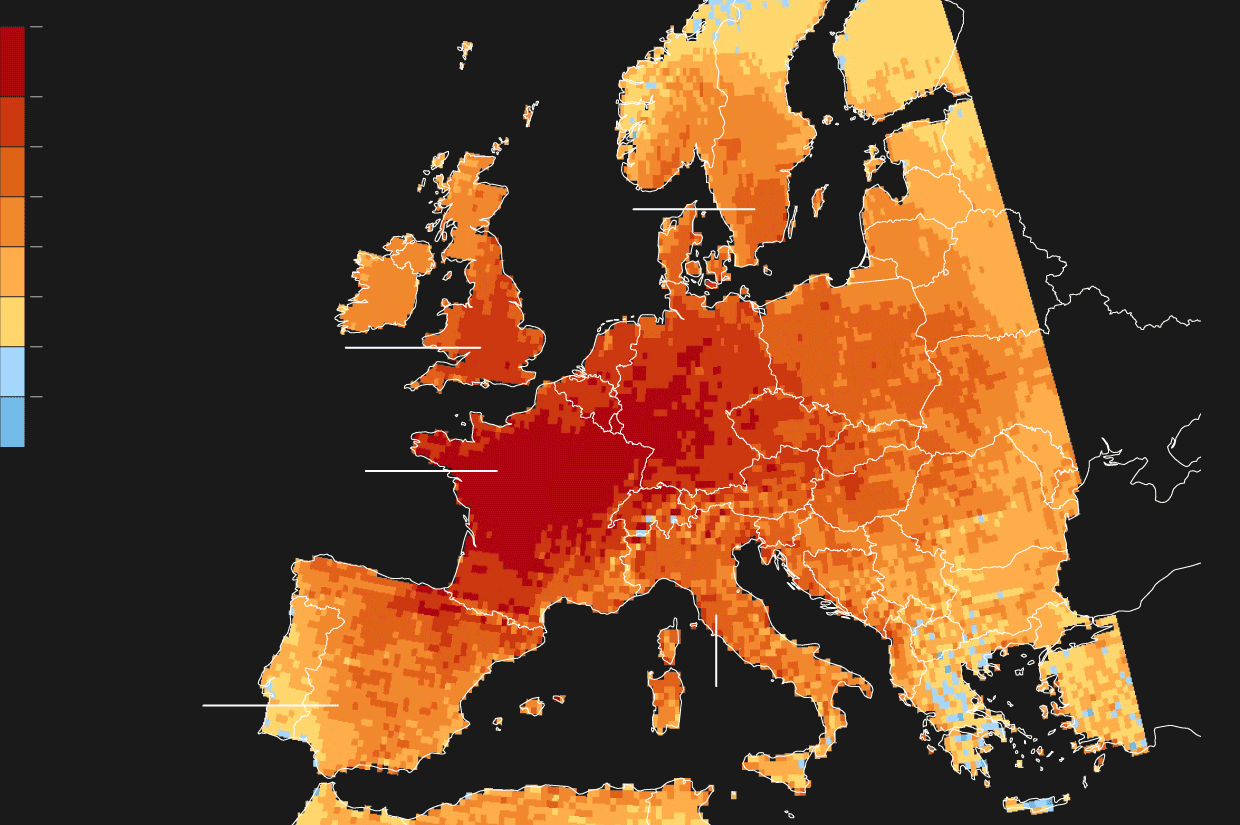
Across Spain, wildfires continue to rage, in an historically unique manner, with nearly 50,000 hectares of land lost in 2026 so far. Temperatures across Western Europe in June soared past the last century of records, with records broken in Hungary, Austria, the UK, the Netherlands, Denmark, Switzerland, France, and Spain. The World Meteorological Organization points towards “the highest sea surface temperatures (SSTs) on record for the month” as a contributing cause.
And so, we find ourselves half way through July 2026 with an excess death-toll of as many as 14,000 people across Europe; a truly tragic loss of life.
Capitalism and the climate crisis
The above are the frightening results of a world ruled by capitalism, a system hellbent on growth for growth’s sake regardless of the consequences. While Dr. Hans Henri P. Kluge points towards more that can be done to heat-proof us from the unfolding climate emergency, it becomes important to point out that the cause of this catastrophe is undoubtedly the capitalist system’s drive. While other sources describe it simply as “human activity”, it is important to note that these activities overwhelmingly spring from the increasingly globalised and interconnected network and profit-driven exchange of commodities and raw materials. These, in turn, rely on continual fossil fuel extraction, mineral mining and transport.
Over the last century and a half, we have drilled more, produced more, flown more, bought more and sold more than at any other time in history – and pointing towards this as simply “human activity” gives the impression that human activity in general is the problem, rather than the very specific way human activity under capitalism is organised. There is a direct correlation between the timing of capitalism’s dominance over the globe and humanity’s involvement in increasing greenhouse gas concentrations.
Capitalism relies, at a fundamental level, on the extraction and exploitation of the planet’s resources: human, animal and mineral. The Global South has already seen the consequences of the neocolonial enterprise that has pillaged their land and turned natural resources into defaced sites of exploitation. We have to confront the reality that it is capitalism’s insatiable hunger for profits and expansion that is the root cause of ecological breakdown.
This is because balancing humanity with nature is something that is “completely beyond the capabilities of bourgeois society”, as John Bellamy Foster put it. As such, it is necessary not just to seek adaptive solutions to the here-and-now consequences of climate change, as illustrated by Dr. Kluge, but to directly confront the system that has dismissed the science, facts and lived experience of the people at the forefront of this crisis as the price of doing business.
Indeed, Zitong Zhang, of the University of Manchester, notes: “addressing climate change requires more than technological solutions or individual lifestyle changes – it calls for reevaluating the entire social system. Without addressing the profit-driven motives that underpin our current economic system, any attempts to mitigate climate change risk are superficial and inadequate.” Capitalism has caused the worsening of this crisis, and it has repeatedly shown us that it is not the system that will solve it.