By Varun
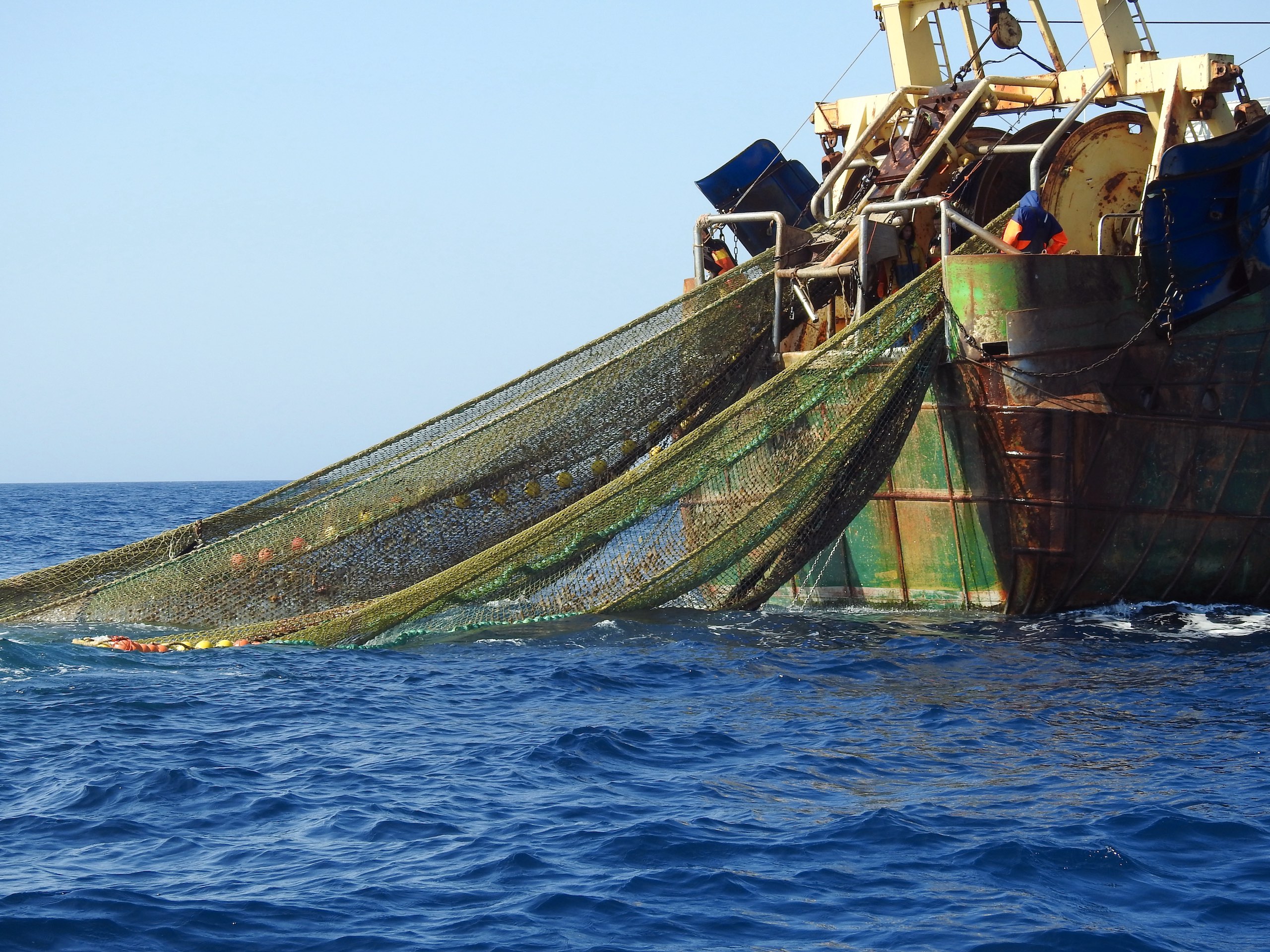
Oceans make up about 71% of our planet. They are vastly unexplored and home to up to 2 million species. But those numbers are rapidly decreasing every day. People have been dependent on the abundance of seafood in the oceans for their diets and livelihoods via small-scale and artisanal fishing. But industrial-scale fishing, which often uses bottom trawls to capture ground fish or crabs, is one of the biggest drivers of marine biodiversity loss today.
Bottom trawling is responsible for releasing over 1.47 billion tonnes of aqueous carbon dioxide from the marine soil every single year. These nets also capture coral, sponges, sea turtles, sharks, rays, and anything else that gets in their path along with the targeted fish. An estimated 92% of the species caught in these nets are not the intended targets, according to Greenpeace. Trawling also impacts marine food webs and kills off species already weakened by overfishing and climate change. Predators lose their prey, reef systems fall apart, and fish populations have a hard time bouncing back.
A single pass of bottom trawl can destroy structures that took hundreds or even thousands of years to form in fragile ecosystems like coral reefs or sponge fields. Parts of the North Sea and the Atlantic have gone from being complex, biodiverse ecosystems to flat, lifeless wastelands.
Sea colonialism in West Africa
The European Union, China, and Russia operate large fishing vessels off the coasts of West Africa via an agreement that allows these countries to fish there in exchange for a payment. But these agreements are devastating the marine life in West Africa. Over half of the fisheries resources in West Africa are already overfished.
The EU’s Common Fisheries Policy was originally intended to provide good quality food to consumers, protect the marine environment, and preserve the fisheries stocks. This policy, while protecting EU waters, ends up damaging marine life in other countries. Furthermore, the subsidies provided to these fleets incentivise overfishing. For example, subsidies for fuel allow the boats to remain in the oceans for longer hours and even go farther. In Gambia, 55% of species caught are over-exploited
In reality, the EU’s regulations to prevent illegal and unregulated fishing are purely motivated by business interests and not to protect our marine life. Yellow cards (warnings) are issued to countries with whom the EU has a high level of trade, and red cards (complete ban) to countries where it has less fishing trade. Despite evidence of overfishing in Guinea-Bissau, the EU hasn’t issued any warning to the country due to its high trade. Guinea-Bissau, for example, has not received a warning despite evidence of illegal, unregulated and unreported fishing. Its maritime enforcement agencies aren’t adequately equipped to monitor the activities of vessels operating in its waters.
Bottom trawling in European shores costs €16 billion annually
A study published by National Geographic Pristine Seas concluded that commercial fishing vessels spend 5.5 million hours fishing on average each year in the waters of the EU. This emits 112 million metric tonnes of CO2 into the atmosphere every year by churning of the seafloor sediment by bottom trawling.
Between 2016 to 2021, the cost of bottom trawling (carbon emissions, government subsidies, labour costs, discarded fish, and fuel costs) far outweigh the benefits, which include protein supply, job creation, and fishing revenue. While the net revenue is approximately €180 million, the costs of bottom trawling is up to €2.25 billion to €16.15 billion.
An estimated €1.17 billion is spent on fuel and other costs as subsidies. Almost 75% of the fish caught by bottom trawling is discarded back into the sea, costing up to €220 million every year. The species caught by bottom trawling provides only 2% of the animal protein consumed in all of Europe. This provides an estimated social value of €2.46 billion per year. When it comes to job creation, bottom trawling employs less than 20,000 people in Europe, while small-scale fisheries provide employment for approximately three times of that.
Banning bottom trawling would lead to a 95% increase in reef species and a 400% increase in juvenile lobsters. It would also save billions in public costs by restoring Europe’s overfished seas, avoid CO2 emissions, maximise food production, and the subsidies supporting bottom trawling could be used for transitioning to less damaging practices.
Irish Government’s ban doesn’t go far enough
The Government’s subservience to big commercial fishing trawlers and indifference to our marine life has turned our oceans into lifeless marine deserts. Skipper Colin Barnes, who quit commercial fishing in 2001 and founded Ireland’s first whale-watching business, declared that whales have left the oceans off Cork because the sprat that they rely on for food has been overfished to almost near extinction.
After almost a decade of campaigning by NGOs, coastal communities, and small fishermen, the Irish Government announced that, starting from October 2026, within the six nautical miles of the coast, boats will be prohibited from trawling over 18 metres. This includes seine nets (nets that are dragged through the water column) and bottom trawls.
However, the move doesn’t go nearly far enough according to the Save Our Sprat group in Bantry Bay, because some 44% of sprat are caught by trawlers under 18 metres. Timmy Dooley, the Minister of State at the Department of Agriculture, Food and the Marine, recently declared that he doesn’t support a total ban on bottom trawling. We cannot expect neo-liberal capitalist political parties to tackle climate change or protect our marine life.
Indigenous resistance across the world
In 2006, the Papahānaumokuākea Marine National Monument in Hawaii was established as a Marine Protected Area (MPA). At 582,578 square miles, it is the world’s largest no-fishing zone. Ten years later, the fish populations have recovered and it also led to a spillover effect, where small fish move from no-fishing zones to nearby waters. This also benefits the fishermen, as their catch rate increases. Papahānaumokuākea is considered sacred by Native Hawaiians and the monument is co-managed by Native Hawaiians and the state and federal government.
Elders and Hawaiian fishers led the charge for better protections and this also led to the recovery of birds like the Laysan albatross which were nearly extinct.
It is predicted that all our coral reefs could disappear within 30 years without proper protection. But we have seen in places like Papahānaumokuākea and the Galapagos Marine reserve that banning bottom trawling and creating no-fishing zones could create an environment where entire reefs could come back to life when crucial organisms that make up the ecosystem are given the necessary protection. Protection from overfishing allows them to become more resilient, supporting our climate, our food supply, and our future.
We need to ensure fishing, a vital industry for our society, is not left in the hands of capitalists, particularly as we face uncertain times with the effects of climate change already here. As part of a democratic plan of food production, the commercial fishing companies must be brought into public ownership and destructive practices like bottom trawling must be completely banned. This will help not only in fighting climate change but will also drastically improve the living and working conditions of those involved in the industry.