By Donal Devlin
The results of the by-elections in Dublin Central and Galway West give an insight into political developments and the shifts taking place in Ireland today. We see an unpopular government with a diminishing support base; the further normalisation of the far right as racist candidates gain support; ebbing support for Sinn Féin as it embraces the talking points of the latter; and, in turn, a rise in support for the so-called ‘centre-left’, namely Labour, the Greens and particularly the Social Democrats.
Rise in far-right influence
Other events that occurred during the by-election campaigns also exemplify the above processes. These include the horrific murder of Congolese man Yves Sakila a week before election day – a stark example of the consequence of rising racism and dehumanisation of black people and other racialised communities in Irish society.
Days before the election, a motion was voted down in the Dáil that would decriminalise abortion and get rid of the patronising three-day wait. The fact that the majority of Fianna Fáil and Fine Gael voted against it, and that Sinn Féin abstained, shows that these parties are increasingly feeling pressure from the far right, in the form of parties like Independent Ireland.
This is reflective of a global phenomenon, with the capitalist system embracing overt racism, a “moral panic” against the Queer community and attacks on the feminist wave of the 2010s. The results that far-right candidates received in this election in Galway West, with Noel Thomas receiving 20.9% of the vote, and in Dublin Central, with Gerard Hutch and Malachy Steenson receiving a similar combined vote of 20.7%, are yet another warning that far-right forces are gaining an echo among certain disaffected sections of society, both rural and urban.
Fianna Fáil nosedive
Both Fianna Fáil and Fine Gael are deeply unpopular with working-class voters. Their combined vote share has reached historic lows in recent opinion polls, and in the Dublin Central by-election. Post-crash Ireland has not meant a reversal of fortunes for the majority; on the contrary, the legacy of austerity remains with underfunded services, unaffordable homes, a cost-of-living crisis, and, with that, rising emigration. All of these have become normalised, a part of everyday life, creating a mood of anger and despair. The recent fuel protests and the widespread support they received, notwithstanding the presence of far-right figures in their leadership, indicate widespread discontent.
Fianna Fáil has seen the biggest fall in support in these elections. The centenary celebrations the party is marking this year will undoubtedly feel like a hollow affair. A party that once styled itself as a “national movement” is facing the outline of an existential crisis. It was never fundamentally different from Fine Gael in terms of its politics; both were parties of the capitalist establishment. However, the degree to which this is apparent for many has never been greater. Fianna Fáil’s ability to successfully use a populist message, notably around the national question, long ago diminished. Fianna Fáil under Martin is seen as an organisation totally devoid of vision, merely managing the status quo of inequality and the various crises mentioned above.
In 2007, Fianna Fáil received 44% of the vote in the general election in Dublin Central. This was the constituency of then-Taoiseach Bertie Ahern (now disgraced) and the “Drumcondra Mafia”, his own clique that ran the local party. In this election, Fianna Fáil were down to a paltry 4%, a humiliating defeat. They desperately wheeled out Ahern, only for him to be caught on camera making overtly racist and Islamophobic comments against the African and Muslim communities.
Their fortunes in Galway West were not much better, again reflecting a historic decline; they received a mere 8% in this election, having received 37% in 2007 and 20% as late as 2020. Both elections indicate how their base, both rural and urban, has been drastically weakened.
Fine Gael fared better by winning in Galway West, getting elected ahead of the far-right Independent Ireland candidate with transfers from Labour’s Helen Ogbu’s 13,000 votes. In Dublin Central, its candidate, Cllr Ray McAdam, received just over 10% of the vote. At this stage, Fine Gael is receiving a greater portion of the diminishing pie in terms of support for the so-called “civil war parties”. Fine Gael has historically drawn greater support from the urban and rural middle class, especially the wealthier section of this stratum, who are benefiting from the current period of lopsided economic growth.
Sinn Féin rightward shift exposed
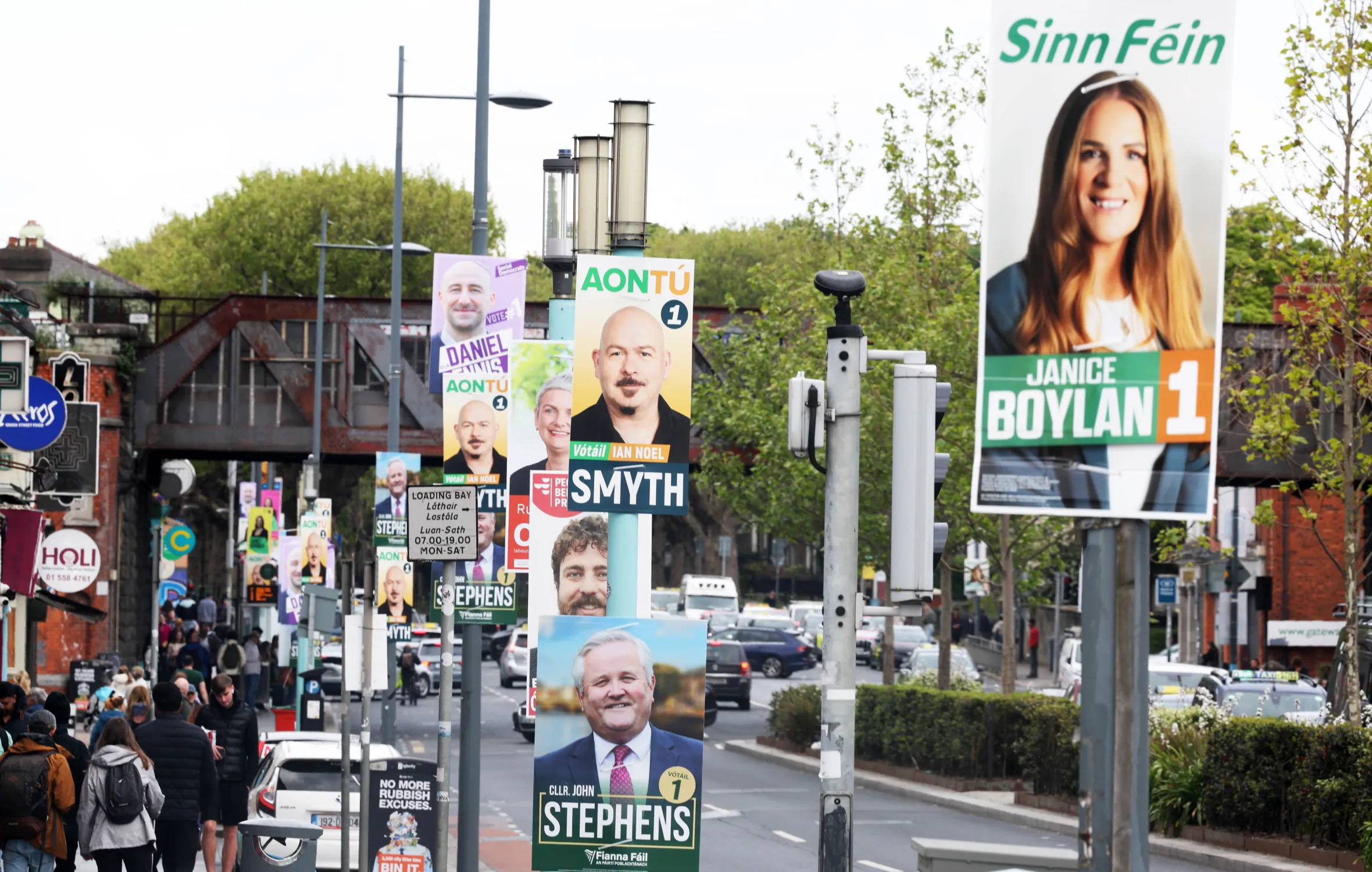
For Sinn Féin, this election will have been a disappointment. Despite Dublin Central being the constituency of party leader Mary Lou McDonald, its candidate, Cllr Janice Boylan, only came in second. It did far worse in Galway West, with its vote halved compared to its 2020 and 2024 results in this constituency. Despite what the party’s strategists hope for, its general shift to the right and its shameful embrace of the anti-migrant talking points have not resulted in them gaining electorally, quite the contrary.
Sinn Féin’s disgraceful approach was evident in the leaflet it distributed in Dublin Central, which outlined how they would “manage migration” and the need to increase deportations. As Solidarity TD Ruth Coppinger pointed out in a debate in the Dáil in March, there was no mention of the fear that racialised minorities are experiencing in this constituency. Instead there was the faint echoing of far-right conspiracy theories.
During the election campaign itself, Mary Lou McDonald refused to even comment on the disgusting racist remarks of gangland figure and independent candidate Gerard Hutch, who argued that refugees should be imprisoned in the Curragh. Likewise, the party remained silent on Bertie Ahern’s racist intervention, and the killing of Yves Sakila. None of their representatives were present at the vigil and protest that took place demanding justice for Yves. This is particularly poor given that the killing took place in McDonald’s constituency.
Sinn Féin’s shift to the right has not gone unnoticed, leading many left and progressive-leaning voters to turn away from the party. The chief beneficiaries of this were the Soc Dems, Labour and the Greens, although it is important to note the very respectable vote of 6.8% achieved by Eoghan O’Ceannabháin of People Before Profit, an increase of 50% on his general election result. Eoghan has been active on key questions in the area, such as the ongoing housing crisis, the rise in council rents, and the depletion of cultural space in Dublin City Centre. His vote is indicative of a small but growing cohort of people, particularly young people, who seek a radical alternative to the rotten capitalist status quo.
The rise in support for “centre-left”
Sinn Féin’s alienation from a left-progressive section of the electorate was not only reflected in their first preference vote but also in transfers. In Dublin Central, a mere 23% of PBP’s second preferences went to them, while 47% went to Daniel Ennis of the Social Democrats. As well as being from the Dublin Central area, Ennis was willing to take on the racist rhetoric of the far right. The fact that he took this stance and won the election is welcome – and shows that challenging these noxious forces and their poisonous ideas is a superior response than caving to them. Janet Horner of the Green Party also campaigned against racism in this election and came third.
In Galway West, Labour’s Helen Ogbu, a refugee from Nigeria, was likewise able to win votes from people wanting to take a stand against racism. She herself was the victim of heinous online racist abuse in the campaign, which she bravely stood against, and her campaign likewise opposed the racist arguments of Independent Ireland.
These ‘centre-left’ parties, however, have important questions to answer about their policies and political positions. In the last 20 years, both Labour and the Greens have been in government and have presided over vicious austerity and the tax-haven model of Irish capitalism, and the chronic lack of investment in public housing and services that goes with it. Last December, both parties on Dublin City Council voted to raise the rents paid by those in council homes and on HAP (Housing Assistance Payments) in the Dublin City area. This is a punitive measure that will impact 40,000 households and those living in the most deprived working-class communities.
The Social Democrats themselves have not yet followed the disastrous path of going into coalition with Fianna Fáil and/or Fine Gael. However, they are not opposed to doing so, and while they have progressive policies such as establishing a state-owned construction company, their policies all fall far short of challenging the capitalist market. Many of those who were radicalised by the Palestine solidarity movement and supported them in the last general election will have been angered that they stood by Eoin Hayes TD, someone who held 7,000 shares in Palantir, a tech company which plays a significant and enthusiastic role in supplying the Israeli armed forces with the tools to commit genocide.
New movements needed
In this context of a rising far right, which is pushing the establishment to the right, it is important to note that while they are a growing political force they are still opposed by a big majority. But just passively watching their continued growth without organising and mobilising in myriad ways to stop it would be a dereliction of duty. There is real potential to build an anti-racist movement that challenges the hate and lies of the far right in all communities. All parties who oppose racism and the far right, as well as trade unions, student unions, community groups and so on, should come together to coordinate a concerted campaign to stem the rise of this nefarious political force and their ideology.
To be really effective, however, this must be linked to a broader movement for an alternative to the capitalist inequality and oppression that allows racism and division to fester. Defeating the far right and defeating capitalism go hand in hand. The rule of profit – of billionaires, big banks, corporations and landlords – means unending crises for the many and obscene enrichment for a tiny few. Amidst the hardship and misery for the majority of ordinary people, they inject division and scapegoating to distract from the immense rip off the system itself is orchestrating. Any attempt to manage this inherently destructive system, or to coalesce with its representatives, will only ruin those who try. Real change can only come through system change. Until the ‘centre-left’ accept this reality, their politics will merely be a politics of the centre, against the left and the radical socialist alternative we fight for, and which the world urgently needs.