By Eddie McCabe
There is no migration crisis in Ireland. None whatsoever. That is to say there is no problem in Irish society that’s caused by there being too many people from other countries living here. Yet this notion, in some form, is widely accepted in society and is increasingly perpetuated by figures in politics and the media – and not just those on the far right. Supposedly moderate or liberal commentators lazily or cynically echo this idea. And the more such figures perpetuate it, the more it takes hold as a common assumption.
Yet it remains false. The truth is Ireland currently has a significant labour shortage, so we need more inward migration, not less. A report by ManpowerGroup found that 83% of employers are struggling to find skilled workers.1 In the construction sector alone, a report by Property Industry Ireland estimated that an additional 110,000 workers will be needed by 2030 just to meet the Government’s (seriously inadequate) housing and infrastructure targets.2 It follows very directly from this that rather than migration being part of the problem of the housing and public services crises, it is a crucial part of the solution. So the question is, why is this wrong notion about migration being promoted and accepted?
By and large, it’s being promoted by three types of people for three different but overlapping reasons. First is the far-right type, whose motivation is racist and xenophobic, who will spread any misinformation that will serve to whip up anti-migrant sentiment. Second is the centre-right or liberal type, representing different wings of the establishment, whose motivation is ultimately to defend the capitalist status quo, who will utilise any argument that will serve as a cover for the real problems in society – for which the capitalist status quo is actually responsible. Third is a less ideological but ignorant type, whose inability or unwillingness to really interrogate the issues and the arguments of others leads them to accept and repeat them.
Taken together, the effect of these ideas being spread from so many sources in so many ways creates the impression of a ‘common sense’ reality: where, for example, the lack of housing is blamed on there being too much demand, as opposed to not enough supply; which leads to an idea of reducing demand, as opposed to increasing supply; which leads to an idea of prioritising some of those in need of housing by excluding others – with “our own” being the ‘common sense’ refrain for who should be prioritised.
The warped logic on display here is a distinctly capitalist one, which confines thinking about society’s problems within extremely narrow parametres. Scarcity is just something we – working-class people – have to accept, notwithstanding the plentiful existence of wealth and resources to provide everything we need. Eleven billionaires in Ireland have more wealth than 85% of the population combined, yet the Government chooses to allow shortages in housing, education, healthcare, and public services generally, in order to facilitate the enrichment of the super-wealthy in society.3 Socialists fundamentally reject this logic, which undergirds not just wrong ideas, but dangerous ones.
Sinn Féin and the far right
At a time when far-right forces are gaining support and influence, and the Government parties are increasingly scapegoating migrants for their failures, it is incumbent on all those who consider themselves on the left to forcefully challenge their ideas and expose their lies. Remaining in any way passive is not an option; both because it would be self-defeating for any left agenda, and a betrayal of those who are most vulnerable to a rise in far-right ideology – migrants, people of colour, women, and LGBTQ people, especially trans people. As Angela Davis said, “it is not enough to be non-racist, we must be anti-racist.” As such, all trade unions, students unions, community groups, sports clubs, progressive campaigns and political parties, should be proactively and energetically using whatever influence and authority they have to stamp out far-right ideas from our communities.
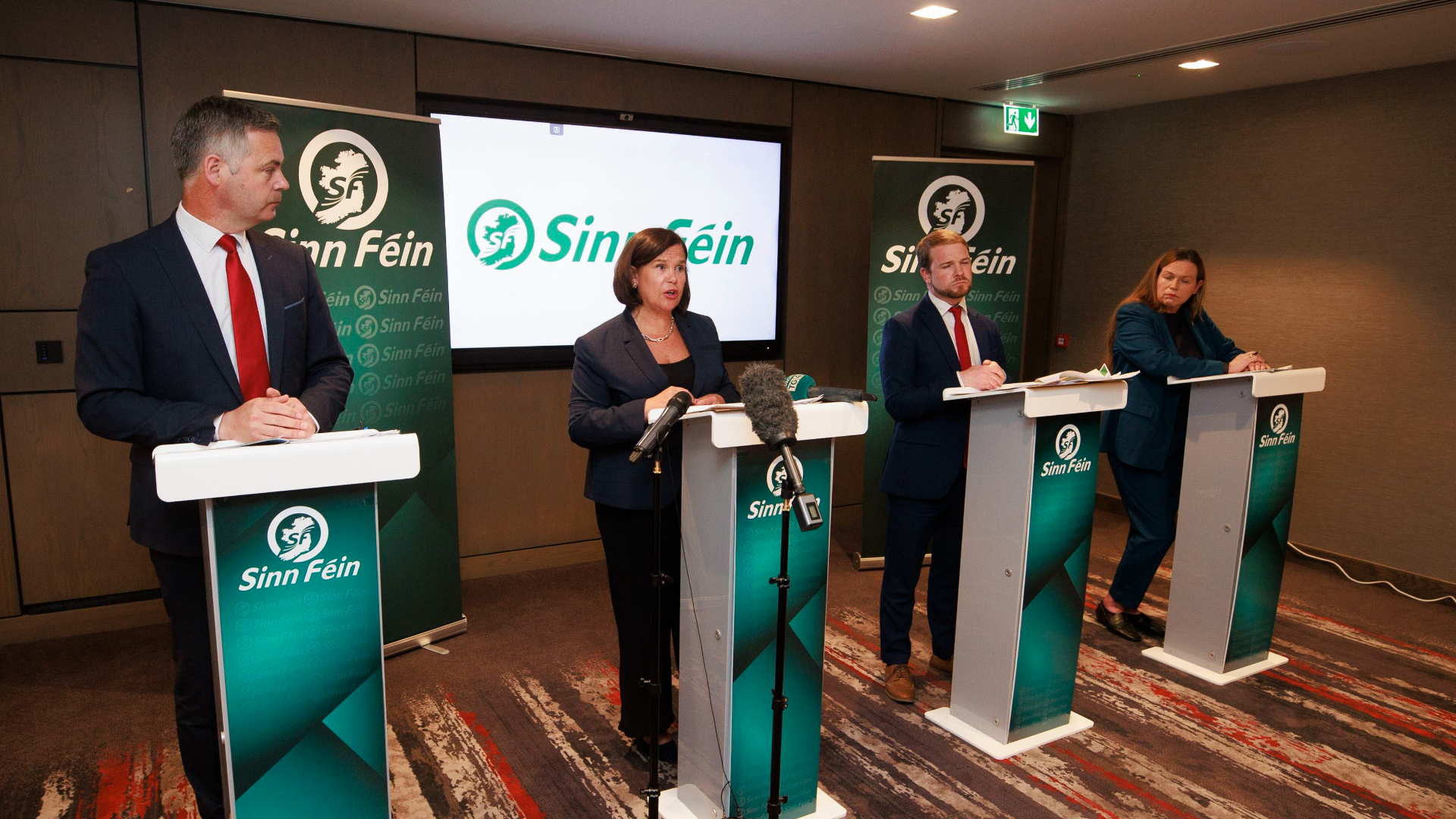
It is in this light that the stance of Sinn Féin on the question of migration should be assessed. Sinn Féin is not just the largest opposition party in the South – with thousands of members, 102 councillors, and 39 TDs – it claims to base its approach to migration on “Republican values and principles – equality, economic and social justice, sovereignty, anti-racism and anti-colonialism.” From this point of view, any honest assessment must conclude that Sinn Féin’s response to the rise of the far right in Ireland has been disgraceful, and completely at odds with those principles.
In the early period of this rise, from 2022, when the first anti-migrant protests were organised in East Wall, Dublin, Sinn Féin’s response was an unmistakably passive one – saying little and doing less, despite (or because of) Sinn Féin itself being a key target of the far right, who constantly label them ‘traitors’. Under pressure, particularly in certain communities where Sinn Féin has built a base, it responded not by taking on the far right and its lies about migrants, but, like the Government parties, adopting a harder anti-migrant stance itself. Of course, rather than undermine its far-right critics, this gave them legitimacy – including at Sinn Féin’s expense. Its disastrous results in the local elections in 2024 (where all its candidates put out leaflets making clear the party’s opposition to non-existent “open borders”) was misdiagnosed by Sinn Féin as a result of it not being “vocal enough” in addressing concerns about migration, particularly refugees.4
Sinn Féin has hardened its anti-migrant stance since then. In Dáil debates on the issue of migration, Sinn Féin often sits on the same side of the fence as the Government parties, and the backward, far-right populists in Aontú and Independent Ireland. The recent shameful decision by the Government to cut supports for Ukrainian refugees – fleeing an ongoing war in their country – was criticised by most of the opposition but welcomed by Aontú and Sinn Féin, with Pearse Doherty TD only lamenting that it wasn’t done sooner: “So we welcome that they are coming to our view, late in the day. But it is very late in the day in relation to that.”5
To be clear, the view of Sinn Féin was that the support provided to Ukrainians was distorting the rental market, of which there was no real evidence,6 and “deeply unfair”. This support was indeed better than what’s afforded to other refugees, but rather than argue for all refugees to receive the better support, Sinn Féin wanted no one to receive it. This put Sinn Féin to the right of the Government until the Government came around to Sinn Féin’s position.
Racist scaremongering
It should be noted that other opposition parties that see themselves on the ‘centre left’, such as the Social Democrats and Labour, have made some efforts to counter the far-right narrative about migration. This is welcome, although much more needs to be done, and in reality at some point, particularly in government, their anti-racist stances will come into conflict with their pro-capitalist stances – and it’s not hard to predict which will be dropped. Unfortunately, Sinn Féin has taken the opposite approach, of essentially aping key tenets of the far-right narrative. Ahead of the by-election in Dublin Central in May, Sinn Féin sent out a leaflet throughout the constituency with the headline: “Sinn Féin will manage migration.” The text read: “The Government’s mishandling of migration has been an inexcusable disaster. Instead of planning, the government has allowed chaos to take root.”7
Note the framing of the problem as being about migration itself, when in reality there is no ‘disaster’ or ‘chaos’ relating to migration. This is a purely racist, far-right fabrication. The issues people sometimes wrongly associate with migration – lack of housing, school places, access to GPs, or things like crime or gender-based violence – may be rightly described as disasters, but they have nothing to do with migration. They are the results of the policies of right-wing governments, and the capitalist system they oversee. The leaflet goes on to state:
“In the international protection system decisions are taking too long; deportations have not been enforced and there has been massive profiteering from the provision of inappropriate IPAS accommodation.”
Of course, like with every issue, Fianna Fáil and Fine Gael governments badly manage things and allow private companies to profiteer. That’s not in question. But the decision by Sinn Féin to highlight problems with the international protection system is motivated solely by pressure coming from far-right racists. For example, Sinn Féin moved amendments to outlaw profiteering in IPAS and refugee accommodation, but not to outlaw the exact same profiteering in homeless accommodation.
What exactly are the real consequences of ‘decisions taking too long’ or ‘deportations not being enforced’? Merely that some non-Irish people remain in the state longer than they are legally allowed. But is this really a major problem in society that’s causing hardship for ordinary people? Save for racists, and those influenced by racist scaremongering, it isn’t. Rather, it is a sinister distraction from the real problems in society.
Just like its declarations about ‘open borders’, which don’t actually exist, Sinn Féin is dangerously feeding into far-right narratives. This is truly deplorable, and makes a mockery of its supposed principles. Moreover, it has real adverse consequences for politics and society as a whole – especially for migrants and racialised communities, who are increasingly living in fear. Witness the recent torrent of racist abuse meted out to two Black women earlier this month: Helen Ogbu, the Labour candidate in the Galway West by-election, and Suad Mooge, the medical scientist and Dublin Rose. This abhorrent abuse is a direct result of racism being allowed to raise its ugly head.
Zero tolerance for racism
In early May, Gerard Hutch, the alleged criminal gang leader and indepenendent candidate in the Dublin Central by-election, made the following vile comment in an interview with a far-right councillor:
“Illegal immigrants… they’re coming into England and France, and they’re mooching their way into southern Ireland, because it’s a freebie, and they’re getting paid. I think they should be all interned, they should be put in the Curragh, in camps, until they’re sorted.”
Adding, more specifically: “the ones that are Somalians and them type of people – no way”.8
Quite rightly, other opposition candidates condemned these comments. The Sinn Féin candidate Janice Boylan, when asked about her thoughts on them said they were “out of order”, before insisting that she was “concentrating on what we’re hearing on the doors… and not very much on any other candidates.” Mary Lou McDonald, when pressed, said: “We can’t comment on other people’s comments.”9
Nor did Sinn Féin comment when former Taoiseach Bertie Ahern made disgusting racist comments while canvassing in the Dublin Central by-election.10 He said that: “the ones I worry about are the Africans”, and the “next generation” of Muslims, and said “we can’t be taking in people from the Congo and all these places. I think there’s too many from those places”.11
Of course, the suggestion that they can’t comment is clearly ridiculous. What McDonald is really saying is that she is choosing not to comment; she is choosing not to condemn horrible and despicable racist comments. Racist comments, moreover, that are very consciously being made in a context of rising tensions about migration, particularly in certain parts of the Dublin Central constituency, of which she is very well aware. But this feigned attempt at being neutral is a political statement in itself: one that says Sinn Féin is prepared to tolerate racism.
It’s a message McDonald would like to subtly send out to a section of her constituency that’s been turned against migrants, but one she doesn’t want to be called out on by those who see it for the dreadful caving to the far right that it is. It is the duty of those on the anti-racist left – the only kind of left there is – to do just that. If we don’t, who knows how much lower Sinn Féin may go in its futile attempt to beat the far right at its own game.
A left pact?
This rightward shift by Sinn Féin on migration has implications for others too. The trend of opposition parties situated to the left of the Government parties cooperating on issues they agree on has been elevated since the formation of the current government. Its highest point came with the victory of Catherine Connolly in the presidential election, having received the active support of these parties. Some have advocated that these parties should increase this cooperation, including by agreeing a formal transfer pact relating to the next elections. People Before Profit (PBP) representatives have been most vocal on this point. A group named Keep Left has also been formed to push for such initiatives, organising meetings and events to this end.
Whatever the merits are of such initiatives, they take as given that all these parties can be considered left, or more accurately ‘centre-left’. But can this just be taken as given, or are there real question marks over some? Of course, socialists have major criticisms of all of these centre-left parties, whose policies at best aim to manage the capitalist market system in a more progressive way than FF and FG, which is possible only to a limited degree and ultimately unworkable – as the corporate and imperialist forces that dominate the capitalist market will still hold the real power.
But even with these criticisms, we in Solidarity can and do work with and alongside other parties on issues where there is agreement. We can and do support the general proposition of ‘Vote Left, Transfer Left’ in elections. But to be meaningful, this general proposition has to come with clear red lines, which exclude from the proposition any parties that cross them. One of those red lines must be the total rejection of any far-right narratives. The most pernicious and prevalent of which, at this time, relate to migrants and racial minorities, and trans people, and on both counts Sinn Féin has crossed red lines that put it firmly on the wrong side of even the most hazy divide between left and right (as part of the Northern Executive Sinn Féin supported a ban on puberty blockers for under 18s – a position more extreme than that of FF and FG).
A united front against racism and the far right
Of course, this is not to say that Sinn Féin is a far-right party, or should be treated like one. But neither can it just be treated as another left party. Sinn Féin is very clearly on a trajectory to the right, not the left. It has been pressured this way by the activity of the far right, but it was already moving in that direction. Historically, it was pressured by the left to change its policies on water charges and repeal of the 8th amendment, and more recently on fox hunting. Yet even on abortion rights Sinn Féin is rowing back, as shown by its TDs abstaining on a Social Democrats bill to expand abortion access.12
What can make an impact on Sinn Féin – like all opportunistic parties – is the building of real people power movements that create a pressure in society that forces change. This should be the overriding focus of those on the left. And combatting racism, and the right-wing capitalist policies that breed racism – of artificial scarcity and division – is one issue that warrants an urgent movement.
The evident increase in racist abuse and violence on the streets of cities and towns is a horrible reality that many migrants and people of colour are experiencing daily. Racism is extremely damaging to the health and lives of those on the receiving end of it, and as we saw with the brutal killing of Yves Sakila in Dublin in May, it is life-threatening. All progressive, anti-racist forces in society – trade unions, student unions, community groups, and political parties – should come together to form a programme and plan to actively combat all occurrences of racism in our communities and society generally, including through awareness campaigns and actions, national demonstrations, and even self-defence networks.
Notwithstanding Sinn Féin’s trajectory, it should be challenged to change its course and be part of such initiatives. It would be objectively positive if Sinn Féin stood against racism consistently, which will only happen if its failures and betrayals towards refugees, migrants and people of colour are highlighted and criticised by the anti-racist movement.
Moreover, if such a united front can be built, which activates broad layers in society, that could be the basis for a genuine political project of the left: one that a) points to the wealth in society being hoarded by the super-rich corporate elite, which maintains its privileged position through the division of working-class people whipped up by the political and media establishment; and b) demonstrates the working-class and socialist alternative that would be possible by overturning this state of affairs. This is the only political position that can really undermine both the establishment parties and the far right.
PBP’s mistake
The worst thing those on the left can do is give left cover to Sinn Féin, even while it moves to the right. This is a real problem right now.13 As Eamonn Sweeney, the former sports columnist turned politics and culture writer, wrote recently: “It’s not so much that [other opposition parties] refuse to criticise [Sinn Féin’s] position on immigration, it’s that they’re pretending not to notice it.”14 Solidarity TD Ruth Coppinger has been the exception – consistently calling out Sinn Féin’s caving to racism. Unfortunately, however, PBP representatives have been guilty of this.
PBP has made talking up the idea of a left government after the next election a central part of its programme. By ‘left government’, however, it means in effect a government without FF or FG, which would presumably be made up of a coalition of Sinn Féin, Social Democrats, Labour, the Greens, and PBP (perhaps supporting from outside). We’ve written previously (in articles here, here and here) about how deeply problematic this position is, given that such a government could be considered left only in the most superficial sense. It may be left of FF and FG, but it would not be a left government that would in any way threaten the status quo of tax haven Ireland, or the neoliberal EU fiscal rules, or the subservience to US imperialism.
It would not be a government that offered the radical change people need, and to give the impression that it would is a major mistake. But this seems to lead to PBP making further mistakes, such as a failure to really challenge Sinn Féin on its anti-migrant turn. Doing so would naturally raise a question over Sinn Féin’s left credentials, which would in turn raise a question over PBP’s strategy for a left government led by Sinn Féin.
A recent article by Paul Murphy TD in advance of the Dublin Central by-election argued that one of the main reasons to vote for the PBP candidate Eoghan Ó Ceannabháin was to send a message to other opposition parties that they too should rule out coalition with FF and FG, and agree to a pact for the general election.15 The article does make a point of correctly criticising Labour and the Greens for their disgraceful support for rent hikes for Dublin City Council and HAP tenants,16 but it is remarkably silent on Sinn Féin’s anti-migrant stance – which is particularly relevant in a constituency like Dublin Central, where more than a third of the population is non-Irish.
In the view of Solidarity, PBP should stop putting this undue emphasis on a potential government involving forces that we know – given the politics they currently espouse – cannot be trusted to implement any genuine left programme (or even vote against rent hikes for struggling council tenants) – and who will betray any hopes invested in them for real change. Instead, it should focus on helping to mobilise people into activity on the key issues affecting working-class and oppressed people, as well as the very real and compelling reasons why people should vote for candidates – like its own in the by-elections – who are genuinely, principally left.
The tasks for the genuine left
In the wake of the by-election results, in which Sinn Féin performed badly – particularly in Galway West but also underperformed in Dublin Central – there has been a notable uptick in commentary about its rightward trajectory, including its stance on migration. Sinn Féin’s failure in Dublin Central, where it was widely considered the favourite at one point, came at the hands of Daniel Ennis of the Social Democrats. These two opposition parties share much of the same politics, with one notable exception being their respective stances on anti-migrant racism – with the more principled stance winning out in this contest.
Much of this critical commentary is now coming from right-wing political analysts trying to emphasise division between the parties in opposition, but opposition representatives have also been more vocal. Labour leader Ivana Bacik reportedly said Sinn Féin “have pivoted rightwards, particularly on migration, and on climate, and indeed on their taxation policies.”17 Social Democrats Leader Holly Cairns suggested the party was “at a crossroads” and needed to figure out where it was going.18 Paul Murphy similarly said “Sinn Féin needs to choose. Are they a left party willing to head up a left government, in which case they should rule out coalition with Fianna Fáil and Fine Gael, stop scapegoating asylum seekers and take consistently left-wing positions?” 19
This shift is welcome, but it has to go further. Inevitably, any signs of discord between the opposition will be exploited by the right-wing establishment to try to undermine the idea of a left alternative made up of these opposition parties. The way to respond to this is not by downplaying real disagreements in a false attempt at displaying unity, especially when the disagreements relate to issues as serious as racism, migrant rights, abortion rights, trans rights, animal rights, and so on. Sinn Féin’s accelerating shift to the right over recent years is proof that that approach doesn’t stop or even slow down its shift. All it will do is undermine the credibility of those who don’t see or take seriously enough the consequences of that shift. But as long as Sinn Féin maintains these disgraceful positions, talking about its role in any left pact never mind left government is clearly untenable.
What the left needs to offer in this time of economic instability, war, genocide, and ecological breakdown is a vision and programme of radical transformation of this rotten society we’ve inherited from successive right-wing governments. A left, socialist government must be one that challenges capitalism and the rule of the billionaire class – the main obstacles to the real change we desperately need. For the genuine, socialist left, this is the case we need to make ever more forcefully. How other forces, like those on the centre-left, respond to and adopt this programme themselves will determine what, if any, kind of progressive role they can play in the coming struggles. Unlikely, to be sure, but the only conceivable way this will happen is if they are pushed to do so by social movements from below, which again illustrates the importance of building those movements and a powerful socialist left.
Notes
- 2025 Ireland Talent Shortage Report, www.manpower.ie
- Martin Claffey, 26 Feb 2026, ‘110,000 additional construction workers will be needed over next four years, warns report’, irishexaminer.com
- Joe Brennan, 19 Jan 2026, ‘Ireland’s 11 billionaires are collectively wealthier than 85% of adults in State, says Oxfam’, irishtimes.com
- Tadgh McNally, 17 Sept 2025, ‘Sinn Féin ‘probably wasn’t vocal enough’ on migration, says TD’, irishexaminer.com
- Emma Hickey, 28 April 2026, ‘Government plans to cut support for Ukrainians criticised as ‘immoral and unethical’, thejournal.ie
- SF argues that the ARP scheme (which gave money to people hosting Ukrainians) was displacing others in the private rental / rent a room market, but a study by the Red Cross found 91% of this scheme were not going to registered landlords.
- https://sinnfein.ie/wp-content/uploads/2025/09/Sinn-Fein-Policy-on-Immigration.pdf
- J. Horgan-Jones & C. McQuinn, 5 May 2026, ‘Gerry Hutch’s comments on immigration described as ‘absolutely racist’ by Dublin Central candidate’, irishtimes.com
- Mark O’Connell, 9 May 2026, ‘Gerry Hutch is a smart man. He knows what he’s doing with immigration comments’, The Irish Times
- Janice Boylan told the Irish Times she hadn’t “seen or heard Ahern’s comments”: Jack Horgan-Jones, 16 May 2026, ‘Following the canvass: Frustrations emerge in Dublin central Sinn Féin heartland’, irishtimes.com
- L. Burne, P. Hosford & V. Clarke, 14 May 2026, ‘Fianna Fáil MEP calls on Bertie Ahern to apologise for immigration remarks’, irishexaminer.com
- On 13 May, Sinn Féin TDs abstained on a Social Democrats’ bill to expand abortion access. Sinn Féin’s health spokesperson David Cullinane explained that the party does not support decriminalisation and opposes expanding access to abortion to those who receive a diagnosis of a catastrophic foetal abnormality. This is a retrograde step, as Sinn Féin TDs voted in favour of a very similar bill proposed by Bríd Smith of PBP in the last Dáil.
- For example, the group United Against Racism promoted Sinn Féin’s Janice Boylan ‘proudly’ signing its anti-racist pledge during the by-election, despite the anti-migrant literature Sinn Féin was spreading throughout the constituency at that time.
- Eamonn Sweeney, 3 May 2026, ‘The Enigma of Sinn Féin’, saturdaynightwaltz.substack.com
- Paul Murphy, 7 May 2026, ‘Dublin Central: Make the Government Pay’, rebelnews.ie
- Although the article makes no comment on what implications this has for these parties being considered part of the left.
- Gràinne Ní Aodha, 24 May 2026, ‘Opposition parties question ‘mixed message’ from Sinn Fein after by-elections’, belfasttelegraph.co.uk
- Jane Moore, 21 May 2026, ‘Sinn Féin ‘at a crossroads’ and ‘need to figure out where they’re going’, Holly Cairns says’, thejournal.ie
- Paul Murphy, 25 May, ‘Five takeaways from the by-elections’, rupture.ie