By Aislinn O’ Keeffe
Spoiler Alert
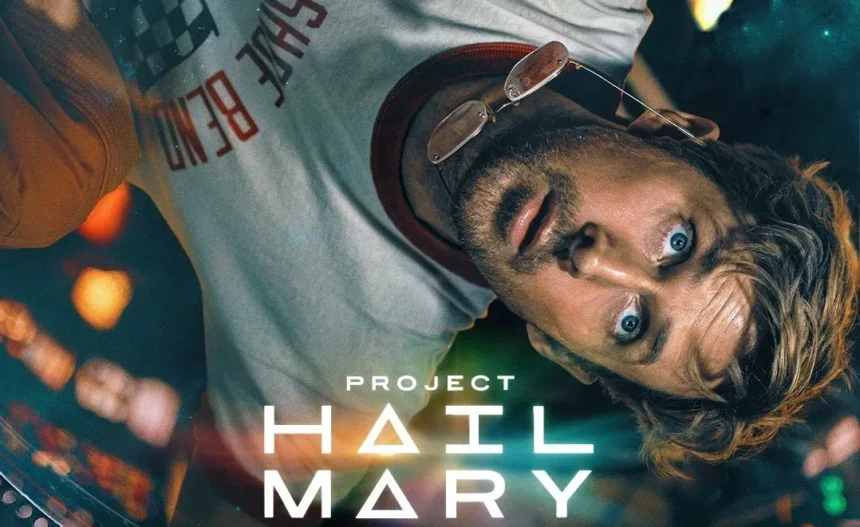
Project Hail Mary is a sci-fi adaptation of a novel by Andy Weir, published in 2021. The story revolves around teacher Ryland Grace, played by Ryan Gosling, who wakes up to find himself alone on a spaceship floating near a sun over 11 light years from Earth. A series of flashbacks over the course of the film reveal the circumstances leading up to Grace’s current predicament.
It is revealed that Earth is facing an extinction-level disaster after the discovery of an alien life-form or ‘star-eater’ which is blocking Earth’s sun. Scientists predict that within 30 years, catastrophically low temperatures will see all forms of life on Earth, including humans, going extinct.
Grace is seemingly entrusted with a trip to the far-off star, Tau Ceti, which has somehow managed to repel this life form, in the hopes of finding a solution. The mission is a one-way trip with no hope of returning to Earth and so, essentially, constitutes a death warrant. When Grace’s ship arrives at its destination, he discovers an alien craft already in the vicinity where he meets his alien equivalent (Rocky), with whom he strikes up a friendship.
Missed potential
Questions of self-sacrifice, consent, alienation, human rights, and the existential crisis of living on a planet in the throes of climactic crisis – are all themes that are not explored in any depth in Project Hail Mary. Despite the obvious parallels with some of the most pressing and relevant issues of our times, the film (rather impressively) manages to completely sidestep these themes in favour of a light-hearted ‘Buddy’ movie.
But even this doesn’t quite hit the mark. Although the film is genuinely funny at times, and Ryan Gosling entertains as Grace, it ultimately doesn’t have anything much to say and suffers as a result. The viewer expectantly awaits a plot twist which will illuminate some point to it all. But it never arrives.
Most of the movie is taken up with the development of the friendship between Grace and Rocky interspersed with flashbacks of Grace’s memories, each of which unveils something about the purpose and circumstances of his mission.
Individualism
Gosling puts in an excellent performance and much of the film is carried by his charisma. The friendship between Grace and Rocky is heartwarming but a deeper investigation of human experience and the themes thrown up would have added a depth and texture that was much-needed. Grace’s willingness to sacrifice himself for Rocky reveals something about current levels of political consciousness and a particularly right-wing ideological tenet – that of individualism and ‘looking after our own’. Grace was willing to sacrifice himself for his personal friend but was unwilling to sacrifice himself for humanity as a whole and his own home planet. The film doesn’t interrogate this, and therefore it is presented as a natural or normal response.
Apoliticality is political
Overall, the film is disappointing, and we learn that there are limits to even Gosling’s charm. Taking up two and a half hours of the viewers’ time, Project Hail Mary is full of its own self-importance, but in the absence of anything thought-provoking it becomes tedious. The directors would have been better to fill the time with a thoughtful exploration of the moral implications raised, or alternatively, to shave an hour off and go full-in for an entertaining fluff piece.
Weir says that his work is not political, a common assumption when one’s politics align with the status quo. But of course, apoliticality is a political position, one which naturalises the dominant political beliefs and which uncritically reflects them back to us. In this case, a film that goes out of its way not to say anything meaningful is precisely the appropriate symbol of 21st century capitalism. While we are bombarded by 24/7 reportage of the latest atrocities committed by the global ruling class we are encouraged to skip over them to the latest distraction. With this unchallenged, no amount of Hail Marys can save us.