By Caitríona Ní Chatháin
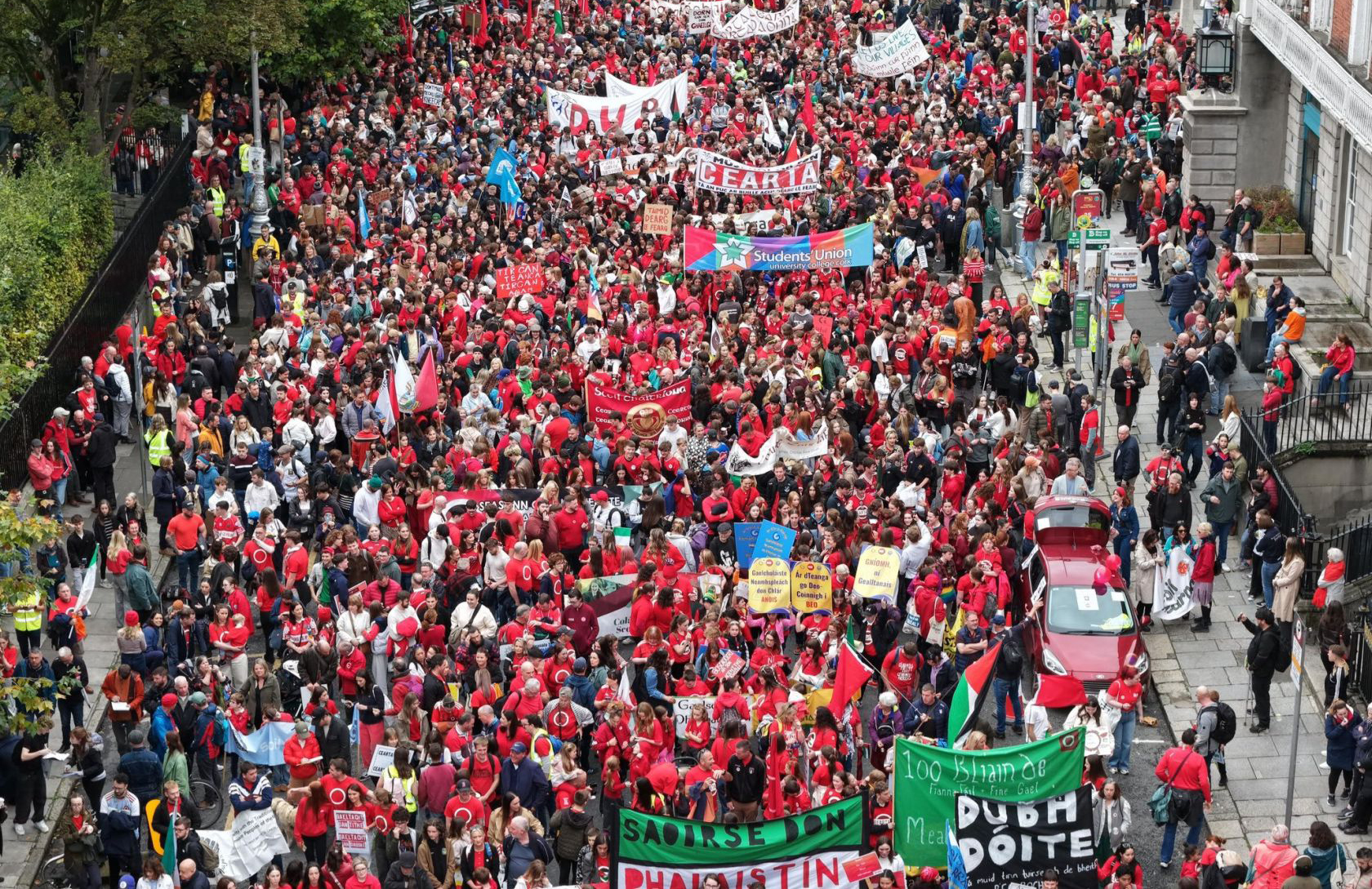
It is fair to say that the Irish language is having a moment. To give some examples: over the past 12 months, content on TikTok in Irish has doubled.1 Meanwhile, Irish language rap duo, Kneecap, with their talent and their vocal anti-imperialism, are inspiring a renewal of interest in learning Irish among young people. In September, a 25,000-strong march took place through the streets of Dublin to decry the shortfall of vital state funding for essential services through Irish, such as childcare, youth clubs and education. It is worth mentioning too that, at the time of writing, the sad passing of Manchán Magan – Irish language author, documentary maker and environmentalist – has provoked a national outpouring of grief. His work, spanning decades, captured the beauty and interconnectedness of oral tradition, language and the natural world. The language has also seen a growing interest, from a seemingly unexpected source, with the growth of the Irish language project, Turas, in East Belfast.
That said, behind this recent surge of interest and popularity is the difficult truth that the survival of Irish as a living language is under grave threat. In the North, Irish is the home language of 0.3% of the population while 12.4% have some ability to speak it. In the South, although Irish is a core part of the school system, 2022 CSO data indicates that the number of daily Irish speakers has fallen to under 72,000.2 More worrying still, intergenerational transmission in the Irish speaking regions – the Gaeltacht – is dramatically falling. The proportion of Irish speakers in Gaeltacht areas continued to fall, down to 66% in 2022, having been 67% in 2016 and 69% in 2011. Overall, despite a certain amount of institutional support on both sides of the border and even its status as the first official language of the Republic of Ireland, Irish is categorised as “definitely endangered” by UNESCO.
However, there is nothing accidental about what we are seeing take place with regard to the Irish Language today – both in terms of the longing to speak the language or connect with it in some way, and also in terms of the dramatic decline in daily speakers over the course of the last two centuries. This article will look at Irish as one of a vast multitude of minority, indigenous languages under threat today. It will discuss the global processes of colonialism and capitalist expansion, along with its tools of forced assimilation and cultural hegemony, and how they have played out on the Irish language and its speakers, as well as the struggles waged in the name of its survival.
More than just a language crisis
“The language crisis is connected to the political and economic system: The decline of linguistic diversity in the world is linked to the world political economy which invades and takes over the territories of indigenous peoples, threatens the ecosystems in which they live, wipes out their traditional means of livelihood, and (at best) turns them into low-caste labourers in the larger society in which they must now live on the margins.”3
The sobering words of American linguist Leanne Hinton, who in 1999 made the explicit link between environmental devastation, territorial dispossession, imperialist expansion and language death. Hinton rightly situated language as part of our natural environment, and not merely a technical aspect of human communication. Just as biodiversity loss spells danger for the long-term survival of all species, mass language death (currently at a rate of one language every ten days) should sound the alarm. So much so that, “Any reduction of language diversity diminishes the adaptational strength of our species because it lowers the pool of knowledge from which we can draw.”4 The increasing tendency towards homogenisation of cultures and forced assimilation of diverse people means that we are losing a wealth of vital knowledge: worldviews, art, music, history, medicine and much more.
Today, most of the world’s 6,000 languages are under threat of extinction, with only 10% of these deemed strong enough to survive into the next century. Indeed, the last speakers of half of the languages on the planet are alive right now.5 A small minority of dominant languages prevail as languages of government and education.
Colonialism
European colonialism has many crimes to answer for. This process of exploration and conquest, involving settlement and the assertion of power over geographically distant “others” produced uneven capitalist development across the globe and led to the destruction or transformation of diverse social structures and ways of life. This destruction included the myriad languages that were decimated along with their diverse peoples. In pre-1500 in Brazil, over 1,000 languages were spoken. Now there are less than 200, with many of them endangered.
This was not an accidental by-product. Colonial powers understood the importance of language suppression as well as the suppression of other areas of native and indigenous culture in order to assert dominance, and Ireland was no different. In fact, Ireland was an early laboratory for the English settler colonies that followed. Using violence, laws and control of the economy, English colonisers drastically changed the social order, fostering political subjecthood and cultural assimilation of the Irish-speaking population.6
The most explicit colonial text which centered on language was written by poet and settler colonist of the violent Munster Plantation, Edmund Spenser in 1596. Spenser identified intermarriage and the care of children as the causes of “most dangerous infections”. The use of Irish nurses to raise children was particularly ‘dangerous’ because of their linguistic influence. Children would imitate the language of their nurses as “the words are the image of the minde”. Citing Roman imperial policy he said: “it hath ever beene the use of the Conquerour, to despise the language of the conquered and to force him by all meanes to learne his”.
Spenser made it clear that by colonising the Irish language and naming system, the English could cause the Irish to lose their sense of identity, weaken their resistance, and thus make it easier to conquer and subdue them.7 Shortly after Spenser penned his thoughts above, the Cromwellian invasion in the 1650s would result in dispossession and the removal of native people to the West, where land was less arable. These areas, barely able to support their population, would become the Congested Districts of the late 1800s, and the last refuge of the Irish language in the 20th century, later to be known as the Gaeltacht.
The Famine
Nowhere else in Irish history do we see more devastating consequences of colonial ideology put into practice than in the Great Famine / Gorta Mór. The Great Famine / Gorta Mór of 1845-52 was a catastrophic event in Irish history. Not only did it decimate the population, with over one million dying of starvation and disease and many more emigrating, but the areas hit hardest were the impoverished, mostly Irish speaking ones. On the eve of the Famine, more Irish speakers were alive than any other time in history. In 1841, Ireland’s population was close to 8 million, with 2.5 million Irish speakers. At that time the language ranked comfortably within the top 100 of the world’s languages in terms of the number of speakers. To put it into perspective, at the same time, in 1800, there were fewer than one million speakers each of Finnish, Norwegian and Danish.
Crop failure may have been the cause of starvation, but the decimation of the population was entirely deliberate and in-keeping with the prevailing “laissez faire” ideology of the British ruling class and landed gentry, who saw an opportunity to make more money raising livestock on lands belonging to the dispossessed or dead Irish people, in order to feed the growing urban working class in England. Essentially, the British ruling class used the crisis as an opportunity to further consolidate its domination of Ireland and clear the land of the rural poor in the name of “modernisation”. It was what Karl Marx referred to as the “clearing of the Irish estate”.
The colonial process of dispossession, greatly accelerated by the Famine, engendered a social order which favoured a dominant English-speaking class. Irish speakers came to represent a subjugated class. For Irish speakers, participation in the economic order became possible only on unequal terms. English reduced Irish to the status of the language of the dispossessed, the poor, the sound of rural poverty. It became a stigmatised and secondary language. And because emigration became a simple fact of life for the Irish after the appalling toll of the Famine, Irish parents demanded that their children be taught and learn English, the language of emigration and economic opportunity.
The creation of what Kenyan author Ngũgĩ Wa Thiong’o dubbed ‘colonies of the mind’, i.e. using administrative processes (such as the education system) that saw colonial subjects not only coerced into new administrative systems but also internalising the dominant status of the coloniser culture, no longer viewing their own traditions and languages as viable or useful under the new conditions, had a destructive impact on Gaelic culture in Ireland.
Independence and partition
Post independence and partition, with the Government of Ireland Act (1920), two diverging approaches emerged. The Unionist-dominated Northern State’s antipathy and suspicion towards the language was palpable from the very beginning. It pushed the Irish language to the margins, with MPs going so far as to boast about reducing the number of primary schools which taught Irish in 1928.8 Broadcasters were not allowed to speak Irish in Northern Ireland until 1982. It was another example of the systemic and sectarian discrimination faced by the minority Catholic population of the new gerrymandered state.
In fact Irish had been spoken within both the Protestant and Catholic communities since the Plantation of Ulster in 1609, and the revival of the language in the 19th century is indebted to both Protestants and Catholics. Historically, Protestants also played a role in promoting the Irish language, especially in leading the Gaelic Revival movement of the nineteenth century.9
South of the border, the Irish language became a prominent badge of identity adopted by the Free State. The Gaeltacht, formerly associated with dire poverty and emigration, became an important national touchstone, romanticised by the new architects of the modern Irish State. The Gaeltacht Commission of 1925-26, which reported on the location and number of Irish speakers in the state as well as their economic conditions, was established with a view to expanding Irish as a language of administration and public life. The newly formed state saw its connection to a distinct language and community of speakers (albeit poor, marginalised and constantly forced to emigrate) as a way of setting itself apart from its former colonial ruler.10
The main finding of the Commission was the necessity to alleviate the extreme poverty in the Irish speaking regions in order to preserve the language. However, as one historian puts it: “The Gaeltacht Commission Report suggested some solutions for the Gaeltacht’s problems but the government’s White Paper reflects a position which on the one hand eulogised the west as the cultural core of the nation, yet separated its survival from economic circumstances prevailing there”.11 Many of the recommendations proposed by this body were deemed too costly to implement. So began the legacy of the Southern State paying lip service to the preservation of the Irish Language without any significant material support.
Language activism North and South
As a response to poor state support, subsequent decades saw grassroots struggles on both sides of the border to fight for the survival of the Irish Language, a legacy that holds true today amid the brutal austerity cuts and deliberate stoking of sectarianism by sections of the ruling classes both North and South. In the North, the Irish-medium school Bunscoil Phobal Feirste, was set up on Shaw’s Road, Belfast, in 1971, with nine children. The school owes its existence to a small group of Irish-speaking families who wanted to raise their children in an Irish-speaking environment. These families faced difficulties in gaining recognition for the school and were even at risk of prosecution for conducting an unregistered school.12
In the South, particularly from the 1960s onwards, various grassroots and political groups were established. Inspired by the US Civil Rights Movement, people took to the streets demanding political action to secure the survival of Gaeltacht areas ravaged by generations of emigration and the lack of employment. Of note was the founding of Gluaiseacht Cearta Sibhialta na Gaeltachta under the auspices of renowned author and activist Mairtín Ó Cadhain. Founded in 1969, it had a very strong base in the Connemara Gaeltacht.13 The tactics and strategies deployed by this campaigning group won important rights still enjoyed today, such as the establishment of a state-run Irish Language radio station, and a local Gaeltacht Authority.14
In his scathing 1969 pamphlet, Gluaiseacht na Gaeilge, Gluaiseacht ar Strae (The Language Movement, a Movement Astray), Ó Cadhain made the explicit link between the need to improve the material conditions of its speakers in order for the language to survive. Evoking James Connolly, he wrote: “It is the duty of Gaelic revivalists to be socialists. The Gaelic speaking population in the Gaeltachts make up a class that is the most abandoned and the most oppressed of the Irish people. Their salvation and the salvation of the language are one and the same thing to me. But this is not possible without the reconquest of Ireland – Ireland and its productive resources to be taken back into the control of the people. To me the revolution that is necessary for the reconquest is necessary also for the salvation of the Gaelic language. Therefore any action which raises the spirit and enthusiasm of the Gaelic-speaking public is part and an important part of the reconquest.”15
What next for the Irish Language?
For over 100 years, the Irish language had an official status, or since 1937, recognised as the first language of the southern Irish state. However, the mass emigration, underfunding of services, and a chronic housing crisis has served to undermine the Irish language. This is despite the fact that there is a growing support for the language, as shown by the growth of Gaelscoileanna. In the North, the language is also experiencing a renewed interest, from both sides of the sectarian divide; this is something to be celebrated. Likewise, Irish language activists have made it clear their support for the conservation and funding for Ulster Scots. Of course, both Orange and Green sectarian politicians have, to varying degrees, used it as a political football and weaponised it for their sectarian ends.
The far right, with its appropriation of national symbols and an extremely narrow conception of Irish culture, including appropriation of the language in order to push an exclusionary and racist model of an ethno-nation state, must be challenged. It is this very concept of a nation state – something Lenin warned of when he spoke against the recognition of specific languages as “state languages”,16 particularly when that meant that significant language minorities were discriminated against – that brought about the erasure of so many languages in the first place.
In reality, Irish is a living, breathing language, with a rich history and tradition, sharing a common history of colonialism and resistance with other minority and indigenous languages all over the world. Irish language activists, be they from the Gaeltacht heartlands or further afield, see the necessity to defend and preserve our shared heritage. This is an act of resistance which breaks with an increasingly monolingual, homogenic, anglophone world order. The survival of a minority language implies a fight for improved material conditions of its speakers, the defence of land, the natural environment, increased public funding and expanded rights. As such, the only logical conclusion is the public ownership of lands, resources and other goods necessary for the thriving of humanity.
Notes
1. Victoria Brunton, 14 Aug 2025, ‘Here’s why Irish history is having a moment on TikTok’, RTÉ
2. Central Statistics Office, 19 Dec 2023, ‘Press Statement Census 2022 Results Profile 8 – The Irish Language and Education’, CSO.ie
3. Leanne Honton, 2001, Language revitalization: An overview, Biosystems
4. Russell H Bernard, 1992, ‘Preserving Language Diversity’, Human Organization, 51(1), p 82-89
5. Caoilfhionn Nic Pháidín and Seán Ó Cearnaigh, 2008, A New View of the Irish Language, Cois Life
6. Ngũgĩ wa Thiong’o, 2025, Decolonizing Language and Other Revolutionary Ideas, The New Press
7. T Crowley, 2006, ‘Law, Economics and Cultural Hegemony: The triumph of English and the loss of Irish in Ireland’, Henry Sweet Society for the History of Linguistic Ideas Bulletin, 46(1), p 23-42
8. Caoilfhionn Nic Pháidín and Seán Ó Cearnaigh, 2008, A New View of the Irish Language, Cois Life
9. Fionntan De Brun, 2024, ‘Walls with no pictures – the alternative interiority of Séamas Mac Annaidh’s short stories’, Eire – Ireland, 59(1&2), p 53-68
10. Abhimanyu Sharma, 2021, ‘Whither the Irish Language Act? Language policies in Northern Ireland’, Current Issues in Language Planning, 22(3), p 308-327
11. John Walsh, 2002, Díchoimisiúnú Teanga: Coimisiún na Gaeltachta 1926, Cois Life
12. Nuala Johnson, April 1993, ‘Building a nation: an examination of the Irish Gaeltacht Commission Report of 1926’, Journal of Historical Geography
13. Abhimanyu Sharma, 2021, ‘Whither the Irish Language Act? Language policies in Northern Ireland’, Current Issues in Language Planning, 22(3), p 308-327
14. Cathal Ó Háinle, 2002, ‘Máirtín Ó Cadhain’, TCD.ie, https://www.tcd.ie/media/tcd/secretary/pdfs/discourses/2002_C-O-Hainle-on-M-O-Cadhain.pdf
15. Arthur Beesley, ‘‘A Gaeltacht-driven movement’ — the civil rights agitation that spawned Raidió na Gaeltachta and TG4’, Irish Times
16. Máirtín Ó Cadhain, 1969, Gluaiseacht na Gaeilge: Gluaiseacht ar Strae, Translated by Seósamh Ó Díochan, Communist Party of Ireland, https://conor-mccabe.com/2023/01/31/mairtin-o-cadhain-the-language-movement-a-movement-astray-1969-trans-1970/
17. Rob Jones, 7 April 2020, ‘How the Bolsheviks Treated the National Question’, Socialist Party, https://www.socialistparty.ie/2020/04/how-the-bolsheviks-treated-the-national-question/