By Michael O’Brien
The US-orchestrated blockade on Cuba has stepped up in recent weeks, pushing Cuban society to a fresh crisis point. Trump’s new year assault on Venezuela resulted in that country capitulating to demands to end its oil supplies to Cuba. Likewise, the Mexican government has caved into similar demands from Trump. The promise of an oil delivery from Russia will not be enough to assist with anything more than short-term survival
The situation has forced extreme rationing of fuel in the country and decimated its tourist industry, upon which it has become reliant as a source of foreign currency. Airlines are refusing to fly there for fear of being unable to re-fuel, leaving their planes stranded.
Revolutionary history
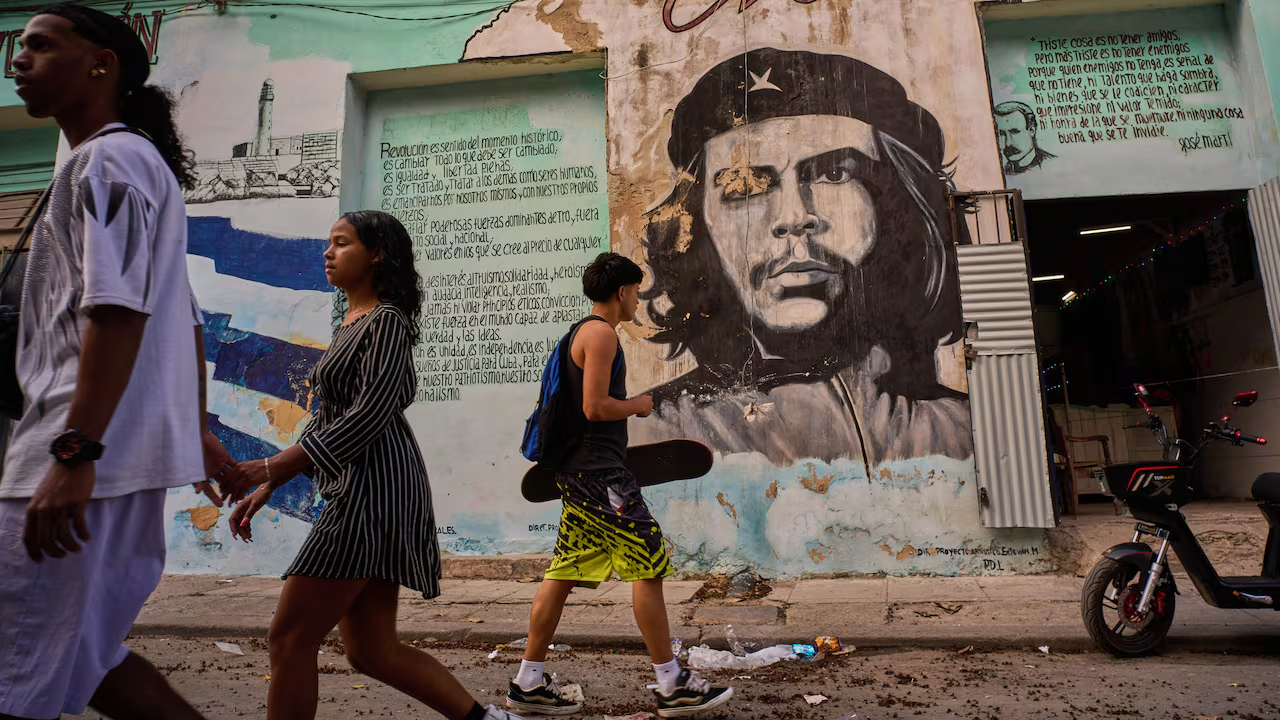
Sanctions in some form have been a constant from the early days of the 1959 revolution, led by Fiedel Castro and Che Guevara. This revolution, which began with the intention of implementing radical democratic reforms, had to go further in response to US opposition – leading to the effective abolition of capitalism.
While the Socialist Party would not have described the society that emerged as genuinely socialist – with the lack of democratic planning and personal freedoms – despite this and the sanctions, Cuban society was able to make serious strides throughout the 1960s, 70s and 80s – evidenced particularly in terms of the performance of its health and education systems, which far outstripped its peers in Latin America. Such was the turn out of medical graduates that Cuba was able to send doctors and specialists around the world to assist in humanitarian disasters, or simply assist in the development of the rudiments of public healthcare.
Cuba’s standing as an anti-imperialist bastion was further enhanced by Che Guevara’s commitment to replicating (unsuccessfully) the same methods of the Cuban revolution in other countries, including Congo and ultimately Bolivia where he was executed. In the 70s and 80s, Cuba committed troops in southern Africa when siding with the oppressed in conflicts including during the Angolan war, when it assisted the MPLA against Western-back forces, as well as SWAPO in Namibia in the fight for independence from apartheid South Africa.
Support shut off
The ability to trade with the Soviet Union and other Stalinist states was a vital assist to its survival, and advancement within certain parameters, during this period. However, the collapse of these regimes between 1989 and 1991 ushered in a period of hardship and the beginnings of capitalist activity, particularly in the tourist sector, making a comeback. The fact that Cuba itself did not go down with the Soviet Union and other Stalinist states is a certain reflection that the Castro regime had retained a level of support that had dissipated for others.
The situation was mitigated for a period with the election of leftist leaders in Latin America, such as Hugo Chavez in Venezuela, who were prepared to assist Cuba and in return obtained the benefit of Cuban doctors when the native medical profession refused to participate in a public system.
For all these reasons the current administration in Cuba remains hated above all by the exiles, concentrated in Florida, and their descendants including Trump’s Secretary of State, Marco Rubio. These represent the interests of the minority of lackeys who directly benefited from the right-wing Batista dictatorship that was overthrown by the revolution. They wish to turn the clock back and restore the power and privileges they lost from the time Havana was a site for rich playboys and the mob.
Therefore, socialists and anti-imperialists should oppose the blockade and agitate particularly in countries that have the means of providing Cuba with the basic requirements for society to function.
Solidarity against Trump’s imperialist agenda
It is clear from local reports that there is an understandable weariness in Cuba among working people and confidence in the administration is further eroded by its official non-acknowledgement of the crisis. There is no great desire within Cuban society for another US takeover, over 125 years from the last effective takeover.
There is a suspicion that a wing of the administration wants to reach an accommodation with the Trump administration for a managed transition. However, it should be clear from the overall foreign and domestic policy of Trump that the interests of ordinary people in Cuba will not be served by a transition being negotiated behind the scenes. Instead, they will have to independently organise and continue the fight for genuine socialism.