
By Thomas Carmichael
CW: brief reference to sexual abuse
Banned outright in Ireland and censored everywhere for 55 years, Ken Russell’s masterpiece The Devils has now been given a full theatrical release in its uncut form for the first time. The current run may also be its first full theatrical run anywhere on the island of Ireland. While not banned outright in the UK, I can find no record of whether it was or wasn’t screened in the North during its original theatrical run in 1971. It seems likely that it was not, although it has since received several one-off screenings in the Queen’s Film Theatre.
The French Wars of Religion and subsequent Huguenot Rebellions are ended. Under heavy influence from his Chief Minister Cardinal Richelieu, King Louis XIII seeks to re-establish the dominance of Catholicism. In service of this, he grants Richelieu permission to demolish the fortifications of all the walled towns in France, that they will be less easily defended and more susceptible to the external control of the state. This permission he grants in all cases except one, the town of Loudun, to whose recently deceased governor he promised that their fortifications would never be touched. Richelieu attempts to carry out the demolition nonetheless, only to be prevented by Father Urbain Grandier, a charismatic and educated yet proud and arrogant priest.
As a Jesuit, Grandier represents the progressive wing of Catholicism, such as it was, in the 17th century. Jesuits were founded upon the idea that the Catholic Church was in dire need of reform and must be ridden of corruption. Grandier has recently impregnated the daughter of the local magistrate. Subsequent to this, however, he has fallen in love with another parishioner and married her in secret, in accordance with his own private, sincerely held religious convictions which he bases directly upon the gospels rather than church doctrine, which do not forbid him marrying, as the church does. An unholy alliance begins to form out of disparate elements of the aristocracy, the state and the clergy, bent on destroying Grandier for reasons of petty grievance and of national and religious politics.
Religion as a tool of class power
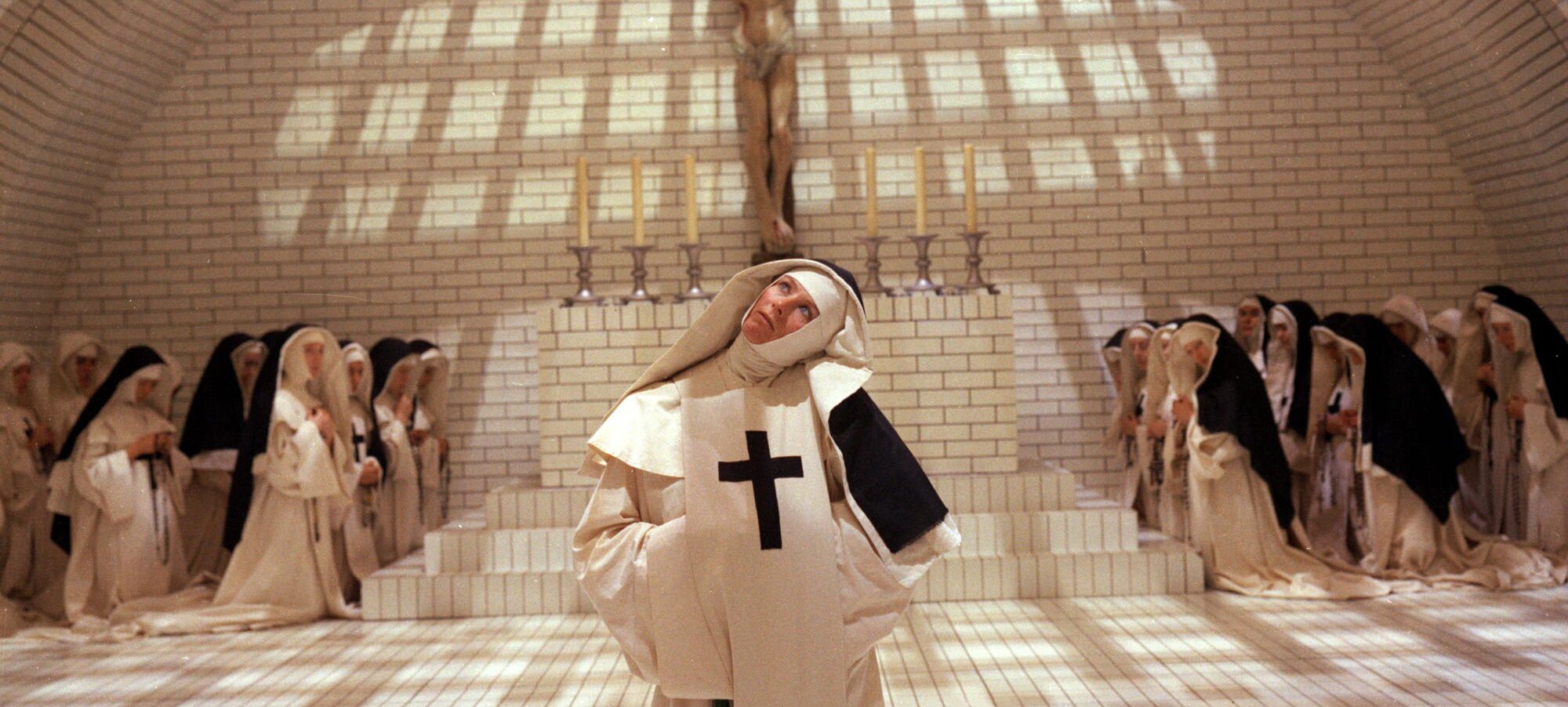
Bogus allegations of witchcraft are brought against Grandier, and he is accused of causing the possession by demons of an entire convent of Ursuline nuns. The nuns themselves are manipulated and threatened into acting out this possession in a debauched spectacle carried out within Grandier’s church itself.
Grandier is accused of being in league with the devil, and persecuted in the name of the church by men who know full well that he is innocent of the charges. It is a sickening act of hypocrisy that demonstrates how institutions become absorbed by the ruling class and used as a pillar to uphold their power. We see how organised religion is used by the ruling class as an effective instrument of control and domination but that they personally care not a whit for its doctrines and are happy to provoke acts of the most unimaginable blasphemy to serve their political agenda. Grandier is depicted as a flawed but ultimately pious, principled man. His faith is so sincerely held that it transcends any attempt by the powerful to bend religion to suit their machinations and so he must be destroyed, nominally in the name of God, by whatever means necessary.
Gender and oppression
Alongside the exploration of religion and power, the oppression of women emerges as another fundamental pillar of the ruling class. While the film’s depiction of women themselves does marginalise them and the named female characters are all defined predominantly through their relationship to a man, Grandier, the film equally does hold back when depicting their treatment in society.
The women of the Ursuline convent live a cloistered existence, shut away doing penance while God’s male servants enjoy a comfortable lifestyle and occupy a position of power and respect in the community. Worse still, we are told explicitly that most of them did not choose this life out of a genuine religious calling but are daughters of the nobility sent to the convent because their fathers could not afford to provide them a dowry.
The plot to bring about Grandier’s downfall rests almost wholesale on their abuse. They are manipulated and threatened into acting the part of crazed victims of demonic possession and at the same time are sexually abused by their so-called exorcists. Most severely treated is Vanessa Regrave’s Sister Jeanne des Anges, the Abbess of the Ursuline convent. Redgrave herself is a socialist and a lifelong supporter of movements against oppression, war and imperialism, often to the detriment of her career. That an actor with this political record would agree to such a difficult role shows she was confident the film’s portrayals of abuse were not gratuitous or exploitative but rather served an important political statement. Redgrave’s performance is exceptional, and she maintains that she is immensely proud of the film.
Censorship and the film’s power
The film has been subject to much state censorship. Banned outright in Ireland, with minor cuts mandated by the British state censorship board, the BBFC, and more extensive cuts mandated by the MPAA, the American industry body which classifies films.
The most significant censorship, however, was not state censorship but corporate. Warner Bros, who financed the film, took out a central sequence in which the nuns tear down and defile a crucifix en masse. This sequence is key to the central thesis of the film, as this scene of blasphemy is intercut with Grandier receiving communion elsewhere. The point is unmistakable. An act of sacrilege has been deliberately provoked for the purpose of tearing down a godly man for political purposes.
Not that blasphemy should be considered out of bounds in artistic expression, or justification for censorship, but for what it is worth Father Gene D. Phillips, academic film critic and ordained Catholic priest, defended the scene against accusations of blasphemy, saying the scene was not itself blasphemous but rather a depiction of blasphemy in service of a broader artistic endeavour that was not anti-Christian.
It is rare that a film should be so heavily censored and for so long. As filmmakers began to push boundaries from the late 1960s onwards, censorship became common. In the UK, films including Straw Dogs, A Clockwork Orange and The Texas Chain Saw Massacre were pulled from release entirely, with local councils having the authority to ban further films from screening within their jurisdictions. In Ireland, the state censorship board banned around 2500 films between its founding in 1923 and the mid-2000s, from which time onward the culture of banning and cutting subsided. Recently To Kill a War Machine, a documentary about Palestine Action, was banned in 2025 after that group was proscribed. The Irish author Sally Rooney has also had her books withdrawn from sale in the UK after her publisher feared legal action because of her support for Palestine Action. Besides this, all the above-mentioned titles were released uncut in the UK decades ago.
The Devils, on the other hand, has only been released uncut now for the first time. It has not been state censorship that prevented its release, but the continued corporate censorship of Warner Bros. Why has this film taken so much longer to be released unhindered than many of its contemporaries? An instructive comparison may be The Exorcist, released just three years later. Despite being a controversial film in its own right, and sharing the subject matter of demonic possession, The Exorcist had remarkably little trouble with censorship boards. However, when examined closely, this is not overly surprising.
Despite the overlap in subject matter, the two films take up the issue of possession in markedly different fashions. For all its notoriety, The Exorcist is an essentially conservative film; demonic possession is treated as absolutely real (which Catholic doctrine still officially holds it to be) and is overcome by the power of Christ wielded through his representatives in the church, itself portrayed in a mostly benevolent light and shown to succeed where modern medicine has failed. In The Devils, the possession of the nuns is explicitly treated as a case of mass hysteria and moreover, as a case of mass hysteria deliberately provoked by elements within the state, the aristocracy, and the clergy in the pursuit of the destruction of a pious and devout man for political ends. It is a far more radical message.
The Devils are not otherworldly beings that possess nuns; they are the men of power and of property. This film must be seen.

