By Conor Tormey
Maricarmen Abascal, an 87-year-old woman, was evicted from her home in Madrid on 23 September. The sight of a disabled pensioner being stretchered out of the home that she lived in for over 70 years sparked a housing movement that forced the investment company that owned Maricarmen’s home to allow her to move back, and reverberated across the Spanish state.
On 7 October, Maricarmen died, no doubt because of the stress and exhaustion caused by being evicted. We send our solidarity to the movement continuing to fight in her name. Spontaneous protests took place in the aftermath of her death, with protesters chanting “it’s not a death, it’s a murder”. Shamefully, the far-right Vox absented themselves from the local parliament tribute to Maricarmen, and the right-wing People’s Party vetoed a minute’s silence in parliament.
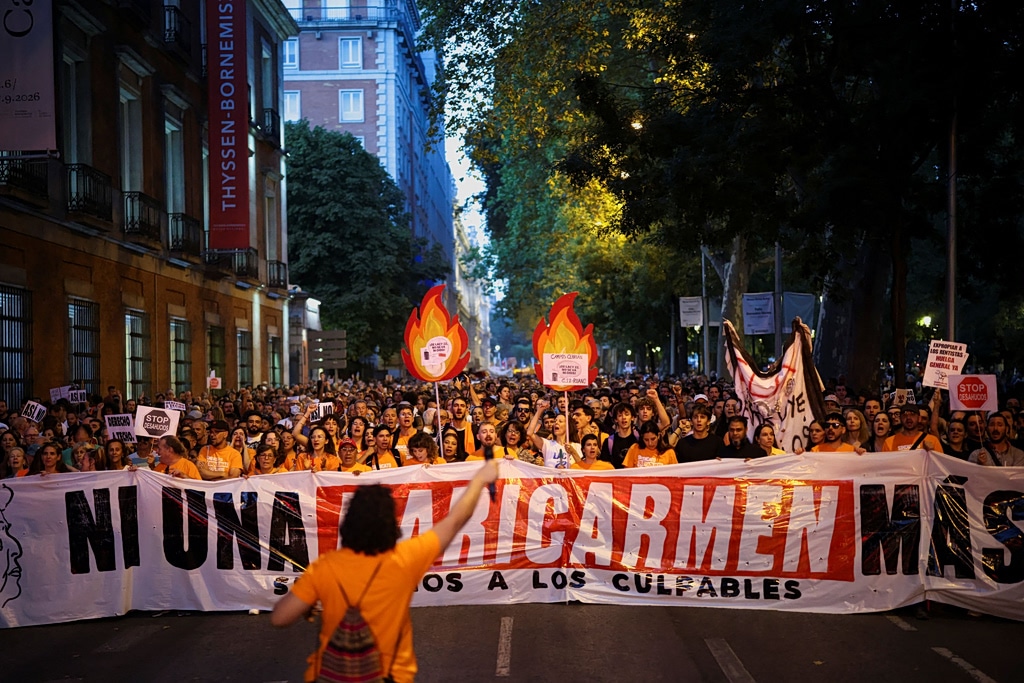
Over the past few weeks, thousands have attended protests, encampments have been set up in Madrid, and a snap election has been called for late November. Spanish Prime Minister Pedro Sanchez has called the election a referendum on housing policy, with the conservative People’s Party, the far-right Party VOX, and the right-wing Catalan party Junts voting against a series of proposals from the Sanchez government to ban evictions until 2030.
Francoist code
For the last 70 years, Marciarmen has lived in this house in Madrid’s Retiro district, moving in at 17 during the height of the Franco Dictatorship. A 1964 Urban Leasing law introduced “renta antigua” (old rent) leases, which allowed tenant contracts to be renewed indefinitely, heavily restricted rents, and allowed leases to be passed down to spouses or children. Thirty years later, this law was repealed, and a two-generation cap was introduced.
A 1956 Francoist civil code banned women from being co-holders of this lease, meaning Marciarmen’s father was the sole holder, passing it down to her mother when he passed away. When her mother died, due to the 1994 law, the house being inherited by her was illegal. She has paid over €500 a month until Urbagestión (a real estate company) bought the apartment in 2018. They tried to increase the rent to €2,650 and then to €1,650 a month, well above her monthly pension of €1,300.
This issue has been building since 2018; almost instantly, Urbagestión took the pensioner to court to squash the lease. The lower court sided with Macriarmen; the Provincial Court of Madrid (Audiencia Provincial de Madrid) sided with the real estate company, and the Supreme Court also sided with the real estate company, with no appeal allowed, in March.
For the past year, Urbagestión has held this eviction over her head, with the only alternative given by the local government in Madrid being an elderly care home stripping away her autonomy so Urbagestión could make more profit from the apartment. After four eviction attempts, and the UN Committee on Economic, Social and Cultural Rights calling for the eviction to be stopped, and a volunteer to cover her rent, she was evicted on the 22 September, having to be hospitalised due to extreme stress.
Movement develops
Instantly, a movement from below was developed; a spontaneous 10,000-plus protest outside a luxury penthouse bought by the People’s Party-run Madrilenian government erupted. Another protest organised by the tenants’ union was called on 26 September. This protest in Madrid, of over 300,000 people, with other protests happening in 12 other cities and towns across the Spanish State, including Barcelona, Seville, Valencia and Malaga to name a few, saw an encampment set up in the Puerta del Sol square, as a reference point to the indignados anti-austerity movement in 2011.
Other protests, including at Congress during the vote on the coalition’s housing proposals and hundreds of thousands marching last Saturday, have turned protests against an eviction into a movement about housing being treated as a commodity. This movement also didn’t come out of nowhere, and unfortunately Marciarmen wasn’t the only victim of the housing crisis. On Saturday, a demonstration was held in L’Hospitalet instead of Barcelona in tribute to Olga Matute, an anti-fascist and feminist, who committed suicide in early September, five months after being evicted by a vulture fund that wanted to sell.
How did it get here – housing proposals, Ceuta
The average rent rose 8.5% in 2025, housing prices rose 12.2%, and the Spanish state is short 700,000 houses. Just as in Ireland, housing is a key issue and will be a key issue in this upcoming election. Sanchez and PSOE are under immense pressure from what happened in Sabta (Ceuta) in late July, the housing crisis, and a litany of corruption scandals within PSOE, including connections to Sanchez himself. He and the government have also been broadly supported for their rhetoric on Palestine and refusing to allow military bases to be used by the US during the Iran war. When the alternative is a right-wing coalition that has voted against measures to fight the housing crisis, it’s understandable that many young and working class people may vote PSOE in the upcoming election.
The housing measures proposed by the government are broadly positive, including restrictions on short-term rentals, temporary bans on evictions etc.; however, at the time of writing, the proposals have been weakened with a cap on rent increases at 2% for the next year taken out of the second attempt at passing the bill. Although housing activists generally welcomed aspects of the bill, they correctly recognise that the decrees don’t go far enough.
Upcoming election/sanchez + PSOE/movement
Raomon Diaz, a participant in the encampment, said “Young people have been given little prospect for the future. And I’d like to see a truly left-wing government finally come to power.” This is an understandable aspiration that many young people, faced with such a bleak future, look towards. In the upcoming election, a right-wing coalition is the worst-case scenario for young people who will continue to be at the whims of government cuts, a market allowed to run riot without government intervention, and threats to women, LGBTQ+ people, and racialised people’s rights.
It’s vital that, in memory of Marciarmen, the housing movement continues and calls for housing to be a right, for a mass public housing project, and for the necessity of a future for young people. It is crucial that his movement remains on the streets and that the active movement from below is linked to organising a general strike to further push back right-wing and far-right forces. This should be linked to the struggle for a genuinely left-wing, anti-capitalist government that breaks with the rule of corporate landlords and big business, and takes their resources into public ownership to meet the needs of all working-class people.
The movement in the Spanish state, and the student revolts in France, show what is necessary in Ireland and generally across the world. The Gen Z protests across the Global South last year showed that young people can bring down governments. We urgently need an anti-capitalist and socialist movement that takes on the market and gets rid of the crisis-ridden capitalist system once and for all. To quote the German school student strikes against militarisation: “The rich want war – the youth, a future”!