By Chris Stewart
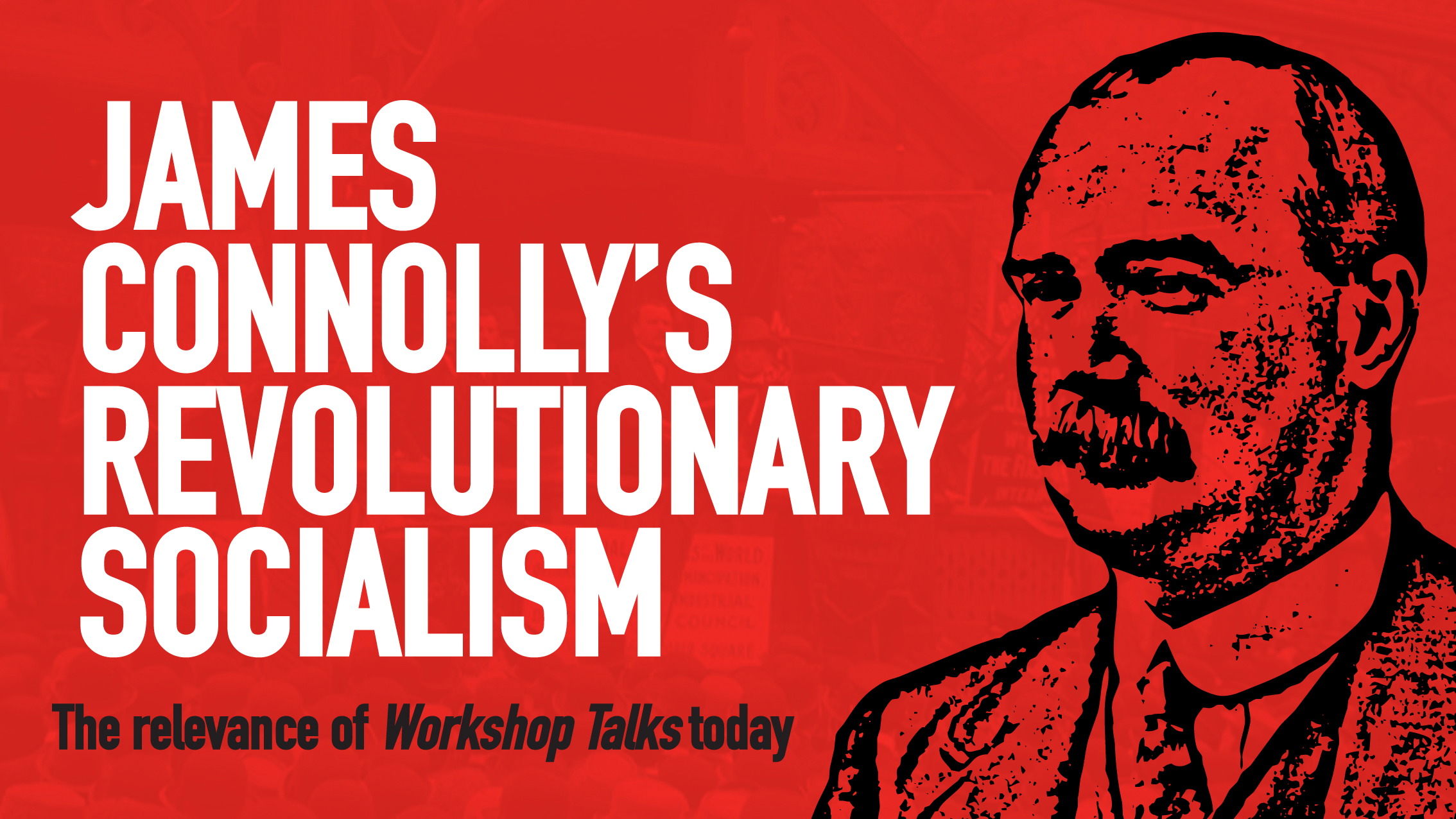
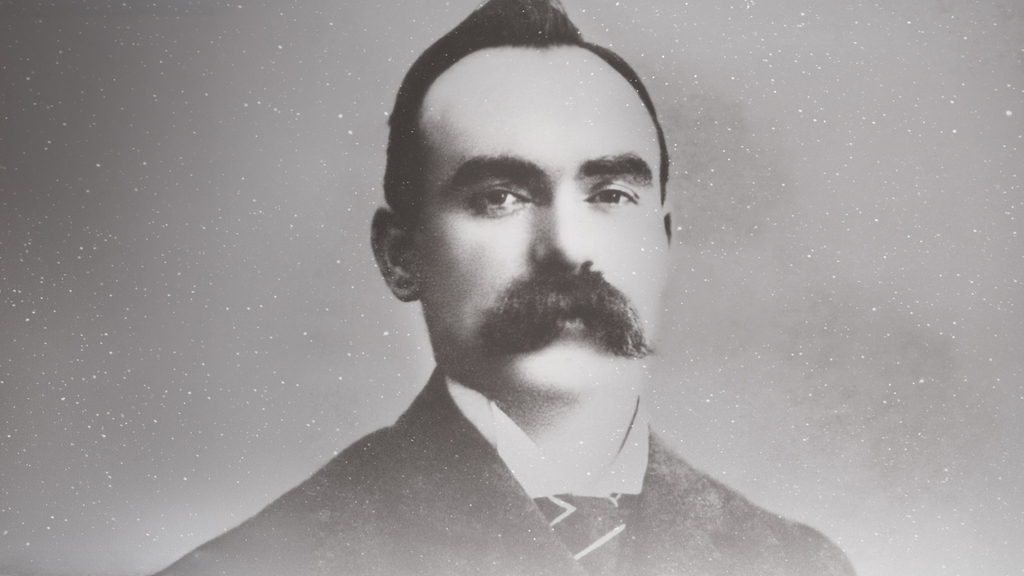
There is perhaps no figure in Irish history whose legacy is more distorted than James Connolly. Time and again, pro-capitalist politicians invoke his name as a nationalist hero of 1916, while taking great pains to gut his memory of any semblance of the revolutionary socialist politics he espoused. A new documentary film, We Only Want the Earth – The Life and Ideas of James Connolly, aims to correct the record. By highlighting Connolly’s role as a socialist activist and workers’ leader, the film correctly depicts Connolly as a revolutionary who played a leading role in the emergence of industrial trade unionism and the socialist movement across Ireland, Scotland and the US.
The film takes us through the key events in Connolly’s life, stopping only to comment on their relevance to life under modern capitalism. Photos of Edinburgh’s Cowgate slums show the conditions of poverty that he was born into as the son of Irish immigrants who fled to Scotland in the wake of An Gorta Mór. Irish immigrants in the city not only faced destitution, but also anti-Irish racism and discrimination. No doubt this experience fuelled the internationalist and anti-racist politics that Connolly held throughout his life. Amidst the stomach-churning attempts by some far-right, nativist figures to claim his image, his own words are a fitting rebuke: “Let no Irishman throw a stone at the foreigner; he may hit his own clansman”.
A working-class intellectual
Poverty forced a young James Connolly to falsify his age and join the British Army “for want of something to eat”. Stationed in Ireland, he was witness to the poverty and oppression wrought by British imperialism. Evidence suggests his regiment was deployed in Belfast during the sectarian riots in 1886, as well as to protect evictions from a landlord’s estate in Collon, but it is not known if Connolly was present at either (more recently, historian Conor McCabe has even raised questions about whether Connolly actually was in the British Army at all). Regardless, it is here that a nascent anti-colonial politics began to emerge in him. Later, he encountered socialist politics and trade unionism in Dundee before returning to Ireland and establishing the Irish Socialist Republican Party.
As the film describes, Connolly was a voracious reader and a working-class intellectual. Throughout his life he taught himself Italian, German, French, a little Russian, and even some Yiddish, in order to be able to hold conversations with fellow workers and comrades, and to be able to engage with the writings of Marxists from across Europe.
Far from the empty rhetoric of various strands of Irish nationalism, Connolly was a revolutionary socialist. He believed Ireland could not truly be free until the working class was rid of the landlords and capitalists who exploited and oppressed them. He aimed to organise working people everywhere as a class, seeing the transformative collective power of the workers of the whole world. He wrote:
“Ireland without her people is nothing to me, and the man who is bubbling over with love and enthusiasm for ‘Ireland’, and can yet pass unmoved through our streets and witness all the wrong and the suffering, the shame and the degradation wrought upon the people of Ireland, aye, wrought by Irishmen upon Irishmen and women, without burning to end it, is, in my opinion, a fraud and a liar in his heart, no matter how he loves that combination of chemical elements which he is pleased to call ‘Ireland’.”
One of the film’s achievements is how it shows the enduring relevance of Connolly’s life and ideas to the problems we face today. Pictures of the slum-like conditions of late 19th and early 20th century Edinburgh and Dublin are set alongside the reality of the housing crisis workers still face today. Discussions about Connolly’s anti-imperialist politics are woven with images of the Palestine solidarity movement in Ireland. And the radical youth fighting today for LGBTQ+ rights, against racism and the climate crisis are correctly cast as carrying the torch of Connolly’s lifelong activism. An image of a sleeping bag on the Connolly statue in Dublin is a particularly striking depiction of the ways in which his vision of a socialist Ireland has long been betrayed.
It is notable that the film received funding from various trade unions (SIPTU, Fórsa, and Unite). It is incumbent on the workers’ movement that we tell our own stories and remember our own history, against the incessant propaganda of establishment and corporate media. As a playwright, poet, and songwriter himself, Connolly saw working-class cultural expression as indispensable to a vibrant workers’ movement. “No revolutionary movement”, Connolly wrote, “is complete without its poetical expression”.
Many musicians, including Christy Moore, Eoghan Ó Ceannabháin, and Connolly’s great-great-granddaughter Tamsin Iona Connolly Heron, score the documentary with ballads of the international labour movement, giving expression to the rhythms of Connolly’s life and the class struggle he was embedded in.
Connolly and the IWW
Economic circumstances made Connolly migrate to America for a period, where he became an influential figure in the emergence of socialist politics and the Industrial Workers of the World (IWW) at the time. Irish immigrant workers played a key role in the early days of IWW organising. Though it highlights Connolly’s role as an organiser and an early champion of the IWW, the documentary ignores his important criticisms of some of the dominant ideas in the organisation. IWW leaders like “Big Bill” Haywood began to see politics as a distraction and advocated for a strategy of “direct action” by workers through “one big union” which could eventually bypass the capitalist state. Although he was partially influenced by these ideas that came to be known as syndicalism, Connolly saw political action alongside industrial trade unionism as necessary to smash the capitalist system.
Upon returning to Ireland, he became an organiser for the newly formed Irish Transport and General Workers’ Union (ITGWU), the first successful attempt to organise a militant, mass workers’ union on an all-Ireland basis. Connolly relocated to Belfast where he helped lead the successful Dockers’ Strike of 1911. Crucial to this strike was Connolly’s ability to unite workers from across the sectarian divide to fight in their common, class interests – a central feature of Connolly’s politics often ignored by the forces of nationalism. He saw sectarian division as a tool of the bosses, and mass workers’ action as the means to break its hold.
Connolly’s socialist feminism
In the documentary, Unite Regional Secretary Susan Fitzgerald, who is also a member of Solidarity, tells a story of how hyper-exploited mill workers in Belfast went on strike in the period after the Dockers’ Strike. These workers were young women, teenagers, and even school-aged girls. They faced horrific workplace conditions and punitive measures from bosses who wouldn’t even allow them to sing during work, seeking to squeeze every millisecond of productivity out of them. Connolly helped organise the campaign, and the workers put in a pay claim in addition to their original demands. After a bitter battle, the workers did not win on pay, but the strikes helped to build a powerful local branch of the union, and when they went back to work, “they went back singing”.
The film correctly describes Connolly as an early feminist, who saw the organisation of women workers and political action for women’s emancipation as crucial to the struggle for socialism. “None so fitted to break the chains as they who wear them, none so well equipped to decide what is a fetter”, he wrote:
“In its march towards freedom, the working class of Ireland must cheer on the efforts of those women who, feeling on their souls and bodies the fetters of the ages, have arisen to strike them off, and cheer all the louder if in its hatred of thraldom and passion for freedom the women’s army forges ahead of the militant army of Labour.”
World war and demoralisation
Connolly’s role as a central figure in the revolutionary history of the working class in Ireland is the focus of the film, detailing his formation of the Irish Citizen Army (ICA) in response to brutal state violence meted out against workers and their picket lines during the Dublin Lockout. Moreover, it points to Connolly’s opposition to the imperialist slaughter of the First World War at a time when the leaders of social democracy in Europe betrayed their principles by supporting their “own” ruling classes. This put him in the camp of Marxist leaders like Rosa Luxemburg, John McClean, Antonio Gramsci, Clara Zetkin, Lenin, and Trotsky, who stuck by their revolutionary principles at a time of extreme nationalism and militarism.
Actor Terry O’Neill performs Connolly’s own words throughout the documentary, and his words on this period are particularly haunting:
“What of the fine resolutions against war passed at the Socialist Congresses? What of the declarations that the workers would refuse to shoot each other down at the bidding of their rulers? What of the noble sentiments expressed in the speeches of the leaders? All gone to the winds. The bugles of war blew them all away”.
This betrayal affected Connolly deeply. He correctly saw that “a great continental uprising of the working class would stop the war”, but the apparent passivity of the working class in the early years of the war frustrated him. No doubt this was why Connolly began to look to radical nationalists like the Irish Republican Brotherhood (IRB) as potential allies in an uprising, though he was critical of their middle-class character and politics. Connolly had always supported the building of independent organisations of the working class and taught workers never to trust the middle-class leaders of the nationalist movement. In 1916, however, he was now willing to participate in a rising where he did not publicly put forward his own programme and vision of a Workers Republic during the week of the Rising itself. Instead, he solely put his name to the 1916 Proclamation, which, despite its anti-imperialist and progressive character, did not call for a break with capitalism and for a socialist society. This reflects the fact that he was desperate to see a blow being struck against the British Empire and the murderous, imperialist war it was involved in. His immense courage on this score can never be in doubt; however, even knew it was doomed to failure given that ripe conditions for revolution had not matured in Ireland.
But the documentary tends to downplay the tensions between the nationalism of the IRB and the Irish Volunteers, and Connolly’s vision of revolutionary socialism. Famously he instructed the ICA just days before the 1916 Rising to hold onto their rifles if they should be successful, for their goal was different from the Volunteers: “Remember, we are not only for political liberty, but for economic liberty as well”. He also commanded that the Starry Plough, the socialist flag of the ICA, be flung over the Imperial Hotel, owned by William Martin Murphy, leader of the bosses in the 1913 Lockout.
The failure of the Rising led to Connolly’s subsequent execution by a British firing squad, strapped to a chair as his injuries meant he could not stand. Nora Connolly’s emotional account of visiting her father before his execution is featured in the documentary. “Your life, James, your beautiful life” were amongst the last words spoken to him by his wife Lillie, who was by his side throughout much of the events described in the film. “Well, Lillie,” he answered, “hasn’t it been a full life, and isn’t this a good end?”.
Connolly’s execution robbed Ireland of its most important Marxist leader mere years before the revolutionary period from 1917-1923, , when a struggle for both national and social liberation emerged, a struggle that was impacted by events here in Ireland and globally, notably the Russian Revolution. This not only resulted in the beginning of the War of Independence in 1919, but also saw a major upturn in the class struggle in the form of general strikes, workplace and land occupations, a mushrooming of union membership and towns and cities being taken over by Soviets. This struggle also impacted the North of Ireland as witnessed by the Belfast Engineering Strike in 1919.
“We only want the earth”
“If you remove the English army to-morrow and hoist the green flag over Dublin Castle, unless you set about the organisation of the Socialist Republic your efforts would be in vain. England would still rule you. She would rule you through her capitalists, through her landlords, through her financiers, through the whole array of commercial and individualist institutions she has planted in this country and watered with the tears of our mothers and the blood of our martyrs.”
These words stand as an eerie warning from history of the capitalist Ireland that would emerge from the revolutionary period, dominated by poverty and inequality, plagued by landlordism and the Catholic church, and enthralled to this day to imperialism and multinational corporations. The “carnival of reaction” that Connolly warned partition would bring manifested in pogroms and the formation of an oppressive, sectarian state in the North, and later the bloody legacy of a decades-long sectarian conflict.
Though an impressive film in many respects, at times We Only Want the Earth tends to dilute the essence of James Connolly’s revolutionary socialist internationalism. Rather than just being an important figure from history to remember, Connolly’s legacy lives today in the ongoing struggle around the world to overturn the rotten capitalist system. “The day has passed for patching up the capitalist system”, Connolly wrote in 1910, “it must go.” Today, this rot in this system expresses itself more and more in imperialist wars and genocides, as capitalism threatens to swallow the whole world in ecological catastrophe.
James Connolly saw the real, living power of the working class to transform society. He saw the outlines of a better world in each struggle he led, a world based on solidarity, and the common ownership by workers of the wealth they collectively produced. Though this film only offers a vague sense of Connolly’s revolutionary vision, the path forward that he saw lay in the building of revolutionary socialist organisations of the working class and the oppressed. That is the key task today for anyone who wishes to carry on Connolly’s legacy. “For our demands most moderate are, We only want the earth.”
The documentary is currently available on RTÉ Player, at this link: https://www.rte.ie/player/movie/we-only-want-the-earth/794470440018