Article originally published on inquilabileninist.substack.com
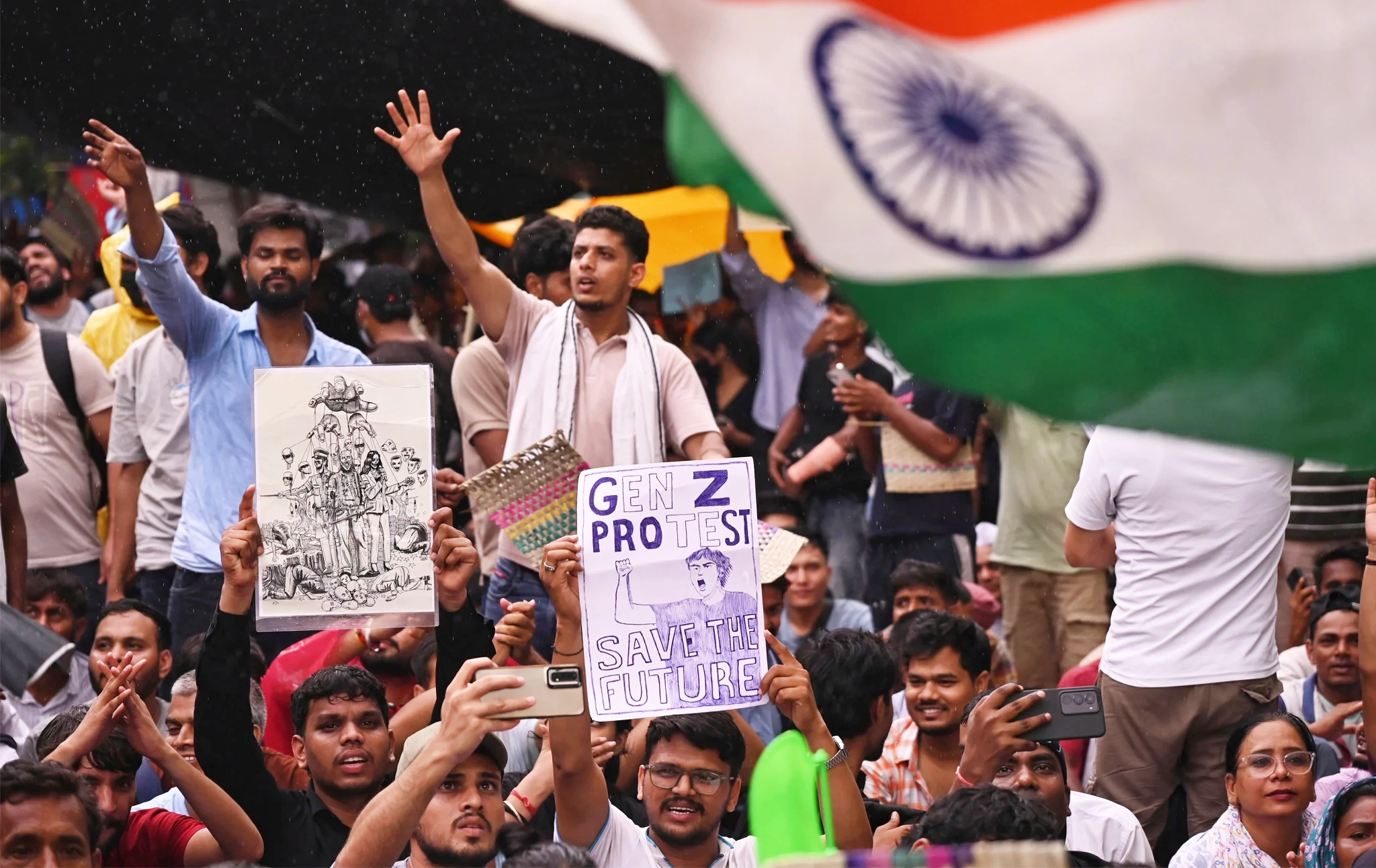
For the first time in 12 years of the Modi regime, a sitting Union Cabinet minister – Dharmendra Pradhan – has been forced to resign. Not out of moral conscience, but because millions of young Indians, breaking the shackles of religion, caste, and gender, flooded the streets of Delhi and every major city. The ideological fortress of Hindutva fascism has been shaken to its core by a wave of unity and solidarity that the ruling Bharatiya Janata Party (BJP) never anticipated. The tyrannical government had to bow before the courage, determination, and creativity of Indian Gen Z.
On 15 May 2026, Chief Justice of India Surya Kant, during a Supreme Court hearing, called unemployed youth “cockroaches” and “parasites on society,” accusing them of becoming “media, social media, and RTI (Right to Information) activists” who “attack everyone.” The remark delivered from the highest judicial seat instantly went viral. Even though the Chief Justice attempted a clarification within 24 hours, claiming he meant “fake degree holders” rather than jobless graduates, the damage was done. The hashtag #MainBhiCockroach trended nationwide, and within hours, a movement was born.
Formation of the Cockroach Janta Party
When Abhijeet Dipke, an Indian student living in Boston US posted on X “What if all cockroaches come together?” millions responded. The Cockroach Janta Party (CJP) was born as a satirical online platform. Its first demand was to sack the Education Minister Dharmendra Pradhan, who has presided over 152 public exam paper leaks since 2014 without facing a single moment of accountability. India’s university entrance exams are among the most brutal in the world – yet they are auctioned to the highest bidder. While the wealthy pay millions to buy the question paper in advance, ordinary youth spend years in gruelling preparation, their families selling land and homes to cover exorbitant coaching fees. The system is rigged from the start. And even for those who manage to clear the hurdle, the economy offers no refuge as 40% of India’s graduates are unemployed today. Between 2014 and 2024, over 25,000 students died by suicide after failing exams. Of these, 55% were under 18.
“Cockroaches only exist in a rotten place. So the system is so rotten that the Cockroaches are coming out!” posted Dipke. This was not a spontaneous outburst; it was the final straw. For over a decade and recently quite intensively, the Modi government had systematically crushed dissent – silencing journalists, satirists, and cartoonists on Instagram and X, arresting student leaders, and muzzling any voice that questioned soaring inequalities, brutal exploitation, mass youth unemployment, precarious work, widespread corruption, dilapidated public services, rising living costs, and growing anger at an increasingly authoritarian state. The Chief Justice’s words, uttered with the full weight of the state, exposed the ruling class’s contempt for the very youth they had betrayed.
Dipke returned to India on 6 June and led the first physical protest at Jantar Mantar, Delhi’s designated protest zone. He was soon joined by Sonam Wangchuk – the renowned environmental activist, leader of the ongoing Save Ladakh movement and the real‑life inspiration behind the Bollywood blockbuster 3 Idiots. When the cockroach campaign was struggling to take off in June, left-wing groups such as AISA (All India Students Association), Student’s Federation of India (SFI), Revolutionary Youth Organisation (KYS), and All India Student’s Federation (AISF) put boots on the ground day in, day out, while many Muslims stood in the frontline of volunteering. Wangchuk launched an indefinite hunger strike on 28 June, alongside six university students and members of the AISA. Protests erupted simultaneously in Kolkata, Mumbai, Bengaluru, Patna, and Hyderabad.
The mainstream media – long dubbed “Godi media” (lapdog media) for its unabashed subservience to the regime – initially buried the story. When it could no longer be ignored, they smeared the movement as “anti‑national,” funded by Pakistani and Chinese agents. Bollywood, which had made billions off Wangchuk’s image with 3 Idiots, stayed radio silent; lead actor of the film Aamir Khan even denied any connection, despite having publicly acknowledged the inspiration in earlier interviews. The establishment’s isolation of the protest only fuelled its growth.
Police repression and state terror
On 18 July, two days before a planned national march to Parliament, Delhi police abducted Sonam Wangchuk from the protest stage in broad daylight, wrapping him in a shroud and holding him in a private hospital under detention. This brazen act of state terror backfired. Within hours, Jantar Mantar was swamped by an estimated 100,000 protesters – arriving by bus, train, metro, and even flights from across the country.
On 20 July, as the crowd marched towards Parliament, they were met by the Rapid Action Force (RAF) and Delhi Police in full riot gear. What followed was a brutal state repression. Peaceful, unarmed protesters, including children, were beaten with nail‑studded batons, tear‑gassed, tasered, and shot with pellet guns. Five suffered severe pellet injuries; one lost an eye. Women were sexually assaulted. They removed their name tags to evade identification, while plainclothes goons wielding clubs joined the assault. Some tear‑gas cans were found expired, which may develop traces of cyanide – exposure could cause blindness and permanent respiratory damage. Yet the march pressed on. At Parliament House, security forces aimed AK‑47s at the crowd while Prime Minister Modi was hurriedly evacuated. By evening, police overran the main stage, vandalising walls painted with revolutionary slogans. But by nightfall, the protesters had reclaimed the site and rebuilt the stage.
Long known to Kashmiris, Muslims, Dalits, gender‑nonconforming people, farmers, and the working class, the illusion of a benevolent police force was finally shattered for the urban middle class who were until then showering flowers upon the police at Jantar Mantar. The Indian police system is governed by the Police Act of 1861, a law drafted by the British Empire as a result of the Sepoy Mutiny of 1857 against British colonialism. The explicit purpose of this institution was to suppress native uprisings, extract resources, and occupy hostile territories. It was designed to treat the civilian population not as citizens with rights, but as colonial subjects to be managed.
The repression only magnified the uprising. Swarms of protesters descended not only upon Jantar Mantar but upon every city centre, railway station, metro station, school, and university campus across the nation. The air thundered with slogans condemning not just the police commissioner of Delhi, but Home Minister Amit Shah – who exercises direct command over Delhi Police. The Emperor Modi was completely naked before the public eye. Chants like “Jab jab Modi darta h, police ko aage karta h” (”Whenever Modi is afraid, he sends Police forward”), and “Jab jab Modi darta h, Hindu Muslim karta h” (”Whenever Modi is afraid, he pits Hindus and Muslims against each other”) were raised. A poster said “The Devil Wears Vardi” (police/military uniform). The walls around Jantar Mantar were painted with anti-BJP artwork and radical slogans. A dedicated “Wall of Shame” was plastered with photographic posters documenting police savagery in grotesque detail – shattered skulls, bloodied faces, women assaulted, children brutalised – each image captioned with bitter, defiant epitaphs: “Dark Day for Democracy” and “Everything Will Be Remembered.” The students of the Indian diaspora held demonstrations in the UK, the Netherlands, Germany, and outside the Indian Embassy in Ireland – turning localised state terror into a global indictment of the Modi regime.
Education minister resigns
On July 22, Rana Ayyub posted, “This protest has completely outgrown the confines of CJP and its leadership. It is no longer about Sonam Wangchuk or Abhijeet Dipke. It has now evolved into an organic, nationwide expression of public anger, not just at the failure of the education system, but a complete collapse of governance under the Modi regime.”
The movement swelled to such an overwhelming extent that Narendra Modi was finally cornered. At midnight on July 24, he scrambled to release a makeshift video acknowledging student frustrations and vaguely promising fast-track courts to expedite paper-leak prosecutions, which is still mocked and trolled on social media. Until that very hour, Modi, Pradhan, and every single BJP minister were completely radio silent on the protests or hadn’t even remotely mentioned any student issue on social media. The following day, on the 25th, Dharmendra Pradhan resigned.
Outside Delhi, the protests have been most radical in the state of Bihar, from which the core of India’s industrial working class is drawn. When the police brought in barricades, they stole them and skated on them. When they were met with water cannons, they blasted music and started dancing to Bhojpuri tunes. When they brought large ropes to tie up groups of protesters, they started playing tug-of-war with them. Reports have emerged that in Siwan, a policeman fired an AK-47 and injured 3 protesters. 694 people were detained for enforcing the Bihar bandh on July 25.
Despite the life-and-death stakes of the struggle – the police batons, the tear gas, the hunger strikes, the shattered futures – the Gen Z cockroaches refused to carry the solemn, grim-faced martyrdom that older generations expected of them. They did something far more subversive: they made resistance joyful. They came with funny posters, sang, danced, made memes, skits, and edits. Protesters wore cockroach masks, Spiderman, Batman, and Power Ranger outfits. One protester held up a handmade sign: “Police daddy, hit me harder!” Young women filmed “fit check” posts featuring helmets, goggles, and homemade protest gear. Several posted get-ready-with-me videos encouraging others to join them to get beaten by cops. Protesters edited subway surfer-themed videos while dodging the police. Others made Bollywood edits.
The protest site became a living testament to mutual aid collective care. Hindus, Muslims, Christians, Sikhs, Buddhists, as well as people belonging to every caste, stood shoulder to shoulder and protected each other as they faced down the police. Local mosques and gurudwaras were feeding Hindu students. Anonymous supporters across India and abroad ordered from food delivery apps, delivering to whoever needed it at Jantar Mantar. So much food poured in that organisers had to post to stop sending more. A lot of protesters volunteered regularly to clean up the street. Queer-friendly tents were set up. The nation was healing.
Why Paper Leaks?
Paper leaks are not isolated incidents of corruption but rather a direct symptom of a systemically manufactured scarcity in education and employment, deliberately maintained to serve private profit over public need. The cut-throat competition that makes a leaked paper so valuable is a result of two converging trends: chronically underfunded public education and an ever-rising cost of private alternatives. While the Kothari Commission’s target of 6% of GDP for education remains unmet (stuck at 3.5-4.5%), the cost of education has skyrocketed, with the Consumer Price Index for education rising nearly 90% since 2013 and private school fees increasing by over 150% in urban areas. This is compounded by a massive disparity in opportunities, as seen with over 2.2 million students competing for just 130,000 MBBS seats in NEET, and 190,000 applicants for 71,000 seats at Delhi University. The artificial scarcity is even more baffling given the acute social needs and existing vacancies: over 350,000 teaching posts and 850,000 central government jobs remain unfilled, while private universities have grown by 150% to fill the void left by a weakened public system. Ultimately, this scarcity is a feature, not a bug, of a capitalist system that thrives on a desperate reserve of labour, forcing millions to accept exploitative conditions and turning education into a profitable commodity for a handful of billionaires.
While Dharmendra Pradhan’s resignation is undoubtedly a victory for the cockroaches, it by no means signals an end to the crisis. He himself was merely a symptom of a deeply dysfunctional system, and his departure does not touch its foundations. As critics have pointed out, his successor, Pralhad Joshi, is Pradhan’s “ideological twin” – both entered politics through the RSS-affiliated ABVP. Joshi is a long-serving RSS member whose most notorious “achievement” was his public defence of the Gujarat government’s decision to prematurely release the 11 convicts in the Bilkis Bano rape case during the Gujarat riots.
Beneath this surface lies an even deeper crisis: Pradhan’s exit cannot alter the two institutional engines driving this dysfunction. The National Education Policy 2020 (NEP) has failed to address inequality, but it is the National Testing Agency (NTA) that has become the epicentre of a full-blown examination disaster. In 2024 alone, of 14 major exams conducted by the NTA, five faced serious issues: NEET-UG was leaked, UGC-NET was cancelled a day after 900,000 candidates appeared, and JEE Main 2025 had at least 12 erroneous questions. Students have been assigned exam centres thousands of kilometres away – Andhra Pradesh candidates were wrongly sent to Kargil – and have endured mid-examination harassment, power outages, and forced re-checks.
The paper leak and for-profit coaching mafia actively fuel this chaos. The NEET-UG 2026 leak involved a multi-state syndicate: a Nashik printing press sold the paper for €30-40,000, which then travelled through six states via a paid WhatsApp group. An NTA subject expert, P.V. Kulkarni, allegedly earned ~€20,000 by dictating the leaked paper to students he coached at home, all to boost coaching institute success rates and profits. The system is not merely incompetent – it is a deeply intertwined network of officials, coaching centres, and criminal rackets that turns the futures of millions into a commodity.
The solution, therefore, can never lie in replacing a minister or reconstituting an agency. As long as education is treated as a source of profit and employment is deliberately restricted, paper leaks, fraud, and desperate competition will inevitably recur. The only genuine alternative is a socialist system – one that treats education, healthcare, and employment as fundamental human rights rather than commodities. In such a system, public spending on education would genuinely reach and exceed the 6% of GDP target, medical and educational seats would be determined by social needs rather than profit margins, millions of vacant public posts would be filled, and the creative and productive capacities of young people would be nurtured rather than wasted. This struggle is not merely about fair examinations; it is about fundamentally breaking the capitalist logic of manufactured scarcity and building a new society that serves the needs of the masses rather than the profits of a handful of billionaires. Students, workers, peasants, and all those oppressed by this system must unite, for their suffering stems from the same contradiction, and it is only through collective struggle that it can finally be resolved.
The situation now
The CJP leadership called off the protests on 25th July after the resignation. Although the collective power of the cockroaches was demonstrated, the state machinery remained exactly where it was. On 26th July, CJP leadership called for a victory standout celebrating Pradhan’s resignation at the major protest sites. However, the sea of angry protesters at those sites weren’t happy with just Pradhan’s resignation and wanted complete accountability for the students brutalised at Jantar Mantar and the complete overhaul of the government. People had posters calling for the resignation of the Commissioner of the Delhi Police, Modi, Amit Shah, Nitin Gadkari, and other prominent BJP ministers.
CJP leadership negotiated a deal with the BJP ministers and made this hasty decision without democratically consulting with the rank-and-file. Instead of demanding structural accountability, CJP was forced to chase one assurance after another: first it was resignation, then the withdrawal of FIRs, then the release of detainees, then the implementation of promises made by the BJP that no protester would face any legal action post the ending of the protests. A fascist state is an expert in finding loopholes; it gives with one hand and takes with the other. It makes promises while preserving the power to punish. State institutions become part of this process: the police, bureaucracy, prosecutors, and delayed implementation all become tools through which repression continues without openly rejecting the promise. While CJP is asking the government to honour assurances, people on the ground are still paying the price. There have been disproportionate crackdowns and detentions upon the usual scapegoats: Muslims, working-class people, and left-wing organisers in Delhi, Bengal, Assam, and Bihar. Several Gen Z social media accounts have been taken down that made viral content during the protests.
Recently, a demonstration was held at Jantar Mantar highlighting the dissatisfaction with the ending of the protests and police crackdowns. Meanwhile, the leftists, ordinary cockroaches, and the continuing state repression and propaganda against the movement have been pressuring to reignite the cockroach movement on an even higher level.