By Conor Tormey
At the time of writing, the World Cup is in its final week. The final will be viewed by billions of people, surpassing the last one. FIFA estimates that over 6 billion people have engaged with the competition in some way over the past month. There’s little doubt that the World Cup remains the most important global sporting event.
Unfortunately, like the last World Cup that was held in Qatar, controversies, corruption and rotten political interference overshadowed the sport in the lead up to the event, leading to relatively low expectations. Being co-hosted by the United States, with the fascistic Trump regime in power and its waging war in Iran (one of the participating teams), created a feeling that the tournament could be a disaster.
That feeling didn’t dissipate, as controversy after controversy has taken away from the matches, which have been good overall – and some really great. But there is still a feeling that the legacy of this World Cup will be the controversies, and the realisation that the soul of the beautiful game is being gutted by a governing body rotten to its core with corruption.
Previous World Cups
Attracting controversy is nothing new to FIFA. In fact, at least the past five World Cups have been tarnished in some way.
The last three hosts have all been repressive states that wanted to sportswash their image. The 2018 and 2022 iterations were held in Russia and Qatar respectively. FIFA president Gianni Infantino turned a blind eye to the human rights abuses, the anti-LGBTQ+ laws, and the abuses of migrant workers constructing the stadiums. At least 6,500 people died on building sites linked to the Qatari World Cup alone. Allegations of corruption are still denied by FIFA and the Qatari and Russian governments, but a report commissioned by FIFA said: “bidders tested rules of conduct to the limit.” The reality is that undoubtedly there were payments to FIFA officials within the bids to host.
Unfortunately, both cups were somewhat successful in sportswashing these countries’ images, and the human rights abuses were secondary during and immediately after the cups. It remains to be seen how well this will go for the US and the Trump regime.
Authoritarianism history
It’s no surprise that FIFA are happy to look past human rights abuses. Jérôme Valcke, former General Secretary of FIFA, said in 2013 that “less democracy is sometimes better for organising a World Cup”.
In 1978, Argentina, under military dictatorship, hosted the tournament. The military junta is estimated to have killed up to 30,000 people during its reign. This will also continue in 2034 as Saudi Arabia is set to host. The Saudi kingdom, which criminalises the LGBTQ+ community, bans unionisation and strikes, and restricts freedom of expression, has heavily invested in sportswashing – creating LIV golf and hosting the Saudi International golf tournament, buying Newcastle United, and holding large WWE and boxing events. Like in Qatar, migrant labour rights and concerns about thousands of deaths from unsafe conditions will be ignored.
A tournament with disturbing similarities to this year’s was held in 1934, during Benito Mussolini’s fascist dictatorship in Italy. Sports were a major weapon used by the fascists to maintain control; socialists were purged from sports institutions, the Fasci Giovanili di Combattimento (National Fascist Party youth organisation) took part in grassroots leagues and cups, and over 2,000 stadiums were built by the 1930s, which were used as a propaganda weapon for the dictatorship.
The second World Cup was given to Italy to host with a mutual benefit gained by FIFA and the fascist regime: Italy’s stadiums built during Mussolini’s reign and the security inherent within an authoritarian regime gave hope for a “successful” World Cup. It also gave an opportunity for Mussolini and the National Fascist Party to promote fascism abroad.
The stadium of the National Fascist Party held the final between Italy and Czechoslovakia, in the presence of Mussolini, who gave the team his own trophy named “Coppa del Duce” in place of the FIFA trophy. Italy won the game 2-1, in a competition that has been accused of corruption and bribery in favour of the Italian team. The 1934 cup gave legitimacy and cover for Mussolini, two years before invading Ethiopia, sending troops to support Franco in Spain, and signing the anti-Soviet pact with Nazi Germany and the Japanese Empire.
World Cup 2026
FIFA’s own human rights policy, implemented under current president Gianni Infantino in 2017, says: “Where FIFA may have adverse impacts on the human rights of people belonging to specific groups or populations that require special attention, it will also consider other international standards and principles that elaborate on the rights of such individuals, including in particular those standards concerning indigenous peoples, women, national, ethnic, religious and linguistic minorities, children, disabled people, migrant workers and their families and human rights defenders. Moreover, where FIFA’s operations extend to situations of armed conflict, it will also respect the standards of international humanitarian law.”
FIFA has openly defied its own policy because it never made any real attempt to adhere to it. It was put in place under pressure because of the awarding of the tournaments in Russia and Qatar.
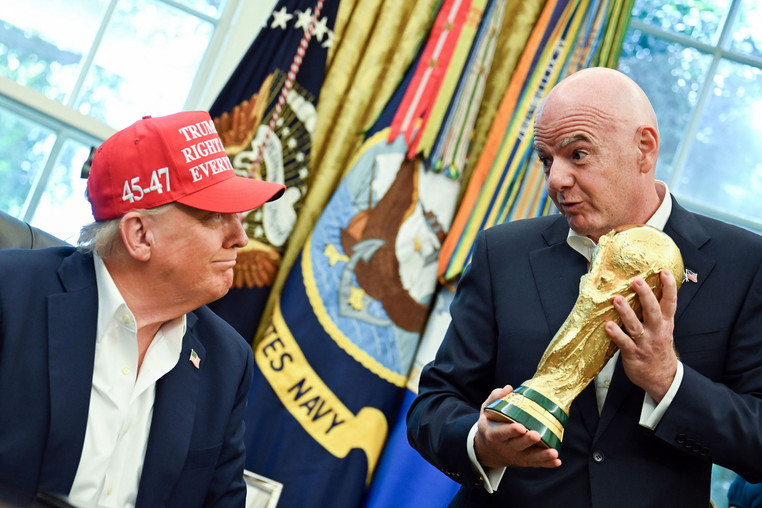
Now Trump has sought to use the competition to sportswash his crimes domestically and internationally – the brutality of ICE, the kidnapping of Maduro, the war on Iran, and the starvation of Cuba. He has continually used sports as a wedge to promote his agenda and put himself centre stage: his administration made trans women in sport central to the nationwide attack on trans people, he has hosted and attended multiple UFC, NBA, NFL, FIFA events since 2025. This year, he hosted a UFC event in the White House, attended the Super Bowl (the first sitting President to do so) and the NBA finals, he’ll give the trophy to the winners of the World Cup, and had plans for a potential visit to the Irish Open taking place on his golf course in Kerry.
His willingness to centre himself at sporting events, even while being booed by a large majority of stadiums, is the crushing blow to the false division between politics and sports we hear about from those who are too cowardly to take a stand against Trump and his ilk. But the ridiculousness of this World Cup isn’t just down to Trump; it’s also down to FIFA, which is willing to bend over backwards to his desires while promoting its own corrupt ends, allowing controversies to overshadow the competition.
Case Study 1: How the US got the World Cup – “Peace Prize”
The US / Mexico / Canada bid for the World Cup was decided in 2017, with 134 footballing associations voting in favour of the bid, and 65 in favour of the opposing Moroccan bid. The disgraceful indulgence of Infantino towards Trump has been a factor from 2017 onwards. In 2020, he had dinner at the Global Economic Summit in Davos. Infantino was at the signing of the Abraham Accords. He attended Trump’s inauguration and the “Board of Peace” meeting in early 2026, pledging $7 billion to build a new stadium and fields in Gaza.
This is despite Israel already destroying all football facilities without any condemnation from FIFA, while Infantino said he supported “the actions and policies” of Trump. The worst kowtowing was the awarding of the ridiculous “FIFA Peace Prize” to Trump just months before he started a war in Iran, and while he was overseeing the genocide in Gaza.
Case Study 2: Ticket prices and commercialisation
FIFA, not content with allying itself closely with Trump, decided to also change established practices to suit the US-style content of the tournament. This included the extortionate ticket prices, which essentially makes the tournament inaccessible to those without thousands of dollars to spend. Looking at the prices for the 2022 World Cup, the cheapest ticket for the opening match was $55, and the cheapest for the final was $206. For the 2026 opening match, the cheapest was $560, and $2,030 for the final.
The price for a supporter wanting to go to each of its team’s matches from the group stage to the final could be up to an outrageous $6,900, without even paying for flights, hotels, transport, and other spending money. One reason for the rise in prices is dynamic pricing, which pushes ticket prices higher as demand rises. The only winners for this model are those who are able to pay, pricing out the working-class fans who supported teams through qualifying.
The World Cup is no longer just a football tournament; it’s an entertainment spectacle, a commercial event not built around the brilliant footballing abilities, but built around celebrities, music, sponsors, appealing to a US audience, looking more like the Super Bowl than a traditional football tournament.
These have always been a part of football. The Champions League final has opening performances by celebrities, and major money spent on advertising space, but the problem is changing the way football is played to fit these aspects in. The final will feature its first-ever “half-time show” with singers going beyond the 15-minute halftime break that has always been part of football matches, going up to 30 minutes.
Throughout the tournament, there have been three-minute ‘hydration breaks’ in each half, which has been a feature of annoyance for fans, with the break being heavily booed in numerous matches as it can impact the crucial momentum and atmosphere of the game. For fans at home, this annoyance has been a way to push advertisements and get more money for broadcasters.
Case Study 3: ICE and Trump’s racism
The ‘Football Unites the World’ campaign was started at the Qatar World Cup by FIFA under pressure due to the host country’s record. Speaking at the UN in May, Infantino said “I hope we can use this World Cup to really unite the world. We say it as our motto in FIFA: Football Unites the World”. Something he’s clearly abandoned during this World Cup.
Only this week, we’ve seen another two murders at the hands of ICE: in Maine, a 26-year-old Joan Sebastian Guerrero, and 52-year-old Lorenzo Salgado Araujo in Houston, both shot by ICE, adding to the eight other people killed by ICE this year. During the World Cup, this semi-fascist agency arrested approximately 2,000 people a day, with 39,000 people held in ICE centres during June, clearly using the media attention on the cup to distract from its targeting of migrants and racialised people.
The denial of visas from the Global South meant that fans of teams such as Haiti, Côte d’Ivoire, Iran, and Senegal were stopped from travelling to support their teams due to a travel ban on these countries. Iranian staff, coaches, and managers had a substantial number of permits refused; other players, such as Swiss striker Breel Embolo and Iraqi striker Aymen Hussein, were subject to interrogations for hours at airports. Somalian referee Omar Artan, Iraqi photographer Talal Salah, and members of the Iranian staff were not allowed to enter the US and were deported.
There has also been an increase in racist chants during matches. The racism being spewed from politicians, governments, and a rise in racism on social media is having an impact on matches. Dutch players Justin Kluivert, Quinten Timber, and Crysencio Summerville were targeted by racist abuse after missing penalties against Morocco (a story similar to what happened to English players Bukayo Saka, Jaydon Sancho, and Marcus Rashford during the 2020 Euro final). After a match between Paraguay and France, Paraguayan senator Celeste Amarilla posted horrendous abuse levelled at French striker Kylian Mbappé.
FIFA said it supported Mbappé; however, it still allows these incidents in stadiums, with negligible punishments. Unless there is a radical shift and fightback from the grassroots of the game to stamp out racism, FIFA will just do the bare minimum, if that.
Case Study 4: Overlooking sexual violence
Along with an increase in racism, there has been the prevalence of players with sexual assault / gender-based violence allegations who have had no limits placed on their involvement. Numerous players, including Cristiano Ronaldo (Portugal), Achraf Hakimi (Morocco), Thomas Partey (Ghana), Gonzalo Montiel (Argentina), Thiago Almada (Argentina), Junya Ito (Japan), among others, were allowed to play every game (with the exception of Thomas Partey, who wasn’t allowed into Canada for his opening game). Even on the pitch, these players were welcomed with open arms. When England played Ghana, Declan Rice (Arsenal and England midfielder) came under fire for hugging Thomas Partey at full-time. The only player to take a stand against him was Djed Spence (Tottenham and England left-back), who refused to shake his hand at the start of the game.
This inaction against sexual violence and gender-based violence is prevalent in all sports, with athletes like Kobe Bryant (Basketball), Mike Tyson (Boxing), Conor McGregor (MMA), and Diego Maradona (Football) all being credibly accused or jailed for rape and are still lauded and celebrated within their respective sports. In the NFL, gender-based violence offences make up nearly half of player arrests. When FIFA links itself so heavily with an administration whose President is an abuser himself, it’s no surprise that it turns away from any action on such abuse.
What happens on the pitch also has an impact on households. A Lancaster University study showed that there’s a 38% increase in domestic abuse reports when England loses and a 26% increase when England wins or draws. The relationship between gender-based violence and the World Cup is especially true in England. The right-wing media, in particular, often seeks to whip up a chauvinistic frenzy where there is so much hype and anticipation about the chances of England winning.
FIFA will wax lyrical about anti-racism and anti-mysogyny, with Infantino’s infamous speech in Doha in 2022 saying “Today I feel Qatari. Today I feel Arab. Today I feel African. Today I feel gay. Today I feel disabled. Today I feel a migrant worker”, but his record shows that there is no limit he will pass on these issues as long as the cash is on (or under) the table.
Case Study 5: Trump and the US red card
The last controversy, with the least consequence but has received the most media attention, is the refereeing decisions in multiple matches. Twenty matches in total have had questionable decisions that mainly favoured bigger ‘footballing’ nations. Argentina has been picked out by the media for questionable refereeing decisions, specifically in matches against Austria, Cape Verde, and Egypt. England has also had questionable decisions given against Ghana and Norway.
The most consequential decision made by FIFA was the decision to overturn a one-match suspension for US striker Folarin Balogun, who was sent off for a bad tackle in a game against Bosnia and Herzegovina, after interventions from Secretary of State Marco Rubio and a specific call to Infantino from Trump. Again, this is just plain corruption and political interference from the Trump administration, however it’s completely unsurprising for a governing body that revels in its pathetic relationship with Trump.
FIFA corruption – beyond Infantino
Gianni Infantino is now a global hate figure, who is regularly and passionately booed at matches. There are calls to investigate Infantino for openly flouting the ‘politically neutral’ policy of FIFA; it’s unlikely that any investigation will take place and that any special congress will be held, as the FIFA presidential election will be held next year. There is also potential that Infantino will win the election, as his promise to increase World Cup places to 64 would be welcomed, especially from smaller nations. Regardless, the problems with FIFA go deeper than Infantino and his cronies; there is a deep corruption issue with FIFA from the top down.
Despite the 2015 corruption case, which ousted previous corrupt president Sepp Blatter, there hasn’t been a cultural change in FIFA. The profits made by this World Cup have exceeded $10 billion, and no doubt FIFA officials are paid handsomely from that.
End billionaire rule of football
Football was kept alive in spite of the ruling class that tried to kill the sport. Textile workers in Manchester, metal workers in Birmingham, dockers in Liverpool, and miners in Yorkshire; it was through these workplaces that the organised football we know today was developed, despite attempts to ban it. Organised football was built from workers’ and trade union struggles for shorter work weeks. Still, football is an avenue for struggle. The growth of the League of Ireland is in spite of the lack of investment from Fianna Fáil and Fine Gael for decades, and in opposition to the English clubs increasingly run by billionaires for profits. We saw the mass protests that forced the owners of some of the biggest European clubs to end the farcical proposal to create a ‘European Super League’, and today we see the vibrant campaign to stop the Ireland V Israel games in September and October.
The football governing bodies, along with owners, are attempting to kill the passion that football has developed. The unpopular rule changes, the extortionate ticket prices that are pricing communities out of stadiums, are radically different from the community-led spirit that was seen 40 years ago. This will unfortunately continue as long as football is run for the profits of an owner or conglomerate, instead of athletes, fans and communities.
Football can be radically different; instead of corrupt bureaucrats in FIFA, UEFA, FAs, and clubs, we can demand democratically run bodies representative of players, coaches, fans, staff, and communities, taking clubs out of the ownership of billionaires and into the control of stakeholders who truly care about the clubs. The beautiful game will truly be beautiful when we end the rotten capitalist commodification of football for all to enjoy.