By Varun
Making a movie is not an easy task but shooting it entirely on 70mm IMAX film and editing it entirely by hand using a vintage 1940s-style splicer, glue, scissors, and physical film with precise edge-code numbers in 2026 is a generational achievement. At a time when there are movies which are made entirely using Artificial Intelligence (AI), Christopher Nolan has gone through incredible pains to make a $250 million adaptation of Homer’s epic The Odyssey. This feat alone makes this movie distinct from other mainstream blockbusters in recent times.
Even before its release, there was a predictable right-wing backlash over the casting of Academy Award nominee Elliot Page (a trans-man, who previously worked with Nolan in Inception) and Academy Award winner Lupita Nyong’o playing Helen of Troy. The infamous whiner and plutocrat Elon Musk declared that “Nolan has lost all his integrity” and promised to make an AI adaptation of The Odyssey using Grok. We can already see it ending up like his long list of failed projects like hyperloop and Tesla robots.
Despite all these culture wars, calls to “boycott” the movie, and right-wing accounts spamming the IMDB page with 1 star ratings, the movie has made well over $1 billion at the global box office, rated a whopping 8.5 on IMDB, and is poised to make huge wins in the upcoming awards seasons. But does Nolan do justice to Homer’s epic? Is this a good follow-up after the all-time classic Oppenheimer? Is the movie really “woke”? Was Matt Damon the right choice to play Odysseus?
The Odyssey is set after the end of the Trojan war. The movie features the siege of Troy and in a typical Nolan fashion is narrated in a non-linear manner. The movie follows the journey of Odysseus on his return to home and the power struggle gripping in Ithaca during his absence. The film opens with Sinon (Elliot Page) guarding a wooden horse half-buried in the sand. The Trojans kill Sinon and believe it was an offering from the Greeks.
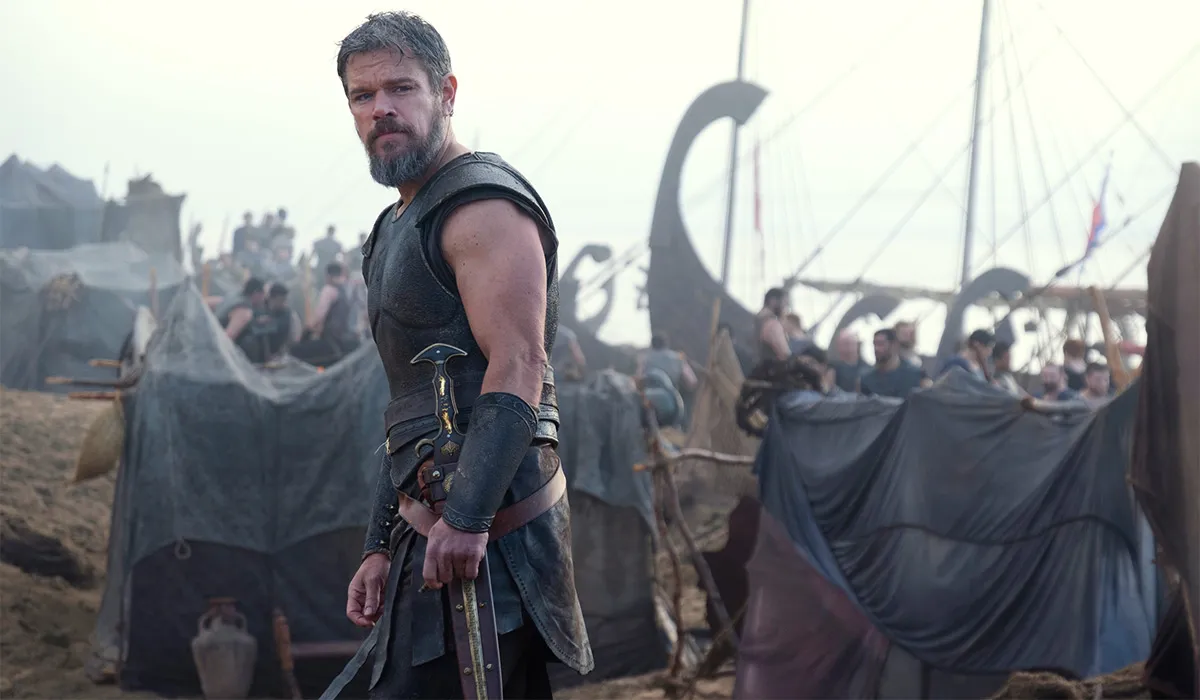
The movie immediately cuts to Ithaca, where Odysseus’ wife Penelope (Anne Hathaway) and his son Telemachus (Tom Holland) are faced with no choice but to entertain an array of brutish, well to do suitors, led by Antinous (Robert Pattinson) due to Zeus’ law. The suitors drink, dine, and torment the workers of the palace. Odysseus (Matt Damon) is introduced to us in a flashback narrated by Eumaeus (John Leguizamo), Odysseus’ blind advisor. Jennifer Lame beautifully edits the movie where distant past, recent past, present, and future are transitioned seamlessly throughout the 172 minute runtime.
Odysseus’ encounters with gods, monsters, and witches are revealed to us as forgotten memories being recollected by Odysseus, who at present is living in a state of semi-amnesia on an island, taken care of by Calypso (Charlize Theron). In those memories, we see Odysseus and his crew led by his commander Eurylochus (Himesh Patel), encounter Cyclops, the iconic man-eating one-eyed giant, the sorceress Circe (Samantha Morton), the giant monsters Laestrygonians in Aeaea who end up killing most of his soldiers, and a journey to Hades, a realm for the afterlife in Greek mythology, where he is chased by his fallen soldiers.
Telemachus leaves for Sparta to find his father and in the process meets Menelaus (Jon Bernthal), the husband of Helen of Troy, who narrates to him about the Trojan war and the tragic fate of Agamemnon (Benny Safdie). Antinous learns about Telemachus’ plan and plans to murder him before he returns to Ithaca. Odysseus is finally able to recollect the memories of the fate of his crew with the help of the Calypso, he heads back to Ithaca after 20 years to save his family.
Ancient story, modern themes
The Odyssey is a centuries old tale but Nolan uses themes of it to highlight the challenges faced in contemporary society. The siege of Troy is depicted as a war crime where innocent women and children are killed because of Agamemnon’s imperialist ambitions. Odysseus instantly regrets his plan to use the Trojan horse after he sees his men inflict horrors on the civilian population of Troy. Those images haunt for the rest of his life. The sorceress Circe’s anger towards Odysseus and his soldiers serves as an allegory to male violence against women and girls in war zones, Odysseus’ semi-amnesia state resembles how soldiers are ignored by the state and often left to die on their own after serving their purposes for imperialist adventures, and fall of the Bronze Age Civilization due to Odysseus breaking the Zeus’ Law is a direct a parallel to today’s world facing the threat of climate change and authoritarianism due to the destructive nature of capitalism.
Nolan depicts Odysseus as a guilt-ridden veteran, offering a different perspective from Hollywood’s usual depictions of a proud masculine unfeeling warrior. But the film does stick to the traditional hero-worship storytelling especially in the third act. The women of the film have very little to do (like most Nolan movies) and Penelope is portrayed as a damsel in distress waiting for her husband to rescue her and while acknowledging that women aren’t often given positions of power, she refuses to fight back against the system. Odysseus is still an old-fashioned hero, who goes through a hero’s journey and finally achieves his ultimate quest. The movie is after-all set at a time when power was hereditary and man was always seen as the governor.
On the technical front, it is yet another feather on the cap for Nolan. The practical effects with minimal use of CGI works like a splendour just like Oppenheimer. You can feel the sand, water, ship, the smell of the air, and the urgency of Odysseus’ crew as they battle one challenge after another. The fact that the entire pig sequence was achieved using prosthetic makeup is a testament to Nolan’s strive and passion for film-making. There are only a handful of film-makers in our history who would take such bold and time-consuming risks. Shot entirely on live locations and avoiding studios makes us feel like we are travelling with Odysseus. But that doesn’t come without criticism, shooting in Western Sahara which is currently occupied by Morocco is a deeply immoral and tone-deaf decision especially when the movie talks about the horrors of imperialist wars.
Matt Damon gives a performance of a lifetime as Odysseus and shoulders the movie entirely on his own, his effort for this movie is evident by the physical transformation he has gone through and the different looks he sports across the movie’s two decade timeline. The Sirens sequence might be a testament to his performance but it is the infamous bow string scene towards the end that cements his ability to be an actor and a star. While Damon anchors the movie on-screen, it is Ludwig Göransson’s score behind the scenes which completes the movie. The soundtrack is haunting and surreal with synth and sorrowful strings at its forefront. It is a goodbye from the orchestral soundtrack that was used in Oppenheimer.
Cinematically Ambitious
The Odyssey is a natural step of progression in Christopher Nolan’s ambitious filmography. His previous two blockbusters, Inception and Interstellar are both heavily inspired from Homer’s Odyssey, except they were set in a world of dreams and in space respectively. Just like Oppenheimer, the protagonist is forced to reckon with the damages of his actions for the rest of his life. While Oppenheimer warns about the threat of impending nuclear armageddon, Odysseus warns us about a world where the rule of law collapses. He wants to sympathise with both Oppenheimer and Odysseus despite their unforgivable actions and portrays them as “flawed men who did bad things for the greater good” but it is hard for us to brush aside when those crimes involve creating nuclear weapons and committing war crimes on civilians.
Despite its warnings of climate change and being explicitly anti-war in its theme, it does come short when it tends to blame it entirely on just “collapse of rules based order” and “Man’s greed”. The imperialist wars and genocides and the ecological disasters taking place today are not a result of the collapse of the rule of law, but the outgrowth of the rule of the capitalist system which is built on violence, theft, and oppression.
It is still refreshing to see a blockbuster made on a $250 million budget tackle bold themes and make more than $1 billion at the global box office. The success of The Odyssey is a proof that ambitious stories and film-making, which shuns the use of excessive CGI and AI, will always appear superior compared to template franchise movies. It is not just about the box office but The Odyssey is a significant cultural phenomenon which will be spoken about for years to come. That’s the film’s true success.