By Thomas Carmichael
As we stand in the middle of the centenary of the 1926 General Strike, it is impossible not to draw parallels with the situation faced by workers today.
Fuel prices have been driven into orbit by the US and Israel’s Imperialist war on Iran. Workers, having never fully recovered from the 2022-23 crisis sparked by the invasion of Ukraine, are staring down the barrel of a further squeeze on their living standards for a crisis not of their making.
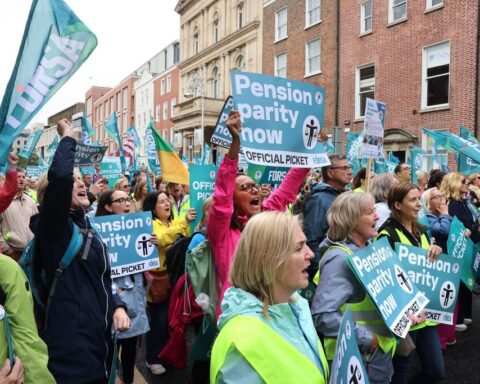
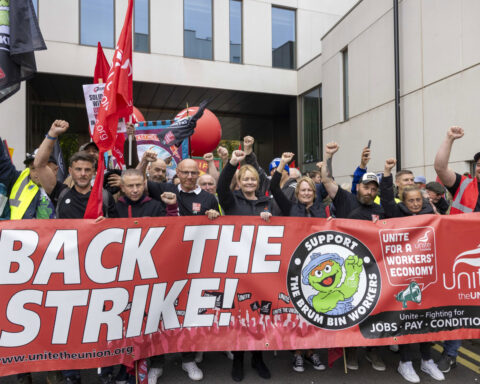
Already in 2022 and 23, we saw a significant wave of strike action in both Britain and the North of Ireland, which won improved pay deals in many individual workplaces. But despite a mood of anger among the workers, the leadership of the trade union movement in the TUC and ICTU did not point a way forward, to escalate towards a general strike and so the full power of the working class to fight back against attacks on its living conditions, or to go even further and vie for political power of its own, was not exercised.
Contrasted with this, the fuel protests by Irish farmers, agri-workers, and hauliers earlier this year used fierce and militant tactics to extract a €500 million support package from the Irish government despite considerable far-right infiltration into the movement attempting to hijack its momentum and misdirect it towards their own disgusting agenda. While not a movement from below, being largely dominated by well-off rural business owners, this example still shows what radical action that effectively utilises its leverage can do.
A background of war and revolution
In 1926, the working class fell afoul of vacillating trade union leadership on an even greater scale.
The First World War was a barbarous, catastrophic collision between the interests of the main capitalist and imperialist powers. The tension and contradictions between the competing interests of different national capitalist classes spilled over into conflict and the slaughter of tens of millions of mainly working-class young people.
By the time the armistice was signed in 1918, the world had fundamentally altered. The traditional powers of Europe had exhausted themselves economically and militarily, while the US, having entered the war late enough to avoid hollowing out the power of its capitalist class, was beginning to gain the upper hand. Most significantly of all, the working class had seized power in Russia in the October Revolution of 1917, with a wave of revolutionary movements spreading across Europe in its wake.
In Britain, there was a colossal class struggle after the war, especially in 1919. A strike in Belfast that year led to 60,000 workers across many industries walking out. Electricity was completely shut down, save for hospitals. The strike was led by a Catholic and crossed the traditional sectarian divide. Another strike in Glasgow led to a major battle between workers and police after the police baton-charged a demonstration in George Square, with troops sent in thereafter. In both cases, a lack of revolutionary leadership prevented the strikes from developing into a fundamental transformation of society.. In the context of the struggle for national liberation in Ireland, there was a major upturn of the class struggle, where workers took over the running of cities, with three general strikes taking place. Clearly, this struggle had an impact on Britain given the size of the Irish working class in Britain, and this was combined with growing opposition to oppression in Ireland meted out by British imperialism.
During the war, the British government had nationalised the coal industry as a temporary measure, but scenes like those in Belfast and Glasgow made them hesitate to put it back into private hands right away. In 1921, they finally made the inevitable move and de-nationalised the mines. The bosses swiftly implemented wage cuts, which the miners rejected.
Before the war, the unions representing miners, railway workers, and dockers had formed the Triple Alliance, pledging solidarity action to defend one another if attacked. The workers of these unions now called a strike in support of the miners. At the last minute, the General Secretary of the miners’ union presented a compromise which the miners again rejected. However, the leaders of the other unions in the alliance used it as an excuse to back out and so never came to the miners’ aid. This betrayal became known as Black Friday.
The miners fought courageously for three months, but without the solidarity of other workforces, they were defeated, and significant wage cuts were pushed through.
Calm before the storm
Black Friday was followed by a period of relative calm. French occupation of the Ruhr prevented German coal from reaching the market, a situation which favoured the British coal industry. Wages increased and mines took on new workers.
At the same time, spurred on by the experience of Black Friday, a shift to the left developed within the trade union movement. The National Minority Movement, under the leadership of the Communist Party, organised the revolutionary elements of the rank and file. A Marxist, A.J. Cook, was elected as the new General Secretary of the Miners’ Federation in 1924.
In 1925, however, the French withdrew from the Ruhr, allowing German coal back on the market. Around the same time, Winston Churchill, as Chancellor, overvalued the pound by 10% by linking it to the so-called Gold Standard, thereby making British goods more expensive to foreign buyers and hurting exports.
Inevitably, the bosses attempted to make up the resulting shortfall through attacks on wages. The Prime Minister, Stanley Baldwin, stated this clearly saying, “All the workers of this country have got to face a reduction of wages to help put industry on its feet.” The mines were first to announce their intention to do so.
The miners turned for help to the leadership of the Trades Union Congress, a federation of British trade unions, which declared its full support for them. It was clear that if the miners were unsuccessful in their struggle, every section of workers would face similar cuts.
The Tory government then introduced a 9-month subsidy to stave off the proposed cuts for the miners. Not an act of support or even charity, but a tactical move to buy time in which the government could prepare for the fight they knew was brewing. Cook said at the time “Next May we shall be faced with the greatest crisis and the greatest struggle we have ever known and we are preparing for it.” But the more conservative elements of the trade union bureaucracy disagreed. One said “I do not fear on this subject to throw such weight as I have on the side of caution. I am not in fear of the capitalist class. The only class I fear is our own.”
The government used the time it had bought wisely. It revitalised its Emergency Supply and Transport Committee and set up the Organisation for the Maintenance of Supplies, an organisation of volunteer thugs which counted fascists in its ranks. The TUC on the other hand, did not prepare and put its hopes in the outcome of an enquiry commissioned by the Tory government. The report criticised the coal bosses but did not call for nationalisation or advise against wage cuts; the best it did was call for a reorganisation of the industry. The TUC only met to consider its position three days before the government subsidy ran out.
The National Minority Movement condemned the report and called a mass meeting, but the Communist Party line was ultimately informed by the Anglo-Russian Committee (a body set up in 1925 nominally to build unity between Soviet and British trade unions but which in reality was used by leading Stalinist officials to bypass the British working class and co-ordinate directly with British trade union bureaucrats) which directed the party to support the left bureaucrats against the right, despite having supporters groups in 300 pits and key positions in the Trades Councils. They would have been perfectly placed to mobilise the mass memberships of the unions against the bureaucrats but instead fell into line behind the less reactionary sections of the bureaucracy.
After the coal bosses announced wage cuts and longer days would be implemented from 30th April, the TUC continued to lobby the government for intervention rather than preparing to strike. They tried desperately to get out of the strike even as the miners rejected the deal. In the end it was the very government they assumed would want to avert the strike that forced them out, using a wildcat walkout of print workers as an excuse to collapse the talks.
Parliament declared a state of emergency; all army and navy leave was cancelled, and troops were dispatched across Britain. The Organisation for Maintenance of Supplies, 100,000 strong, handed itself over to the direction of the government. Churchill said in the Commons “it is a conflict which, if fought to its conclusion, can only end in the overthrow of parliamentary government or in its decisive victory.” Baldwin followed by saying they were being “challenged with an alternative government.”
What alternative government?
It is perhaps worth pausing at this point to consider what Churchill and Baldwin meant with these remarks. In what sense could a strike be considered a form of “alternative government”?
A strike is typically understood as a group of workers collectively agreeing to down tools in pursuit of some goal; better pay, working conditions etc. Broadly speaking this is correct, but it is a limited view of the power of strike action. Workers fundamentally run society. No train, no lorry, no boat moves without workers. Hospitals cannot function without workers. Nor schools, nor public transport, nor anything else. Collectively, the workers of the world control global trade, energy, healthcare, education; in a word, workers control society and society ceases to function without their labour.
Taken to its logical conclusion, this concept means that strike action on a large, generalised scale goes beyond immediate workplace disputes or short-term demands and fundamentally calls into question who runs society. When huge numbers of workers across multiple sectors strike together, they can democratically elect strike committees which, if they have the resolve to do so, can organise workers not just to stop working but to begin to run the services they normally provide on the basis of human need rather than private profit. This is what is meant by workers “seizing the means of production” and within it lies the seed of a truly socialist society.
Ironically, and tragically, Winston Churchill and Stanley Baldwin understood this better than most of the leaders of the TUC in 1926.
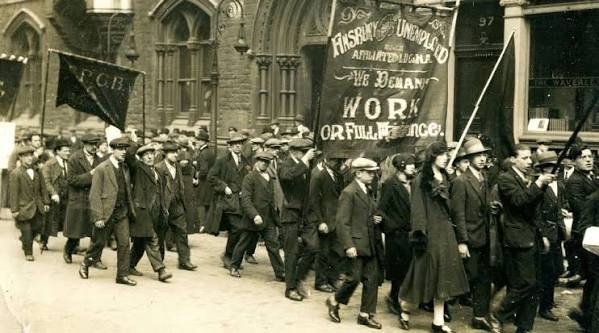
Against the might of the British state, its military, its careful preparation, and its volunteer thugs, 4 million workers came out on strike. On 4th May, transport ground to a halt, by the end of the day builders, printers, iron, and steel workers had joined. The Tories began publishing a newspaper called The British Gazette, printing attacks on the workers and outright lies to disorient the strike, such as the false claim there was a drift back to work. In opposition to this the TUC began to print The British Worker, which focused on debunking the lies in the Gazette but did not outline a strategy or way forward for the movement.
Councils of Action took responsibility for organising pickets, transport, finance etc. Some local strike bulletins were produced but these were discouraged by TUC headquarters. In large areas the CoAs controlled distribution and transport rather than the state, but they were never linked up. Had a link been formed it could have served as the basis of the alternative government Baldwin had feared, a fledgling workers’ state in Britain less than a decade after the Russian Revolution. But the TUC leaders were not prepared to do this.
Even the best union leaders like Cook had no perspective to take the strike beyond a straightforward industrial dispute. The Communist Party supported the better layers of bureaucrats but did not push things further. Moscow, by now in the firm grip of Stalin and his bureaucracy, actively discouraged revolution. Karl Radek, a leader in the Soviet Comintern, said “This is not a revolutionary movement. It is simply a wage dispute.”
Betrayal
On 10th May the British Worker declared, “Stand firm. Be loyal to instructions and trust your leaders.” The TUC were looking for an off-ramp. It came in the form of a new proposal from the author of the government report. This included reorganisation of the mines but did not get rid of the wage cut nor even include protections against victimisation for strikers. The General Council of the TUC cravenly endorsed the proposal. The miners themselves rejected it but the TUC called off the strike regardless. There were sackings and wage cuts across the country.
Workers fumed at the betrayal, fueled by the gloating of the Gazette and other capitalist papers. Many tried to stay out; the day after the strike was called off there were 100,000 more workers out than on the first day. The miners stayed out for seven months but without the support of the National Union of Railways embargoing coal their leverage was irretrievably compromised. They went back in on longer hours for less pay and without a national agreement.
The Communist Party went from 6,000 members to 10,000, but this increase was paltry compared with the numbers of workers they had influence over at the height of the strike. With a genuinely revolutionary programme they could have mobilised those workers against the treachery of the TUC leadership and at a minimum scored a victory for the miners, if not positioning the entire working class to grab power. They were influenced against this approach by the Stalinist bureaucracy in Moscow, now dedicated to the approach of “Socialism in One Country” and fearful of jeopardising its trade agreements with the British government. Through its international instrument, the Comintern, the Stalinist Bureaucracy used the Communist Parties of the world to support the immediate foreign policy aims of the USSR, not to foment world revolution.
The government introduced and passed the Trade Union Bill 1927, a vicious piece of anti-union legislation which, among other changes, outlawed the sympathy strike to prevent groups of workers from going on strike in solidarity with other groups of workers. This ban was eventually overturned before being reintroduced by Thatcher in 1980 and remains to this day despite three so-called Labour Prime Ministers darkening the doorway of 10 Downing Street in the intervening decades.
subhead
In the context of rising prices in 2026, the lessons of 1926 could not be more relevant. In 2022 there was a wave of industrial action in response to the cost-of-living crisis. At that time workers had already experienced years of real-terms pay cuts and borne the impact of the COVID-19 pandemic and related economic fallout. In 2022 it would likely have been possible to harness this energy and coalesce the many disparate disputes into at least a 24 hour national stoppage. Anti trade-union legislation such as that introduced by Thatcher may have posed a certain difficulty, unions could not have called on members to down tools in support of a single, key strike as they did in 1926, but where there’s a will there’s a way and in 2022-23 there was a growing mood for generalised action. Such action could have not just brought pay rises that restored workers to pre-Ukraine levels but potentially could have restored them back to the pre-Tory levels of the 2000s and righted many other wrongs. Potentially it could have been taken even further for a fundamental and radical altering of society.
Alas, the TUC of the 2020s is little different from that of the 1920s and the mood for radical action was not capitalised on. In fact, the trade union bureaucracy has largely acquiesced to the consensus that there is no alternative to the capitalist status quo and has no sense that a struggle is possible to beat the bosses. The historic betrayals of the union leaders in the 1980s in Britain, notably the failure of the TUC to call a 24-hour general strike and widespread strike action resulting in the defeat of the miners in 1985, have left their mark to this day. This has meant that there isn’t the same level of rank and file organisation and movement of workers from below, which could impact the situation. In this sense we have a very different workers movement compared to 100 years ago.
However, the conditions that capitalism is creating in Britain, Ireland and internationally are urgently and objectively posing the need for a militant working class movement and organisation, linked with a socialist programme. Four years on from 2022 the working class finds itself in the same situation once again, only now with greater precarity, a worse housing crisis, and with the possibility of AI eliminating jobs being dangled over us by the bosses. If strike action begins to increase once again over the coming period, and a concerted mood for radical action grows, the need will be greater than ever to learn the lessons of 1926, that the righteous anger and enthusiasm of workers in periods of struggle must be harnessed and unleashed in opposition to the machinations of those who would hold us back from our full potential.