Reviewed by Jonathan Diebold
What if wishes really could come true? And what if the power to make such a wish was granted to a man who, behind his “nice guy” facade, feels a deep sense of entitlement and resentment towards the women in his life?
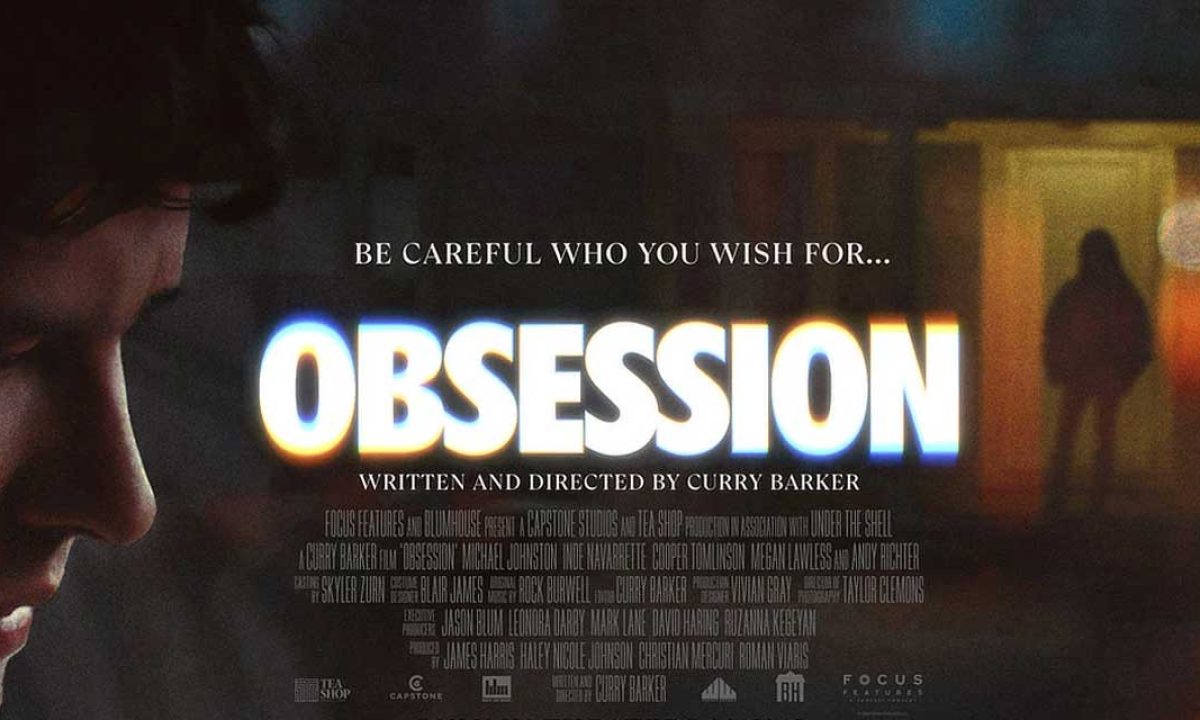
Obsession, directed by 26 year-old Curry Barker and starring a cast of virtually unknown actors, is by some metrics one of the most successful horror movies of all time. On a budget of $750,000, it’s earned well over $200 million, projected to rise to $300 million. It’s the first movie since Stephen Spielberg’s E.T. (1982) to increase its earning three weekends in a row.
The film follows Baron “Bear” Bailey (Michael Johnston), an awkward and insecure young man with romantic feelings for his friend and co-worker Nikki (Inde Navarrette, in an incredible break-out performance). On a whim, Bear breaks a “One Wish Willow”, a toy said to be able to grant wishes, and wishes for Nikki to love him “more than anyone in the world”. Terror ensues as Nikki becomes obsessed with him to an extreme degree. The film is bleak, violent, and terrifying.
If that was all there was to this move, it could still be a good movie. But what makes this a great movie, perhaps what has made it resonate with so many young people (as much as 75% of Obsession’s audience are reportedly from the 18-34 demographic) is the psychology and motivations of Bear. It’s made clear in the film that while he regrets the way the wish is manifesting itself (and how it’s impacting him), he does not regret the profound violation of bodily and mental autonomy which he has inflicted on Nikki. He just wants her to tone it down. On the surface, Obsession might sound like a mere repetition of the “crazy girlfriend” trope, but beneath that, it’s more of a 21st century Stepford Wives, dialed to eleven.
In Ireland, the overwhelming majority of sexual offences are carried out by someone known to the victim (overwhelmingly by men). This pattern is mirrored in every single country where these figures are accurately measured. What Obsession is tapping into is the anxiety that any man might, under the surface, hide coercive, controlling, or predatory behaviours which, given an opportunity, might spring to the surface. A recent hypothetical which was circulating the internet found women overwhelmingly saying that, if asked to choose between being stuck in the woods with a man or a bear, they would choose the bear. In Curry Barker’s Obsession, Nikki might well have chosen the bear, but she was stuck with Baron “Bear” Bailey.
Add in as well perhaps a dash of the anxiety around the advent of “AI girlfriends”: Bear seems fully aware that what he has turned Nikki into an empty vessel, devoid of any real thoughts or feelings, but programmed to “love” him. And he seems more or less okay to go along with that. If it were only fiction, it might be hard to understand. But with the advent of generative so-called “AI”, this has become a chilling reality under late-stage capitalism – the AI “companion” industry is now being funded to the tune of hundreds of millions of dollars annually.
Curry Barker joins several other directors in recent times who have made the leap from YouTube to Hollywood. This includes the Philippou brothers (Talk to Me, 2022, and Bring Her Back, 2025), Chris Struckman (Shelby Oaks, 2024), Mark “Markiplier” Fischbach (Iron Lung, 2026), and May’s other breakout success story, 20-year-old Kane Parsons (Backrooms, 2026). Perhaps it’s no surprise that for all these YouTubers-turned-directors, the horror genre has been the springboard.
In an era of increasingly creatively bankrupt studio executives churning out cash-grabs and nostalgia-slop, horror has always been a genre of vibrant creative exploration and biting social criticism, and a place where industry outsiders can make their mark. This is more true than ever: in the last ten years horror has received a real revival, with a vibrancy not seen in the genre since the 1980s (it’s no coincidence that the genre is at its best at periods where people feel at their most precarious).
All that said, as a final point, it is worth asking, when a movie resonates with its audience like this, when a movie is hugely, unexpectedly, financially successful, who profits? In a viral Instagram post, art director (as well as PA, set dresser, graphic designer, background actor, driver, swing, and buyer) Sally Choi made public that she received $7,000 for her work – 0.0028% of the movie’s earnings (at time of writing). Other crew members were volunteers, paying out of their own pockets to be able to work on set. “It took such a physical toll on my body that I kept losing weight, weighing 90lbs during this production” she wrote.
No doubt a portion of the movie’s revenue is going to movie theatres, whose staff, by showing this movie, allowed it to become a huge success. But the lion’s share is not going to the cast and crew who were paid indie movie rates, nor to theatre staff, but to execs in Blumhouse and Focus Features, and Universal Pictures.