Fight for permanent public housing for all
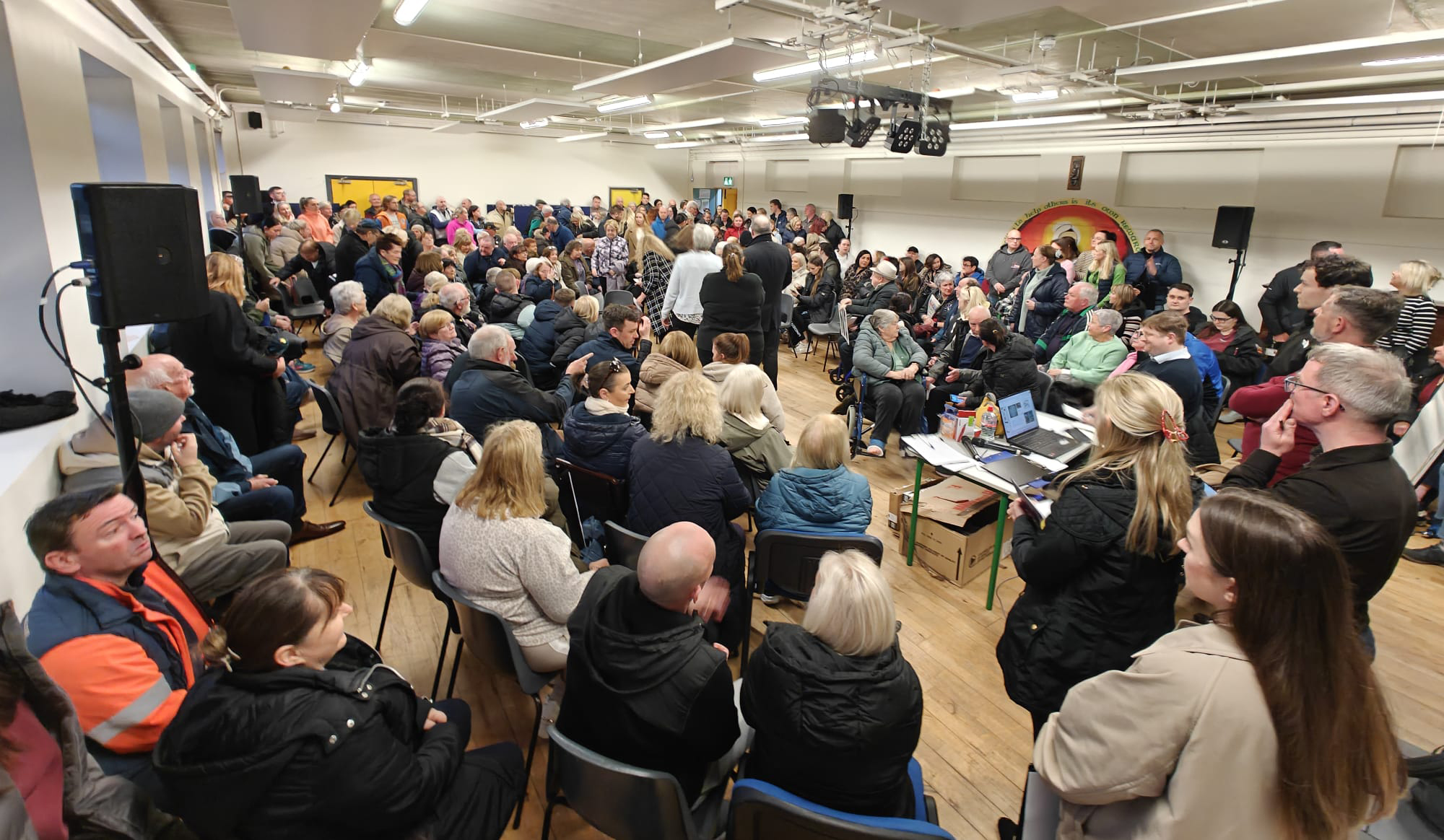
Well over 150 people showed up to Our Lady Queen of Peace School in Janesboro last Wednesday evening for a meeting with the Mayor of Limerick, John Moran, who has proposed a plan to install so-called “SMART” modular housing in Janesboro Park (known locally as Boro Park).
This proposal has provoked deep opposition in the local community and the school hall was quickly filled to capacity, so much so that the security guards brought by the Mayor requested that people who arrived as the room overflowed stay outside in the school’s yard.
Unfit modular units
Mayor Moran’s plan involves replacing the only community park within a 20-minute walk with as many as 500 modular units, of a similar type to those that were on display in Arthur’s Quay Park last winter. Concerns were raised then over the quality of these modular units, with one building contractor saying that the units “appeared to be a repurposed shipping container with rainscreen cladding that was poorly installed.”
Following a wave of criticism after the units deteriorated rapidly when exposed to the elements, Limerick City and County Council appeared to downplay them by claiming they were instead “demonstrator units” for the purpose of displaying floor size. However, this contradicts the statement still available on their own website which refers to them as “cutting edge” and “fully compliant”.
These modular homes are intended as transitional housing for “key workers” and unlikely to have any impact on the social housing waiting list.
Arrogant Mayor
The school hall heaved as dozens of Janesboro and Rathbane residents spoke passionately one after another in defence of the only secure green space in these communities. A place where children can play safely, dogs can be walked, and the elderly can get out and socialise. At times it felt like the atmosphere at nearby Pearse Stadium, with cheers and shouts from the crowd of “Up the ‘Boro!” peppered throughout as people spoke.
Unfortunately, many residents feel that the mayor has already “made his mind up” and this sentiment was compounded in the aftermath of the meeting by his reaction in the local press where he dismissively said that residents “haven’t got a good understanding of the bigger picture, what is planned for the area.” The opposite is the case with residents bringing evidence of soil types, biodiversity research, and knowledge of engineers’ reports of the area.
There was a pattern at the meeting too where Moran attempted to deflect responsibility for this proposal by saying that “the previous Council” had zoned the land, implying that he was only carrying out what was already agreed. This is disingenuous for two reasons. First, as chair of the Land Development Agency (LDA), Moran was integral in identifying the ‘Colbert Quarter’ – which includes Janesboro – for large-scale development, which directly led to its rezoning as mixed-use ‘City Centre’ classification as part of the Limerick Development Plan 2022-2028.
Second, as Mayor, he has intervened to turn a Parnell Street site into a “pocket park” and overruled councillors who sought to develop a green space on the island.
Housing and environment
There is a catastrophic housing crisis and the fact that we need urgent action on housing is well understood. But riding roughshod over working-class communities to pursue distractions like temporary modular homes, which won’t even be available as social housing, is not the way out of this.
John Moran was previously an advocate for a “Liveable Limerick” but increasingly it looks like this was just a slogan for the immediate city centre and not a principle to be applied to the city’s working-class areas. Even then, that slogan looks to have focused on pedestrianisation and cycle lanes rather than the utilisation of the means available, such as Limerick Twenty Thirty, to create more accommodation in the city centre.
Removing Janesboro’s park would be an act of willful public vandalism in a city with already too few public green spaces. The closure and privatisation of public realms and services actively undermines community cohesion and integration. These are political choices that make ordinary people’s lives increasingly unliveable.
Residents at the meeting were adamant that they are not opposed to building houses. They were in favour of previous developments in the area and support the development of brownfield sites nearby. The argument is that this green space is wholly inappropriate not just over what would be lost but also due to inadequate infrastructure. Janesboro is one of the most built-up and compact housing estates in the city. With nowhere to soak rainfall, every rain shower runs down the slope it is built on and regularly overwhelms drains causing spot flooding. One resident said that they witnessed sewage overflow as part of those deluges.
Boro Park is bog land, not only would building 500 units put further pressure on the already overloaded infrastructure it would remove one of the only sources of natural drainage for the area.
Community needs over private profit
Moran has floated the idea of using joint ventures with the private sector for the delivery of these units, but he has not outlined how these private interests would profit. This is no idle concern for residents, as John Moran in his role as secretary general of the Department of Finance was a key architect in opening the Irish property market to international vulture funds. This has contributed in large part to the housing crisis we are living through today. Moran has defended these measures as necessary for a housing system “that encourages private investment.”
However, this reflects the same tired and uninspired thinking that has now dominated the state’s housing policy for decades. Rather than making public land available to private developers for for-profit housing, the alternative is to utilise public land solely for public and affordable housing to alleviate the housing catastrophe. Janesboro itself was built by Limerick Corporation in the 1930s when the state was much poorer. The resistance to this approach by the Irish political establishment, with which Moran is absolutely in lockstep, is a question of ideology rather than one of means.
Save Our Park campaign established
From his comments afterward, it appears that the Mayor is determined to confront the community over this. But what was equally evident as people dispersed into the night is that the Janesboro community is steadfast and will not be budging. A “Save Our Park” campaign is being set up. This is an excellent start. A victory for the community would not only defend the over €170,000 already invested into this park but could also be the spur for further community infrastructure such as a children’s play area.
And a victory is achievable as any decision will have to be voted on by the whole Council as part of a Part 8 Process. Maximum pressure must be built in the coming weeks and months to force the Mayor back.
Other communities can take note too. There is a dearth of green spaces and community centres in working-class communities across Limerick and other urban areas. We should be demanding investment in our communities, as well as decent and permanent public housing. The Mayor should be reflecting the will of people on this rather than imposing his own ideology, but this will only happen if we get organised.
Fortunately, we have a precedent to work from. As one resident cried out at the meeting on Wednesday to a thunderous ovation: “We ran Irish Water out of Janesboro, and we can run the Mayor out as well!”